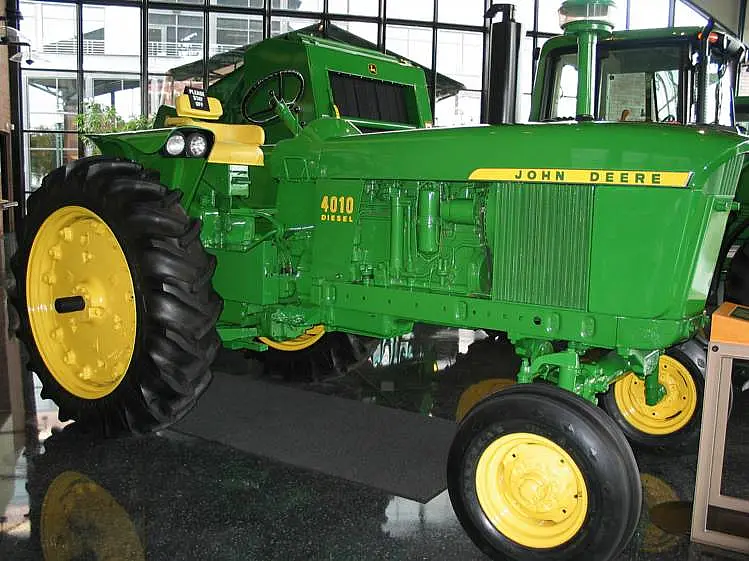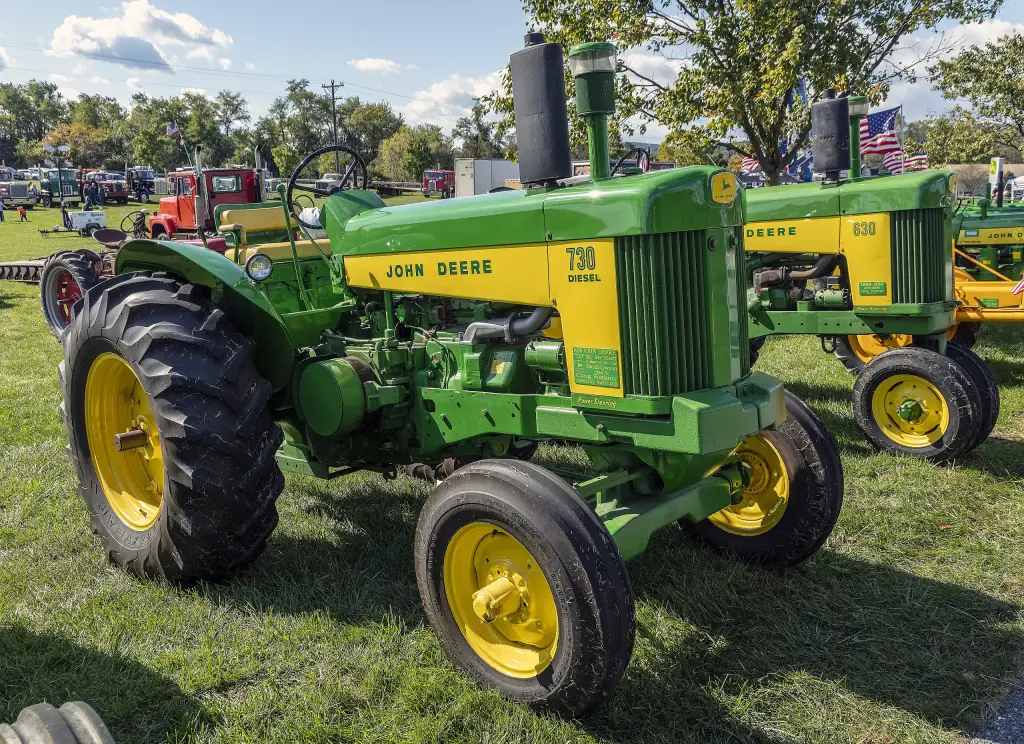
The John Deere 730 was the final development of the firm’s two-cylinder tractors. Introduced in 1958 with the same powertrain as the 720, it was built at Waterloo and, unusually, in Argentina, where the last of the line left the factory in 1971.
John Deere 730 at a glance
| Maker | John Deere, Waterloo, Iowa, and Rosario, Argentina |
|---|---|
| Production | 1958–1960 at Waterloo; 1958–1971 at Rosario |
| Replaced | John Deere 720 |
| Engine | 6,170 cc two-cylinder, horizontal, four-stroke |
| Power | 59.8 hp at 1,125 rpm |
| Fuels | petrol, diesel, kerosene and LP gas |
| Starting | electric starter or an auxiliary petrol engine |
| Gearbox | 6 forward and 1 reverse, not synchronised |
| Power take-off | independent, 547 rpm; belt pulley at 1,125 rpm |
| Lift | hydraulic |
| Weight | 3.350 tonnes |
| Built | 24,495 at Waterloo and 5,095 at Rosario |
History of the John Deere 730
The 730 belongs to the long line of John Deere tractors with two-cylinder engines, a layout begun in 1923 with the Model D and kept until 1960 although it had been outdated since the 1940s. The 730 was part of the “30” range launched in June 1958, which was at first to have been called the “50” range, and its lines were drawn by the stylist Henry Dreyfuss. It replaced the 720 and retained the same powertrain; for diesel models an electric starter could replace the petrol starting engine.
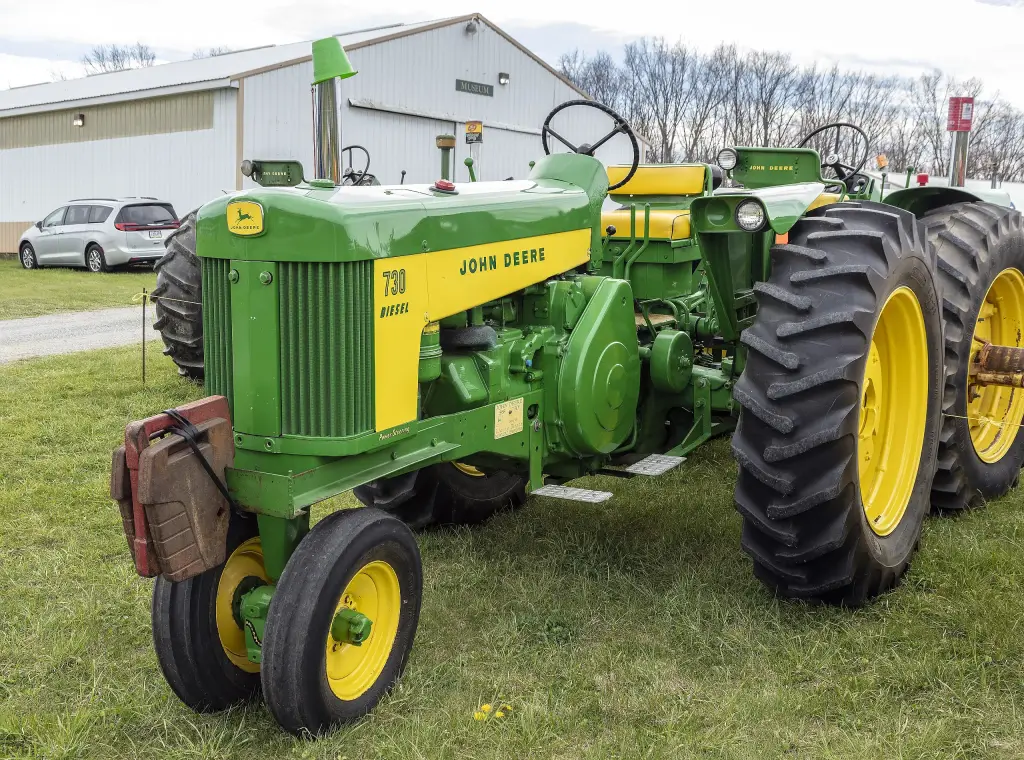
The tractor was built at the American factory in Waterloo, Iowa, from 1958 to 1960, where 24,495 were made, and at the Argentine factory in Rosario from 1958 to 1971, where 5,095 were made. It seems that only a small number of 730s were exported to Europe. Argentine tractors carried a badge with the letters “JD” on the grille instead of the leaping deer, and from 1962 they were painted entirely green. The 730s built in Argentina were the last agricultural two-cylinder tractors made by John Deere.
Engine and transmission
The engine was a water-cooled horizontal two-cylinder four-stroke with a bore of 155.57 mm and a stroke of 161.9 mm, giving 6,170 cc and a maximum of 59.8 hp at 1,125 rpm. The gearbox had six unsynchronised forward speeds and one reverse. The tractor weighed 3.350 tonnes unladen. Four fuels were offered — petrol, diesel, kerosene and LP gas — but the diesel dominated production. The main engine was started either by an electric starter or by an auxiliary petrol engine, the latter preferred where cold starts were frequent.
Versions and equipment
The 730 had an independent rear power take-off running at 547 rpm, a belt pulley turning at 1,125 rpm and a hydraulic lift. It came in a standard-track version, a Row-Crop version with close-set front wheels for row crops and a Hi-Crop version with high ground clearance for tall crops such as sugar cane, cotton and maize. An Industrial version painted orange-yellow was also offered, and a buyer could pay extra for paint in a colour of his choice, though the option was never taken up. Driving demanded practice, because the clutch was worked by a hand lever to the right of the wheel and two brake pedals on either side of the axle acted on one driving wheel each without being coupleable; gears had to be changed with the tractor standing still. Power steering was optional.
Design and features
- End of the line: the last two-cylinder agricultural John Deere.
- Electric starting: an alternative to the auxiliary petrol engine on diesels.
- Four fuels: petrol, diesel, kerosene and LP gas.
- Three body styles: standard, Row-Crop and Hi-Crop, plus an Industrial version.
- Argentine production: built at Rosario until 1971 with a “JD” grille badge.
John Deere 730 versions
- Standard: fixed track width.
- Row-Crop: close-set front wheels for work in rows.
- Hi-Crop: high clearance for sugar cane, cotton and maize.
- Industrial: orange-yellow paint for non-farming work.
- Rosario tractors: “JD” badge and, from 1962, all-green paint.
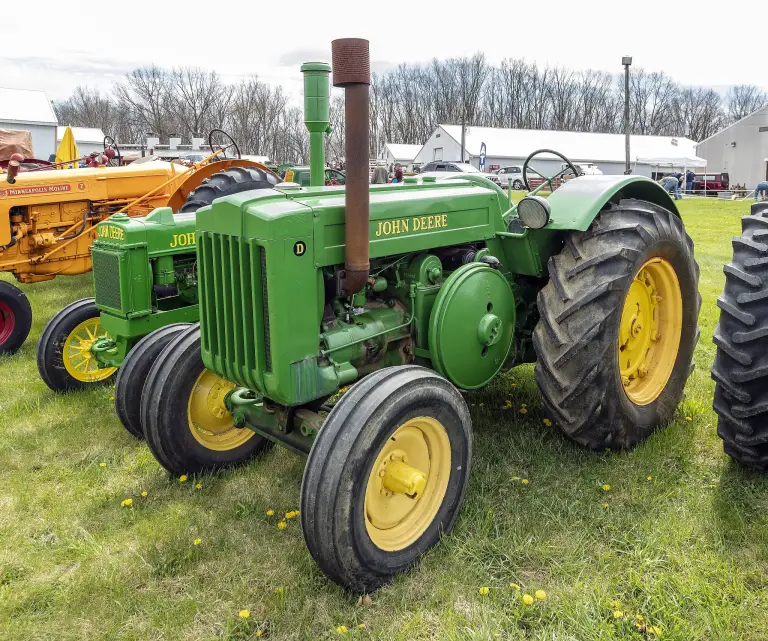
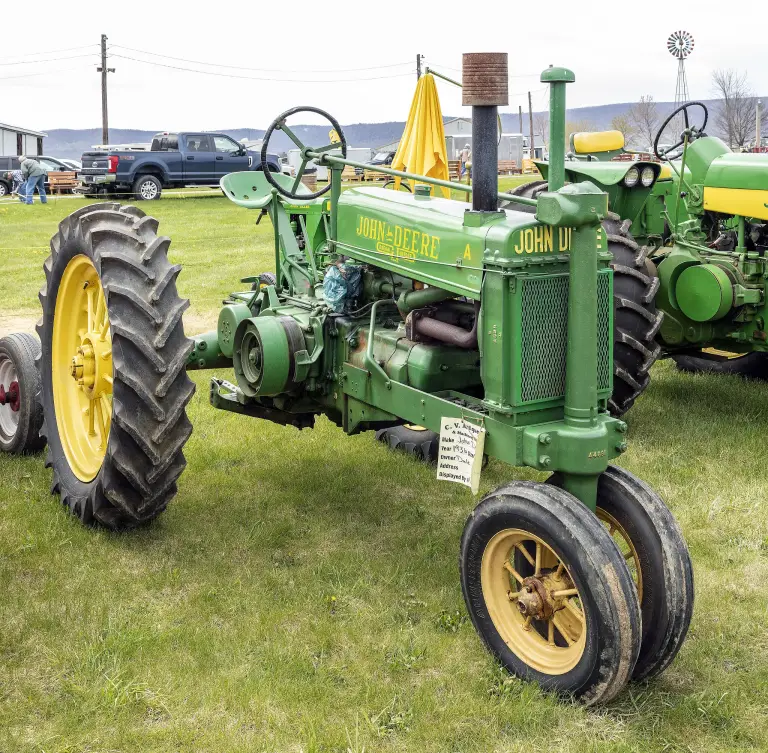
The 730 replaced the John Deere 720 and closed the line that began with the John Deere Model D. Its three-plough ancestor was the Model G. More tractors are in the John Deere collection.
Sources
- John Deere 730, French Wikipedia: production in Iowa and Argentina, engine, equipment, versions
- John Deere Model G, English Wikipedia: introduction of the 730, electric starting, end of American production