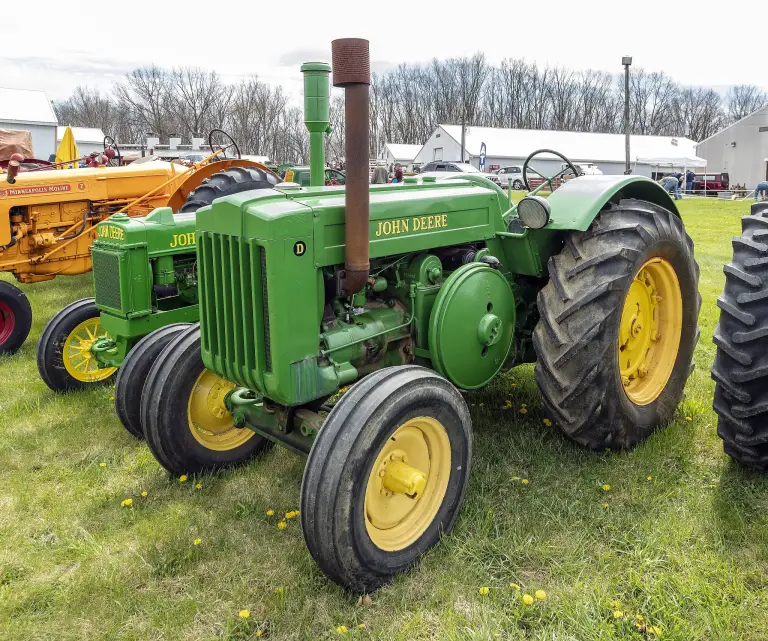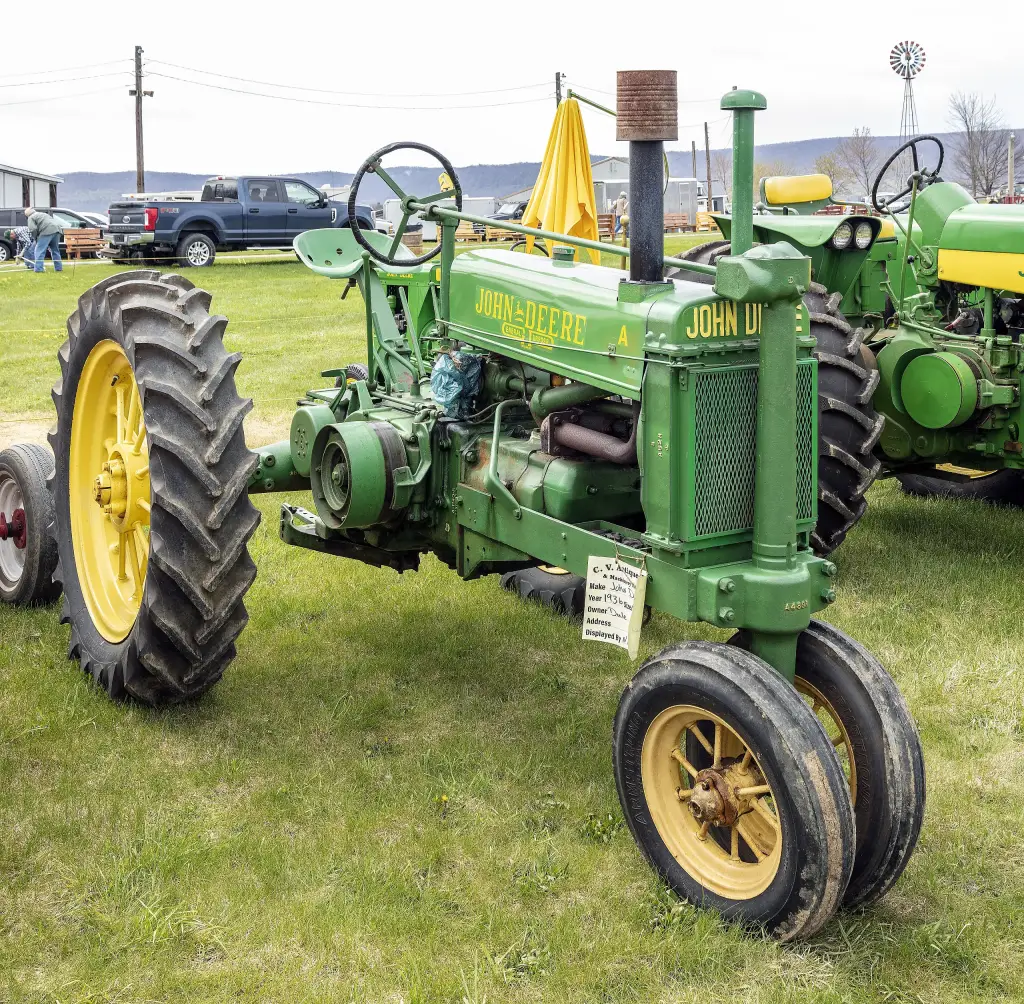
The John Deere Model A was a row-crop tractor made by Deere & Company and intended to compete directly with the McCormick Farmall. Built from 1934 to 1952, it became one of the firm’s most popular machines.
John Deere Model A at a glance
| Maker | Deere & Company, Waterloo, Iowa |
|---|---|
| Production | 1934–1952 |
| Type | row-crop tractor |
| Engine | two-cylinder, the “Johnny Popper” |
| Fuel | distillate on early tractors, later petrol |
| Styling | unstyled before 1939, early styled 1939–1946, late styled 1947–1952 |
| Electric starting | from 1947 |
| Versions | AO orchard, AI industrial, AN single front wheel, AW wide front, ANH and AWH high-crop, AR non-row-crop |
| Built | over 290,000 by 1952 |
| Rivals | Farmall row-crop tractors |
| Designer of the styling | Henry Dreyfuss, 1938 |
| Successor | John Deere 60 of 1952 |
History of the John Deere Model A
The Model A was intended to compete directly with McCormick’s Farmall tractors. Over 290,000 had been sold by the end of its original production in 1952, and a meeting of John Deere enthusiasts at Lincoln, Nebraska, in 1991 recorded a production figure of 327,460. The tractor used Deere & Company’s two-cylinder engine. Early tractors burnt distillate, a petroleum byproduct similar to kerosene, which became a selling point because the fuel was cheap. The two-cylinder design came from a wish to keep costs low by improving the existing engine rather than developing a new one, and these engines made a very distinctive sound that earned them the nickname “Johnny Poppers”.
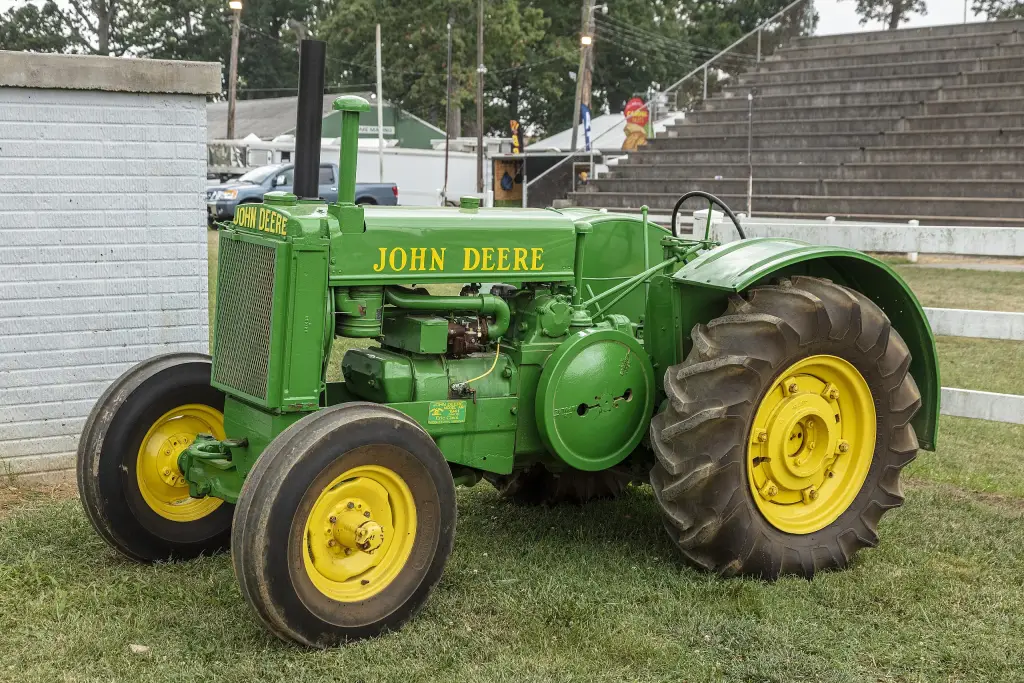
Styling and the three eras
In 1938 the tractors received a styled bonnet and grille designed by Henry Dreyfuss. Tractors from 1939 to 1946 are known as “early styled” and those from 1947 to 1952 as “late styled”, while pre-1939 tractors are called “unstyled”. Electric starting arrived in 1947. All Model As were made at the John Deere factory in Waterloo, Iowa.
Versions
Variants of the A included the AO for use in orchards, the AI for industrial work, the AN with a single front wheel and the AW with a wide front. The AN and AW further varied into machines for high-crop work, the ANH and AWH respectively. The AR was the non-row-crop version. This range of special-purpose versions is why the A was produced in so many forms for cultivation.
From A to 60 and beyond
In 1952 the A was succeeded, with minimal changes, by the John Deere 60, when Deere changed from letters to numbers. The engine was upgraded for more power, LP gas became a fuel option, and a three-point hitch and live power take-off were offered; the 60 also had an upgraded driving position and hydraulic system and became the most popular tractor of its series. Power steering and updated rims came in 1954, and the 60 was replaced by the 620 in late 1956. “Low-seat” 60s were equivalent to the AR and “high-seat” 60s to the row-crop version. An Orchard 60, the O-60, used the A powertrain, and the 620 in turn gave way to the 630 in 1958, which had no mechanical changes and was replaced by the four-cylinder 3010. With the numerical system the A’s line ran on through the 620, 630, 3010, 3020, 4030, 4040, 4050, 4055 and ended with the 7610.
Design and features
- Farmall rival: designed directly against McCormick’s row-crop tractors.
- Johnny Popper engine: the two-cylinder unit with its unmistakable sound.
- Dreyfuss styling: the 1938 bonnet and grille that separate styled from unstyled tractors.
- Many special versions: orchard, industrial, single-wheel, wide-front and high-crop.
- Long numerical line: the A’s descendants ran from the 60 to the 7610.
John Deere Model A versions
- AO: orchard version.
- AI: industrial version.
- AN: single front wheel.
- AW: wide front axle.
- ANH and AWH: high-crop versions of the AN and AW.
- AR: the non-row-crop version.
The A was the larger brother of the John Deere Model B and shared the row-crop idea with the Model G. Its three-plough ancestor was the Model GP. More tractors are in the John Deere collection.
Video: 1948 John Deere A Cold Start
Video by reeseholler92 on YouTube.
Sources
- John Deere Model A, English Wikipedia: production figures, fuels, styling eras, versions, successors