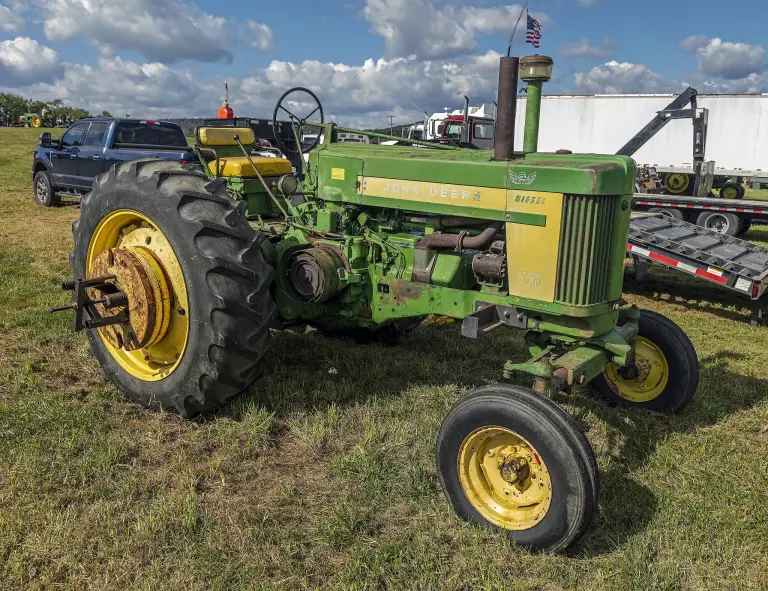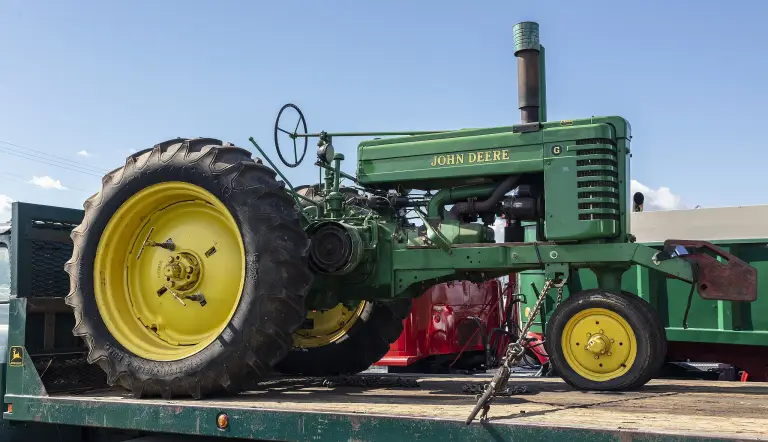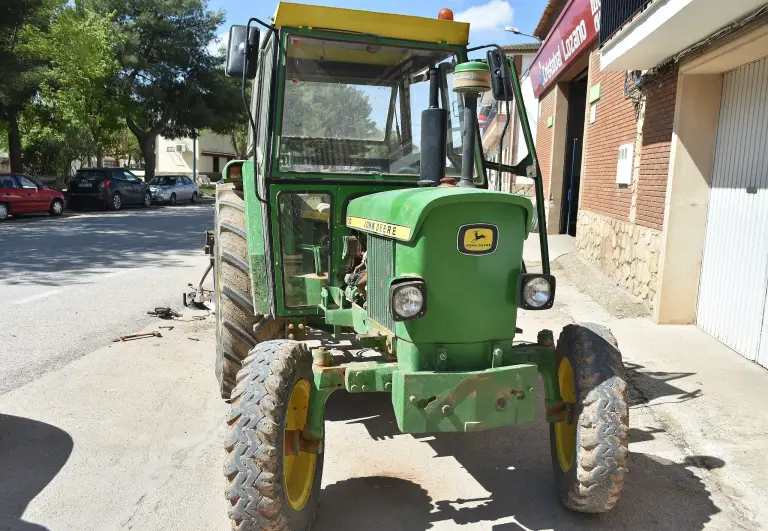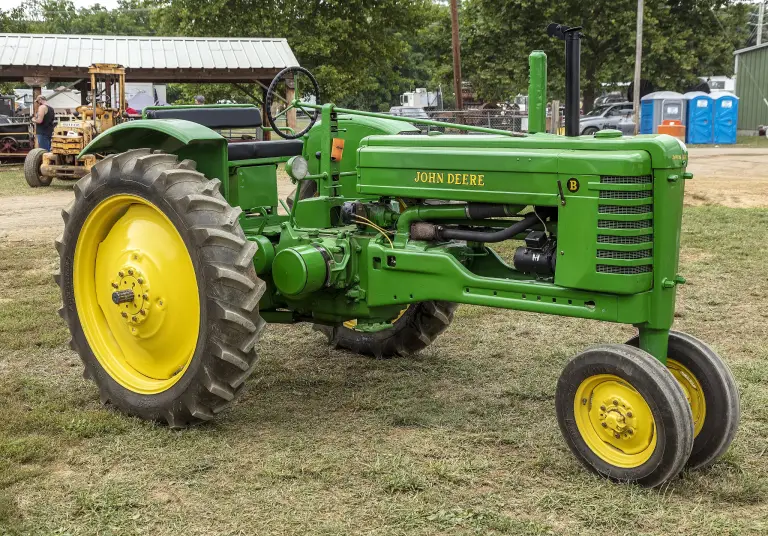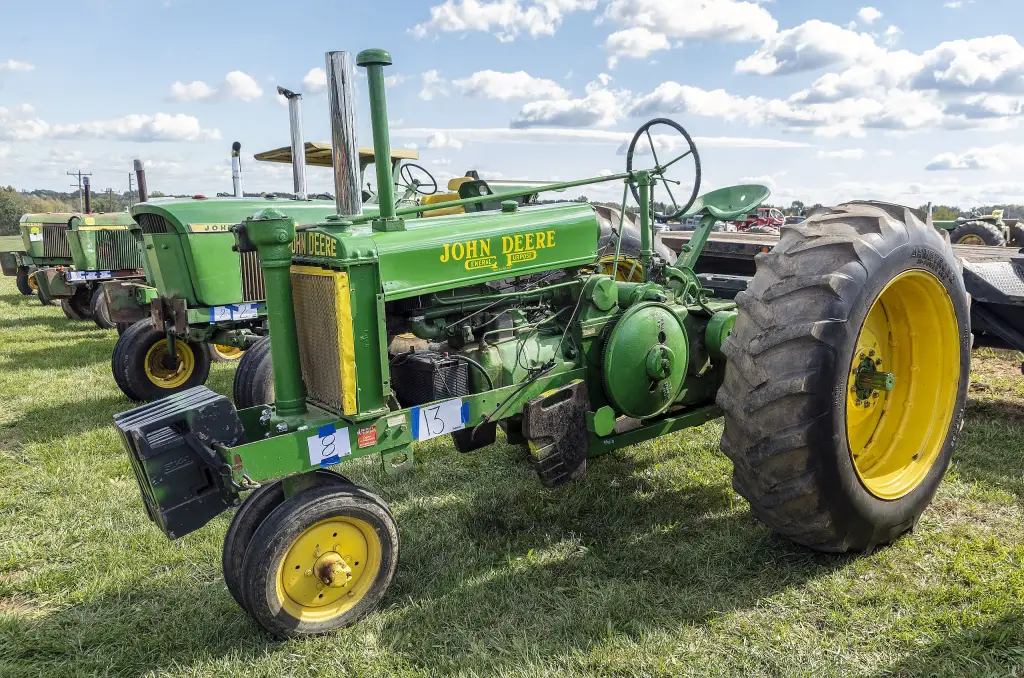
The John Deere Model GP was a two-plough, and later three-plough, row-crop tractor built from 1928 to 1935. It began life as the Model C and was renamed because “C” and “D” were hard to tell apart over the telephone.
John Deere Model GP at a glance
| Maker | John Deere, Waterloo, Iowa |
|---|---|
| Production | 1928–1935 |
| Type | general purpose row-crop tractor |
| Original name | Model C, produced from 1927 |
| Engine | two-cylinder side-by-side, 312 cu in (5,110 cc) |
| Power | 17 drawbar hp, 25 hp on the belt |
| Plough rating | two ploughs, three from 1931 |
| Gearbox | three speeds |
| Fuels | petrol and kerosene |
| Front axle | wide arched axle straddling three rows |
| Built | 30,535 |
| Rival | Farmall Regular of International Harvester |
History of the John Deere Model GP
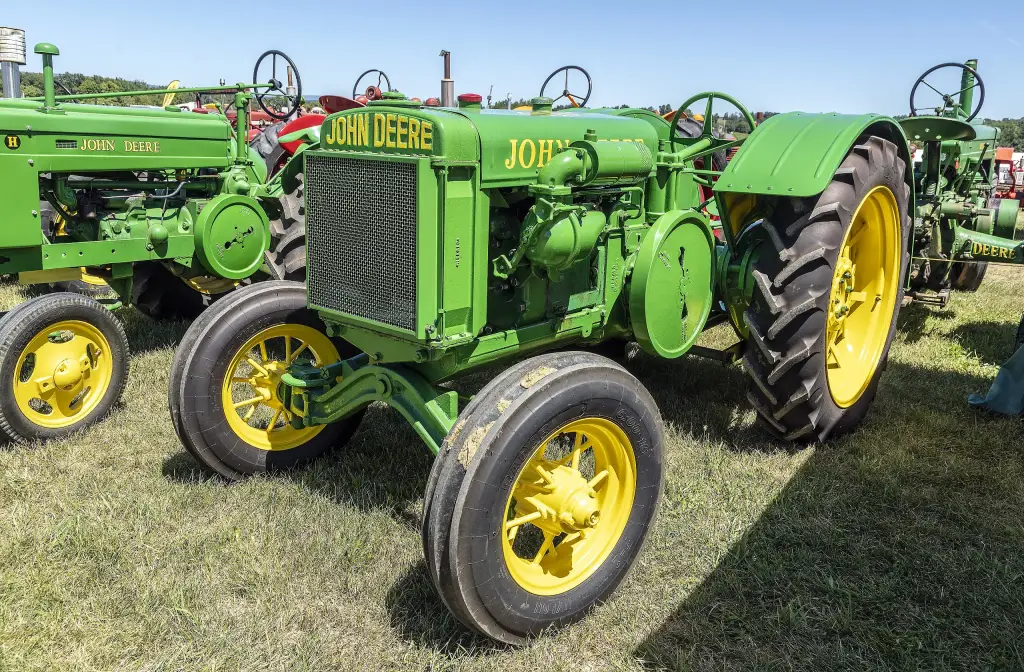
The original C was first produced in 1927 as a general-purpose row-crop tractor intended to compete with the Farmall line of International Harvester. It had a wide arched front axle that straddled three rows of crops. In 1928 the tractor was renamed the GP, for general purpose, after confusion in telling “C” from “D” over the telephone. The C’s innovations included a mechanical implement lift and front and rear power take-offs.
Engine and versions
The GP used a horizontal side-by-side 312 cubic inch (5,110 cc) two-cylinder engine giving 17 drawbar horsepower and 25 horsepower on the belt, which allowed a two-plough rating. It had a three-speed transmission and was available in petrol and kerosene versions. A two-row version, the GPWT or GP wide-tread, was introduced in 1930 with a tricycle configuration and close-set front wheels. By 1931 the engine had grown to 339 cubic inches (5,560 cc) for 18.86 drawbar horsepower and 25.36 horsepower on the belt, which allowed a three-plough rating and also made it possible to drop the water injection used in the smaller engines to prevent pre-ignition. The GPWT was introduced again in 1932, six inches (15 cm) longer, with a simplified steering system arranged over the engine.
Model P, GPO and the end
The Model P was produced specifically for potato cultivation from 1930 to 1931 with a 68-inch (170 cm) rear wheel tread; later GPs could be fitted with adapters to achieve the same result. The GPO was adapted for orchard work with lower axles, and the GPO-L was a tracked version. All GPs were manufactured at the John Deere factory in Waterloo, Iowa, where 30,535 were built. Production ended in 1935, after which the letter series continued with the Model A and Model B of 1934 and the Model G of 1937.
Design and features
- Wide arched axle: designed to straddle three rows of crops.
- Farmall rival: John Deere’s answer to the Farmall Regular.
- Mechanical lift and two PTOs: innovations carried over from the Model C.
- Growing engine: 312 cu in at first, 339 cu in from 1931 for three ploughs.
- GPWT: a two-row tricycle version with close-set front wheels.
John Deere Model GP versions
- GP: the standard general purpose tractor.
- GPWT: the wide-tread two-row version of 1930.
- Model P: built for potato rows in 1930–1931.
- GPO: orchard version with lower axles.
- GPO-L: tracked orchard version.
The GP was the ancestor of the row-crop letter series, above all the John Deere Model A and Model B. The first John Deere mass-produced tractor before it was the Model D. More tractors are in the John Deere collection.
Sources
- John Deere Model GP, English Wikipedia: names, production, engine, versions