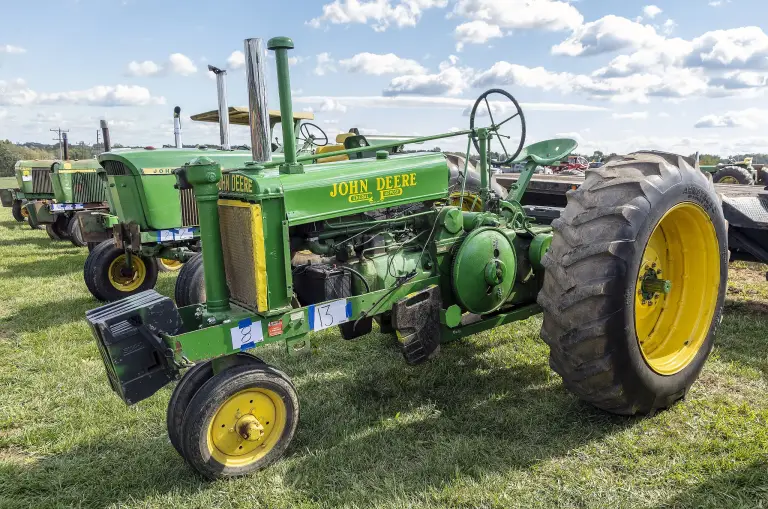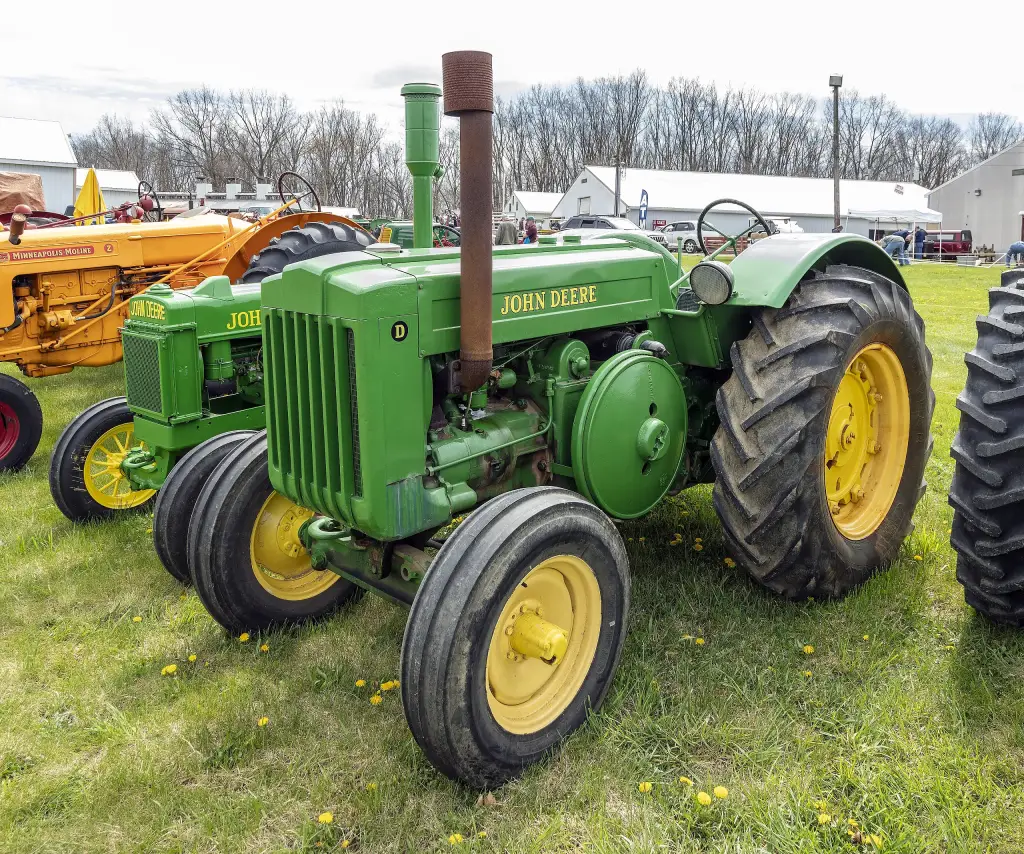
The John Deere Model D was the company’s first mass-produced tractor. Released in 1923, it stayed in production until 1953, the longest run of any John Deere model, and unlike the other letter-series tractors it never changed to a number.
John Deere Model D at a glance
| Maker | John Deere, Waterloo, Iowa |
|---|---|
| Production | 1923–1953 |
| Type | standard tread tractor with fixed wheel widths |
| Engine | two-cylinder side-by-side, 30 hp |
| Capacity | 465 cu in (7,620 cc), raised to 501 cu in in 1927 |
| Transmission | two speeds at first, three from 1934 |
| Fuel | all-fuel: petrol, kerosene or distillate |
| Flywheel eras | “Spoker” 1923–1926, then the “nickel” type |
| Versions | DO orchard, DI industrial, half-track and crawler models |
| Styling | Dreyfuss bonnet and grille from 1939 |
| Built | 55,929 |
| Successor | John Deere Model R |
History of the John Deere Model D
The Model D was John Deere’s first mass-produced tractor and was released in 1923. It was a standard tread tractor with fixed wheel widths, as opposed to the adjustable wheels of a row-crop tractor. It began with a two-cylinder side-by-side 30 hp engine of 465 cubic inches (7,620 cc), which was updated in 1927 to 501 cubic inches (8,210 cc). Early models had a two-speed transmission, and a three-speed unit arrived in 1934.
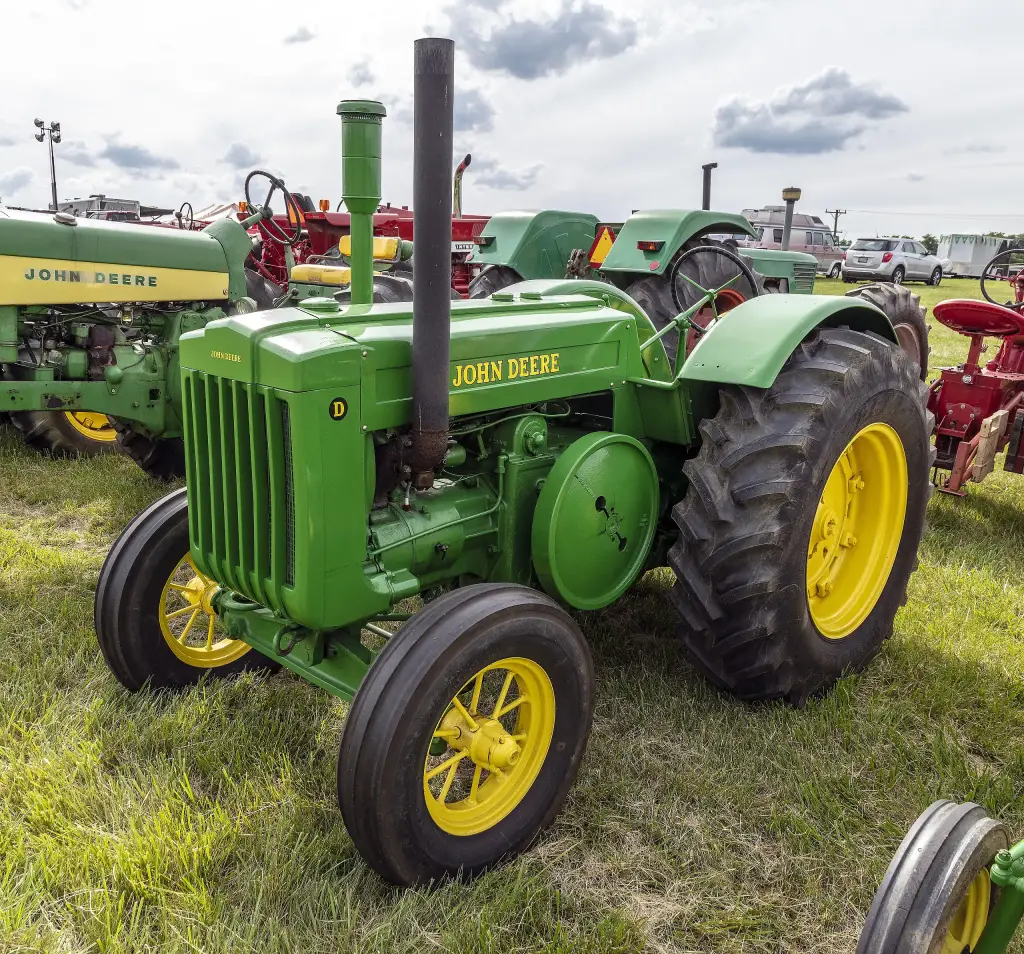
Flywheels and wheels
The earlier D tractors can be sorted into three major eras by the style of flywheel. The “Spoker” type was produced from 1923 to 1926 and had spokes like a wagon wheel. Because a spoked wheel turning at high speed was a hazard, a solid flywheel was introduced in 1926 with small stress-relief holes, earning the “nickel” nickname; these cracked, and the problem was solved by enlarging the holes and slots later in 1926. In 1930 the engine was given more power. By 1935 steel wheels were being phased out in favour of rubber tyres on most models, though they had never been used on the DI industrial tractors, which needed higher road speeds than steel wheels could stand. The D was an all-fuel tractor, able to run on petrol, kerosene or distillate. All Ds were made at the John Deere factory in Waterloo, Iowa, where 55,929 were built.
Versions and the end of the run
Specialised orchard models, the DO, and half-track and fully tracked crawler versions were produced, along with the DI industrial tractor. An optional power take-off was offered. In 1939 the D received the brand-wide styling changes designed by Henry Dreyfuss, with updated bonnets and grilles. After the longest production run of any single model made by John Deere, the D was replaced by the Model R.
The D in the history of the firm
The Model D was designed by Muir L. Frey, father of the Ford Mustang designer Donald N. Frey, and was built from March 1923 to July 1953, the longest production span of all the two-cylinder John Deere tractors. In 1925 the company realised that the standard D did not meet the needs of industrial users: steel wheels were unsuitable for hard surfaces and the gearing too slow for safe road speeds. Solid rubber tyres were fitted and a 28-tooth sprocket gave a road speed of 4 mph (6 km/h); with 40 by 8 inch rear wheels and 24 by 3.5 inch front wheels on solid tyres, the machine was advertised in 1926 as the “John Deere industrial tractor”, the DI. Wheel weights were among the options.
Design and features
- First mass-produced John Deere: the tractor that put the firm into series production.
- Longest run: built from 1923 to 1953 without changing its letter.
- All-fuel engine: petrol, kerosene or distillate.
- Industrial version: the DI, with rubber tyres and a faster final drive.
- Dreyfuss styling: the 1939 bonnet and grille update.
John Deere Model D versions
- Spoker D: the 1923–1926 tractors with a spoked flywheel.
- Nickel D: the 1926 tractors with a solid flywheel.
- DO: orchard version.
- DI: industrial tractor on solid rubber tyres.
- Half-track and crawler D: tracked versions for specialized work.
The D began the two-cylinder line that ran through the Model A and Model B to the John Deere 730. More tractors are in the John Deere collection.
Video: Starting & Driving 1945 John Deere Model D Tractor
Video by Henry Schlitt on YouTube.
Sources
- John Deere Model D, English Wikipedia: production, engines, flywheels, versions, styling
- John Deere tractors, English Wikipedia: designer, industrial DI, production dates