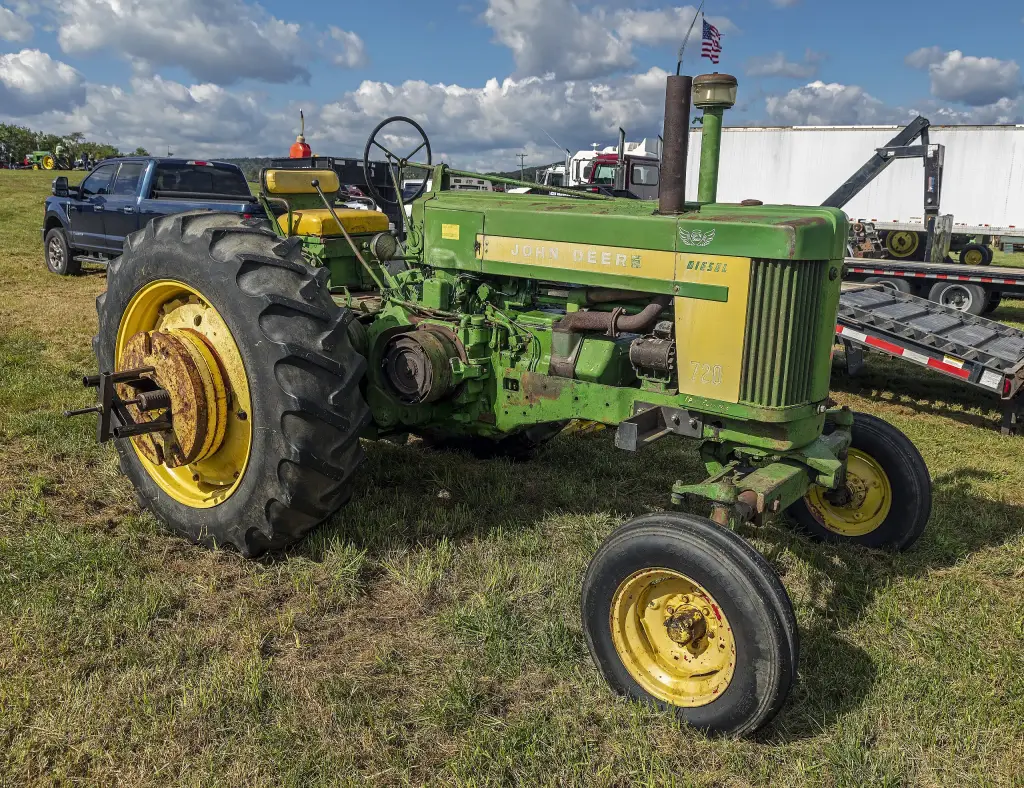
The John Deere 720 replaced the Model 70 in 1956 and was the largest two-cylinder tractor the firm ever offered. Its two-cylinder engine had grown to 6,170 cc, and the tractor was the most powerful row-crop machine of its time.
John Deere 720 at a glance
| Maker | John Deere, Waterloo, Iowa |
|---|---|
| Production | 1956–1958 |
| Replaced | John Deere 70 |
| Replaced by | John Deere 730 |
| Engine | 6,170 cc two-cylinder, horizontal, four-stroke |
| Bore and stroke | 155.57 × 161.9 mm |
| Power | 56.6 hp (65 hp from the petrol engine in the English source) |
| Fuels | petrol, diesel, LP gas and kerosene |
| Starting | auxiliary V4 petrol engine |
| Gearbox | 6 forward and 1 reverse, not synchronised |
| Lift | two-point as standard, three-point optional |
| Built | 22,925 row-crop and 4,523 standard |
History of the John Deere 720
The 720 belongs to the long line of John Deere tractors with horizontal two-cylinder engines, the first of which was the Model D of 1923. The layout lasted until 1960 even though it was technically outdated, apparently because the head of the John Deere development office was attached to it. The 720 replaced the Model 70 in 1956 with freshened styling. It was the largest two-cylinder tractor Deere offered and the most powerful row-crop tractor of its time.
Engine and transmission
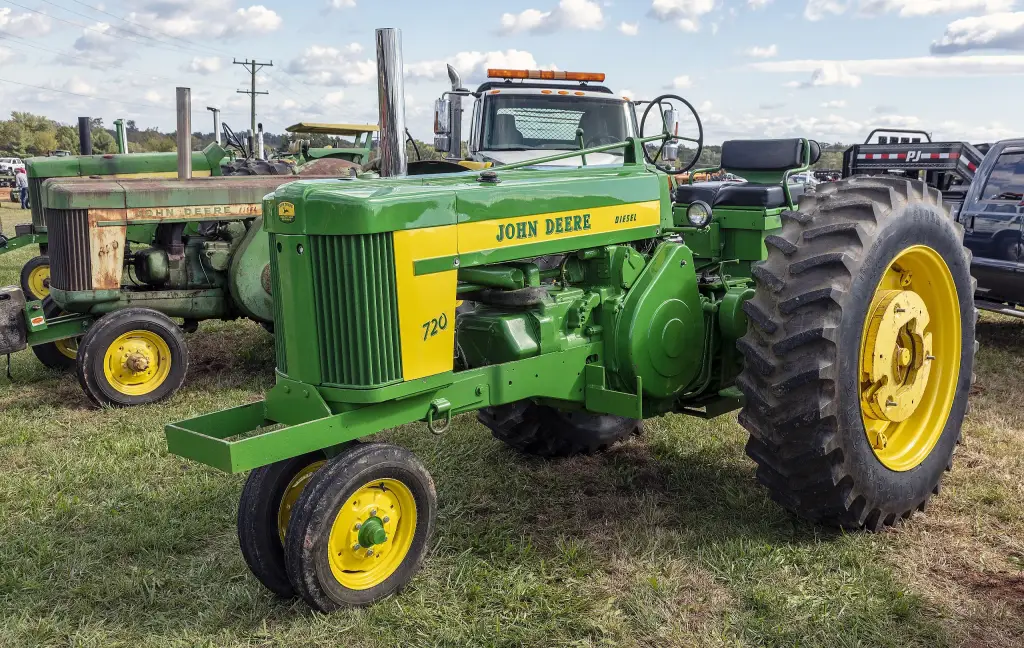
The engine was a horizontal two-cylinder four-stroke with a bore of 155.57 mm and a stroke of 161.9 mm, giving 6,170 cc and 56.6 hp. Four fuels could be ordered: petrol, diesel, liquefied petroleum gas and kerosene, the last under the “all fuel” name. The main engine was started by an auxiliary four-cylinder petrol engine in V form, which was itself turned by a small electric starter. The gearbox had six unsynchronised forward speeds and one reverse. A 540 rpm rear power take-off and a two-point lift were standard, and a three-point lift was optional.
Versions and driving
The tractor came in a standard-track version and in a Row-Crop version with close-set front wheels for work in row crops. Driving a 720 was very different from driving a more conventional tractor: the clutch was worked by a hand lever to the right of the steering wheel rather than by a pedal on the left, and two brake pedals on either side of the axle acted on one driving wheel each and could not be coupled. Gear changes had to be made with the tractor standing still. Between 1956 and 1958, 22,925 were built in Row-Crop form and 4,523 in standard form. The 720 was replaced by the John Deere 730, which kept the same powertrain.
Design and features
- Largest two-cylinder: the biggest tractor Deere built with the two-cylinder engine.
- Four fuels: petrol, diesel, LP gas and kerosene.
- Auxiliary starting engine: a V4 petrol engine started the main unit.
- Hand clutch: a lever to the right of the wheel instead of a pedal.
- Two-point lift: standard, with a three-point lift as an option.
John Deere 720 versions
- Row-Crop: close-set front wheels for work in rows, 22,925 built.
- Standard: fixed standard track, 4,523 built.
- Diesel and all-fuel: the same engine with different fuel systems.
- Three-point lift: an option on top of the standard two-point lift.
The 720 followed the John Deere Model G and its Model 70 successor, and was replaced by the John Deere 730. More tractors are in the John Deere collection.
Sources
- John Deere 720, French Wikipedia: engine, fuels, transmission, lift, production figures, driving
- John Deere Model G, English Wikipedia: place of the 720 in the range, power, styling