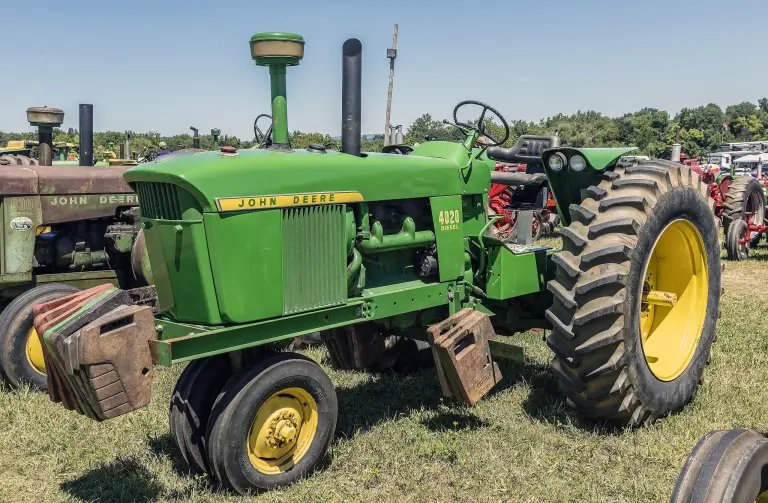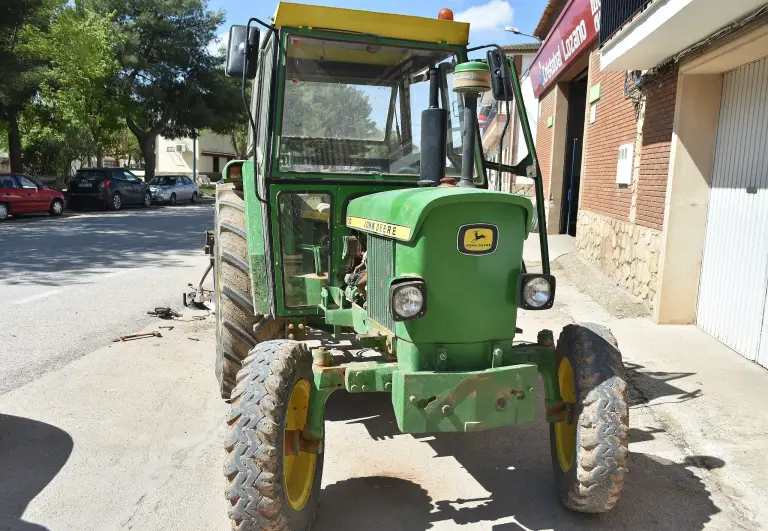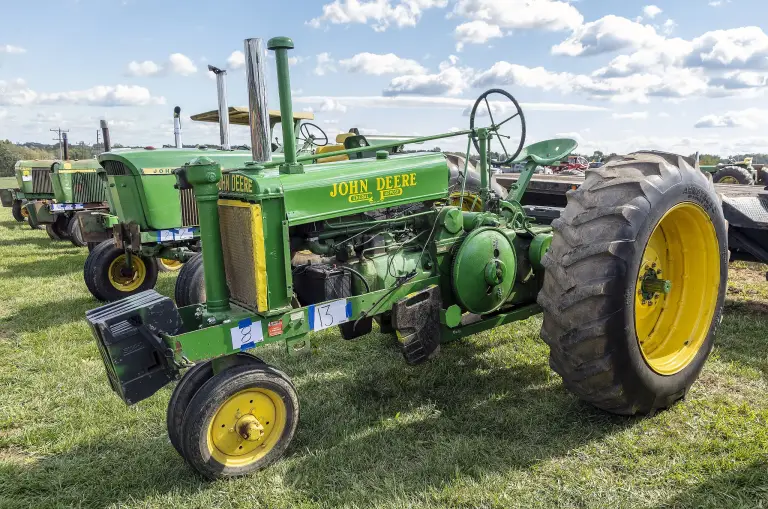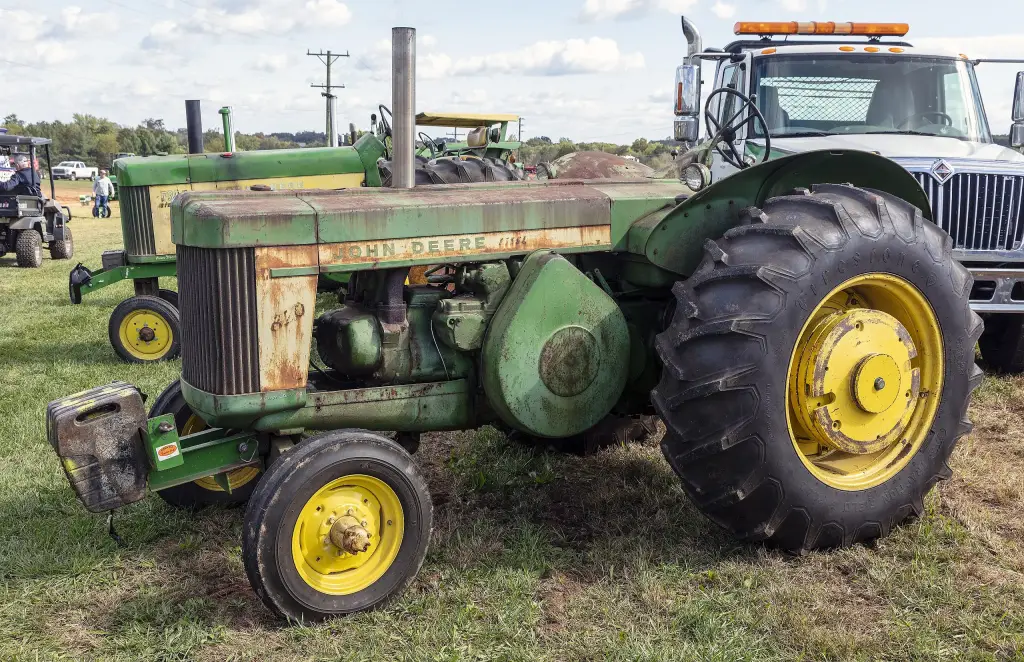
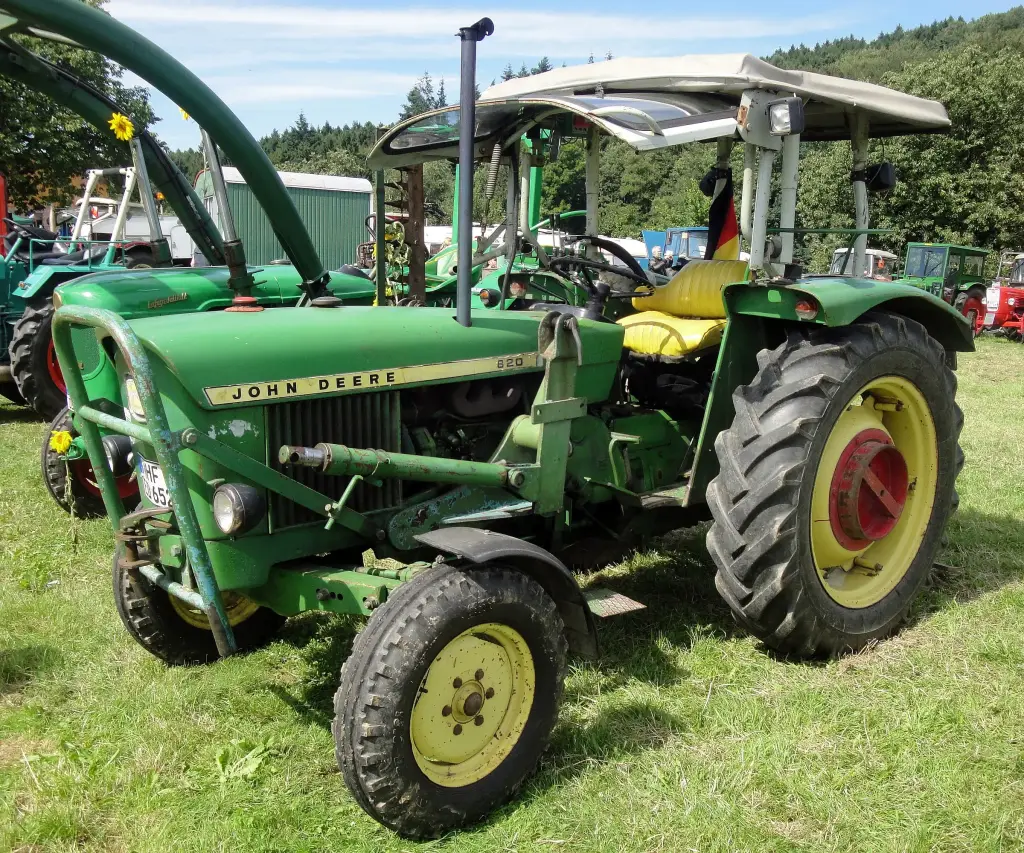
The John Deere 820 was the smallest of the three-cylinder tractors in the European 20 Series. It was designed for small farms, built at Mannheim from 1967 to 1974 and made in 7,415 examples.
John Deere 820 at a glance
| Maker | John Deere, Mannheim, Germany |
|---|---|
| Production | 1967–1974 |
| Family | 20 Series; 820, 920, 1020 and 1120 were the three-cylinder models |
| Engine | 2,490 cc three-cylinder diesel, direct injection |
| Bore and stroke | 98 × 110 mm |
| Power | 32 hp DIN, raised to 35 hp DIN in 1969 |
| Gearbox | 8 forward and 4 reverse, with a parking position |
| Brakes | oil-bath disc brakes |
| Power take-off | 540 rpm rear; 1,000 rpm mid-mounted optional |
| Lift capacity | 1,245 kg |
| Weight | 1,875 kg |
| Built | 7,415 |
This page is based on a single source, the French Wikipedia article on the John Deere 820.
History of the John Deere 820
In 1956 John Deere bought the German Lanz works at Mannheim in order to build low and medium-power tractors for the European market, styled along the lines of the big American models drawn by Henry Dreyfuss. The 20 Series was the firm’s first complete range designed around what European farmers wanted. Introduced from 1967, it was made up of tractors with three, four or six-cylinder engines, and the three-cylinder models were the 820, 920, 1020 and 1120. Standardisation meant that dimensions, gearbox and engine were shared by all or some of them.
Engine and transmission
Although the names are the same, the John Deere 820 built at Mannheim in 1967 has nothing to do with the earlier American 820, a much more powerful two-cylinder tractor of 1956. The European 820 had a three-cylinder in-line diesel of four-stroke type with direct injection, a bore of 98 mm and a stroke of 110 mm, giving 2,490 cc. Its power was 32 hp DIN, raised to 35 hp DIN in 1969. The gearbox had eight forward and four reverse speeds, and a parking position on one of the gear levers locked it and immobilised the tractor in place of a traditional handbrake acting on the wheels. Braking, which was very effective, was by oil-bath disc brakes.
Equipment and reputation
The rear power take-off ran at 540 rpm, and a mid-mounted power take-off at 1,000 rpm could be fitted; a complete hitch and hydraulic outlets for working rams were among the options. Draft control of the lift, which could raise 1,245 kg, worked on the lower links, unlike many tractors of the same power where it worked on the third point. Intended for small farms, the John Deere 820 was considered a very versatile tractor, limited only by its rather low weight of 1,875 kg and by the lack of power steering.
Design and features
- Smallest of the three-cylinders: the entry model of the European 20 Series.
- Direct-injection diesel: 2,490 cc giving 32 and later 35 hp DIN.
- Parking position: a gear lever position immobilised the tractor instead of a handbrake.
- Oil-bath disc brakes: very effective stopping for a small tractor.
- Draft control on the lower links: a layout usually found on bigger tractors.
John Deere 820 versions
- 820 of 1967: the original 32 hp DIN version.
- 820 from 1969: power raised to 35 hp DIN.
- 920, 1020 and 1120: the larger three-cylinder models sharing the same base.
- Mid-mounted PTO: an optional 1,000 rpm unit alongside the 540 rpm rear one.
The 820 was the smallest of the European range that also included the four-cylinder John Deere 2130. The later Mannheim six-cylinders are represented by the John Deere 3650. More tractors are in the John Deere collection.
Video: John Deere 820 Mowing.
Video by Hendrik Strokmeijer on YouTube.
Sources
- John Deere 820, French Wikipedia: production, engine, gearbox, brakes, lift, weight