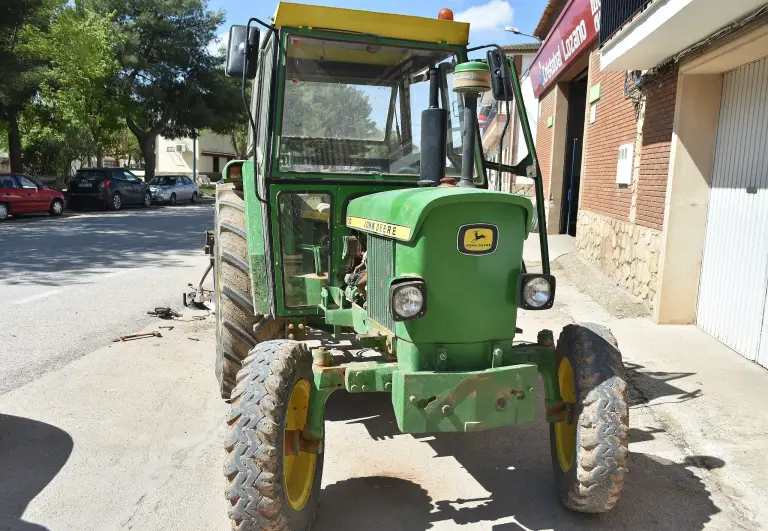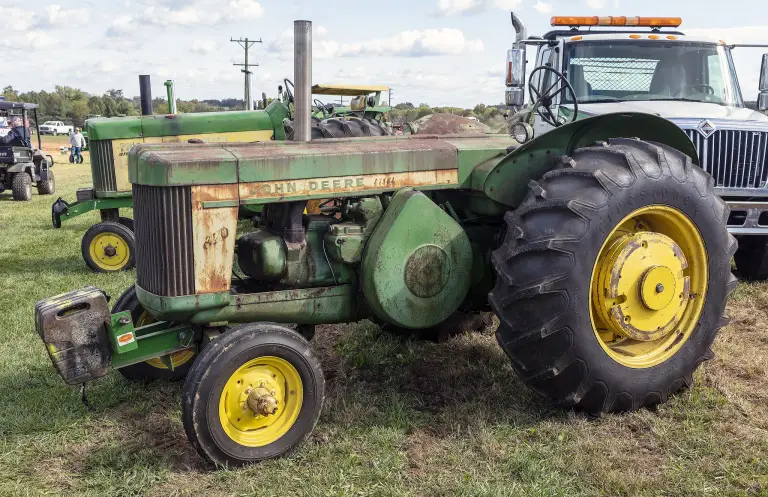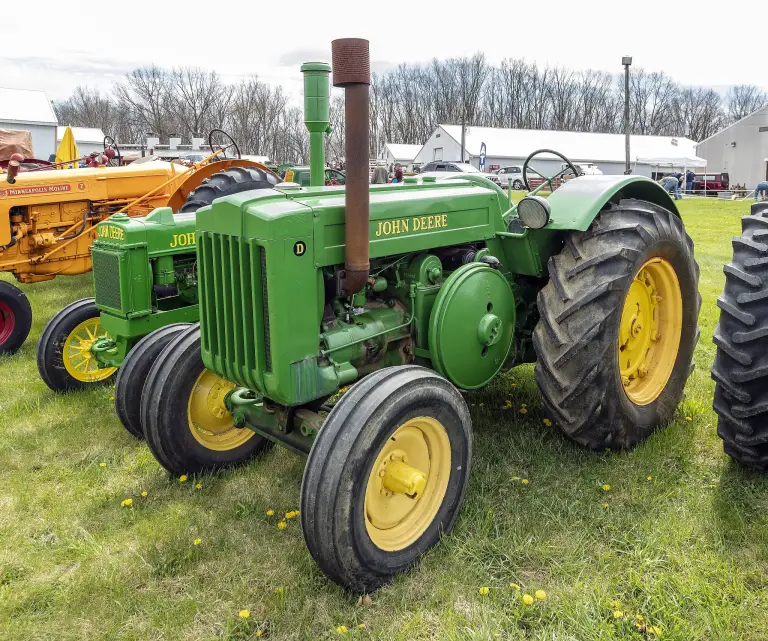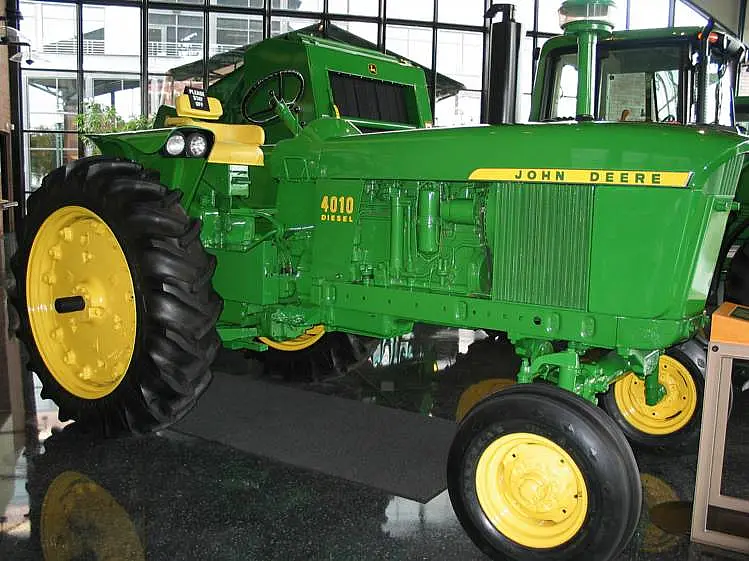
The John Deere 4010 was the star of the new “10” series that John Deere presented to its dealers on 30 August 1960. It was the company’s first tractor with a six-cylinder engine, and it turned John Deere into a maker of modern tractors.
John Deere 4010 at a glance
| Maker | John Deere, Waterloo, Iowa |
|---|---|
| Production | 1960–1963 |
| Series | New Generation “10” series |
| Engine | six-cylinder; 4.9 L petrol or LP gas, 6.2 L diesel |
| Rated power | 80 hp in 1960; 84 hp at the PTO in the Nebraska tests |
| Drawbar power | 53.6 kW (71.93 hp) |
| Maximum speed | 22.9 km/h |
| Gearbox | Synchro Range, 8 forward and 3 reverse, partly synchronised |
| Dimensions | 3.81 m long, 2.20 m wide, wheelbase 2.23–2.45 m |
| Weight | 3,220 kg |
| Drive | two-wheel drive only |
| Built | 59,316, more than 48,000 of them diesel |
History of the John Deere 4010
John Deere had built tractors with horizontal two-cylinder engines since the Model D of 1923. That technology, and details such as the hand clutch, were outdated after the Second World War, and the firm’s market share was slipping. On 30 August 1960 John Deere presented the first models of modern type with vertical multi-cylinder engines, the 1010 to 8010, which made up the “10” series. Dealers from around the world were invited to Dallas, Texas, to see the whole range at the Dallas Memorial Auditorium. The 4010 was the main attraction of the new line, and the most popular of the series by a wide margin.
The tractor that the 4010 replaced in concept was the two-cylinder family that had made John Deere’s name. The new series offered a much better power-to-weight ratio, advanced hydraulics, a more convenient driving position and numerous other improvements. The fuel tank was moved to the front of the bonnet while the engine sat further back towards the driver, so that the fuel was less exposed to heat and evaporated less. The lines of the 10 series, like those of its successors, were drawn by the stylist Henry Dreyfuss, who had already restyled older John Deere models. Between 1960 and 1963, 59,316 Model 4010s were built, of which more than 48,000 had diesel engines; the English Wikipedia gives more than 58,000 sold, and notes that the success of the 10 series helped John Deere move from a 23 per cent market share in 1959 to 34 per cent by 1964.
Engine and running gear
The 4010 could run on three fuels: diesel, petrol or liquefied petroleum gas. The engine was always a six-cylinder four-stroke; its capacity was 4.9 litres in the petrol and LP gas versions and 6.2 litres in the diesel, and maximum engine speed was 2,200 rpm whatever the fuel. Measured output was 53.6 kW (71.93 hp) at the drawbar and 62.6 kW (84 hp) at the power take-off, for an estimated engine output of 88.9 hp. The transmission was a partly synchronised Synchro Range manual gearbox with eight forward speeds, three reverse speeds and a top speed of 22.9 km/h. The tractor was 3.81 m long and 2.20 m wide, with a wheelbase between 2.23 and 2.45 m depending on the version, and weighed 3,220 kg. Only two-wheel drive was offered. Hydraulics worked the disc brakes and assisted the steering; the lift and the power take-off were optional, because in North America tractors mostly pulled trailed implements.
Versions and the Elvis tractor
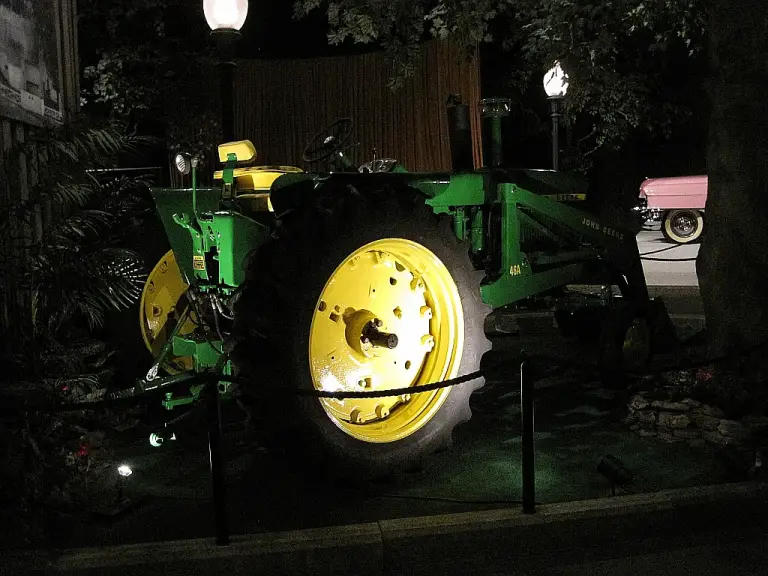
The 4010 came as a Standard model with fixed or adjustable track, a Hi-Crop with enough ground clearance to work in tall crops, a Row-Crop with a narrow front axle under the bonnet for work in rows, and an Industrial version for public works, with stronger axles, wider tyres, a prominent radiator grille and bodywork painted golden yellow. Comfort was taken seriously: the seat was designed by Janet G. Travell, an orthopaedic specialist in muscular and skeletal pain. In 1967 Elvis Presley bought a 1963 Model 4010 with his Twinkletown Farm; the tractor went to Graceland, where it worked daily until 2008, was then restored by students of Northwest Mississippi Community College and put on display at the Elvis Presley Memphis museum. The Ertl company made a 1:16 replica of his tractor.
Design and features
- Six-cylinder power: the first John Deere tractor with a six-cylinder engine.
- Three fuels: diesel, petrol or LP gas.
- New Generation layout: fuel tank forward, engine set back towards the driver.
- Four versions: Standard, Hi-Crop, Row-Crop and Industrial.
- Dreyfuss styling: lines drawn by Henry Dreyfuss, who had restyled earlier John Deeres.
John Deere 4010 versions
- Standard: fixed or adjustable track width.
- Row-Crop: narrow front axle for work in rows.
- Hi-Crop: high ground clearance for tall crops.
- Industrial: stronger axles, wide tyres and yellow paint.
- Diesel and petrol/LP gas: 6.2-litre or 4.9-litre engines.
The 4010 was replaced by the John Deere 4020, the most popular tractor the firm ever built. Its four-cylinder stablemate was the John Deere 3020. More tractors are in the John Deere collection.
Video: John Deere 4010 Plowing Pickett 2014
Video by KG6964 on YouTube.
Sources
- John Deere 4010, English Wikipedia: launch, power, production, Elvis Presley tractor
- John Deere 4010, French Wikipedia: technical data, versions, styling, production split