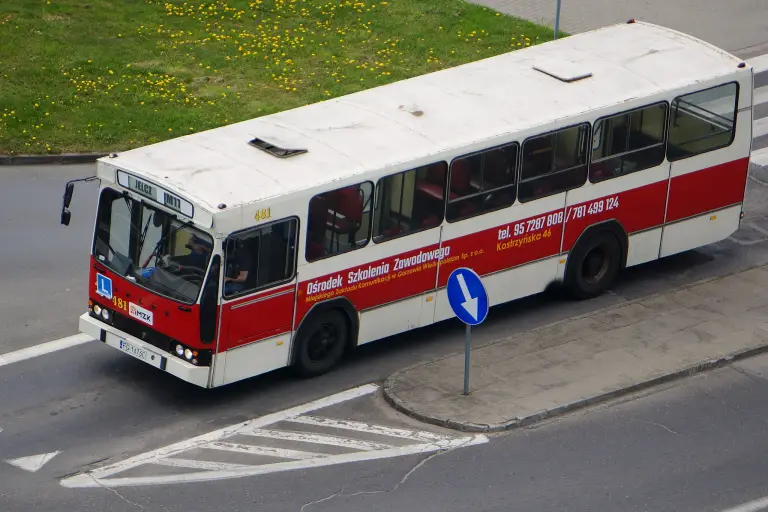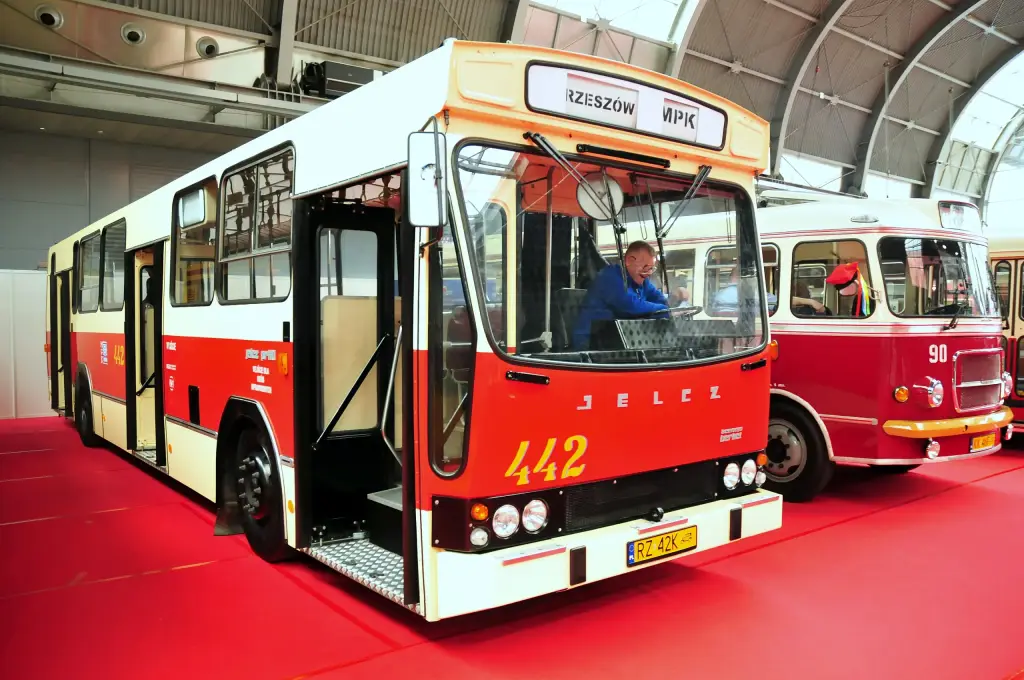
The Jelcz PR110 was a Polish full-size city bus produced from 1975 to 1992 at Jelcz-Laskowice under licence from the French firm Berliet. It was the development of the PR100, with three pairs of doors and a much larger Polish content, and about 12,000 were built.
Jelcz PR110 at a glance
| Maker | Jelczańskie Zakłady Samochodowe, Jelcz |
|---|---|
| Type | city bus, 12 metres |
| Licence | Berliet, France |
| Production | 1975-1992 |
| Designations | PR110U until 1983, PR110M afterwards |
| Doors | three pairs |
| Predecessor | Jelcz PR100 |
| Engine | SW 680, later SW 680/78 |
| Built | about 12,000, 1976-1992 |
| Design changes | 1,901 between 1976 and 1981 |
| Derivatives | PR110L suburban, PR110IL intercity |
| Successor | Jelcz 120M |
The PR110L and PR110IL versions are described in the Polish article; the former separate entries Jelcz pr and Jelcz pr-110 are covered here.
History of the Jelcz PR110
On 14 January 1972 the Polish government decided to start production of a new high-capacity bus, and research institutes began work on a design using domestic parts. The plan was a bus of 11 or 12 metres, but after assessing what Polish industry could supply the authorities chose a foreign licence, considering Karosa of Czechoslovakia or Ikarus of Hungary as politically neutral options before rejecting them after tests in Warsaw. In July 1972 the decision went in favour of a Western licence: offers came from Fiat, Klöckner-Humboldt-Deutz, Leyland, Pegaso, Berliet and Hino, and negotiations narrowed to the Leyland National, Leyland Worldmaster, a riveted Hino, a Pegaso and the 11.23-metre Berliet PR100. Poland wanted to use its own SW 680 engine, built at WSK Mielec under British Leyland licence since 1966, and the Berliet offer won, probably because the other makers would not accept the engine change and because Paris wanted to rescue the failing Berliet; the Japanese offer was rejected for its riveted body.
The PR100 itself did not suit Poland: it carried 97 passengers and its two door pairs made exchange at stops slow, so in France work began on a modernised version with a third pair of doors and a longer body. The first two PR110 prototypes were built in 1975, one tested in France and one in Poland, and series production of the Jelcz-Berliet PR110U, with U for urbain, started the same year. The first Jelcz-built buses were tested in Warsaw, Katowice and Wrocław with five vehicles each from 1976, covering 50,000 km in a few months; the trials led to 1,901 design changes between 1976 and 1981, and the winter of 1977 showed that the fuel and pneumatic systems had to be made frost-resistant and the engine replaced by the SW 680/78.
Production under the Berliet name lasted until 1983, when the licence expired, and the bus continued as the PR110M without important changes; in total about 12,000 PR110U and PR110M buses were built between 1976 and 1992. The family grew beyond the city version. The suburban PR110L had double seats, curtains and no middle doors, a 2-0-2 door layout and a six-speed gearbox, and carried 95 or 98 passengers. The intercity PR110IL, prototyped in 1977 and built in series from the fourth quarter of 1979, had a raised floor with 7 m³ of underfloor luggage space, 51 seats, two door pairs and the SW 680/78 engine lying behind the rear axle with a six-speed FPS Tczew gearbox. The PR110M was in turn the starting point for the Jelcz 120M of 1992.
Design and features
- Three pairs of doors: the main change from the PR100, together with a longer 12-metre body.
- Domestic engine: the SW 680, later SW 680/78, built at WSK Mielec under Leyland licence.
- Large-scale production: about 12,000 buses, with 1,901 design changes in the first six years.
- Body variants: the suburban PR110L and the intercity PR110IL with 7 m³ of luggage space.
Jelcz PR110 versions
- PR110U: the licensed version built until 1983.
- PR110M: the same bus built after the licence expired, with no important changes.
- PR110L: the suburban version with two doors in a 2-0-2 layout and a six-speed gearbox.
- PR110IL: the intercity coach with 51 seats and 7 m³ of underfloor luggage space.
The PR110 succeeded the Jelcz Berliet PR100 and was developed into the Jelcz 120M; its body also lived on in the Jelcz M11. More buses are in the Jelcz collection.
Sources
- Jelcz PR110, English Wikipedia: production years, licence, third door pair and output
- Jelcz PR110, Polish Wikipedia: licence negotiations, trials, design changes and the L and IL versions