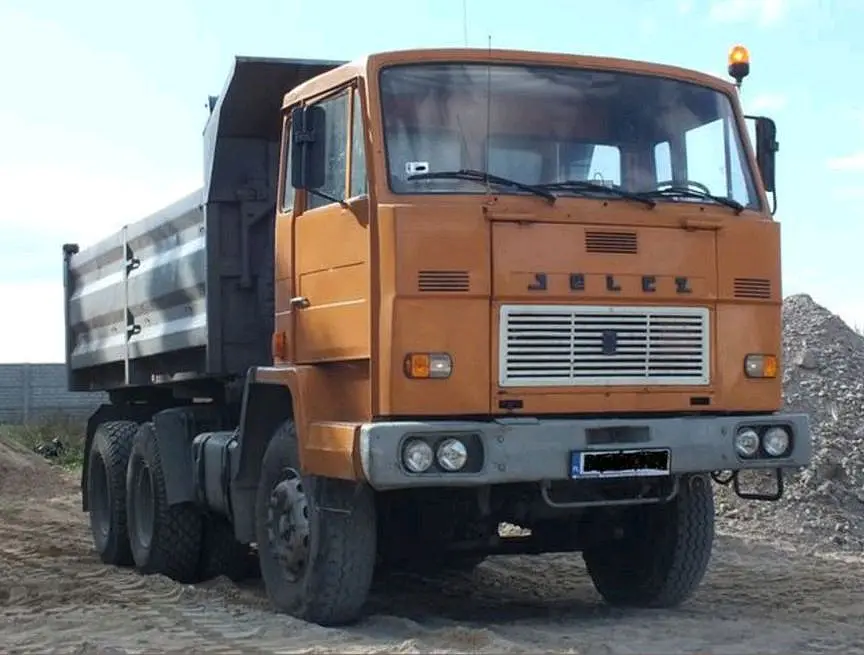
The Jelcz 640 was a Polish heavy dump truck with 6×4 drive, produced in series from 1973 to the beginning of the 1980s. Its chassis was developed under licence from the Austrian firm Steyr, and it became the largest dump truck built in Poland.
Jelcz 640 at a glance
| Maker | Jelczańskie Zakłady Samochodowe, Jelcz |
|---|---|
| Type | heavy dump truck |
| Drive | 6×4, two driven rear axles |
| Production | from 1973 to the early 1980s |
| Licence | Steyr 1490 chassis elements |
| Cab | type 136 short or 134 long, tilting to 63 degrees |
| Engine | SW680 diesel, Leyland licence |
| Gearbox | ZF S6-90 with multiplier, FPS Tczew |
| Rear axles | Steyr, later Berliet-based |
| Dump body | SHL Kielce |
| Designations | 640W, W-640, W640JS, 3W640-825 |
This page is based on a single source, the Polish Wikipedia article on the Jelcz 640.
History of the Jelcz 640
The 640 was the answer to a national building programme. At the start of the 1970s Poland turned into a huge construction site, with the Huta Katowice steelworks at the head, and the government called for heavy equipment including dump trucks. A tender for deliveries to Huta Katowice attracted the Western makers; Mack, Pegaso and Renault withdrew, and after several months of tests Mercedes, MAN, Volvo and Steyr were left, with the Steyr proving best in the field and in payload. The Austrians made cooperation conditional on compensation orders, and in September 1972 an agreement was signed that began with the production of front axles and the assembly of dump bodies on Austrian chassis fitted with Polish engines, gearboxes, cabs and cargo boxes. The first vehicles were handed over on 14 December 1973.
The construction used frame and 6.5-tonne front axles from the Steyr 1490, whose licensed production started at Jelcz. The cab was the Polish type 136 in its short form or the 134 in its long form, developed from the type 113 of the 300-series trucks, with the roof pressed at SHL Kielce and the rest built and assembled at Jelcz. The cab was raised by a mechanical hydraulic pump and tilted to 63 degrees, the headlamps moved into the bumper, and the door skins of the left and right doors were made identical to simplify and cheapen production.
Power came from the SW680 diesel, a Leyland licence built at WSK Mielec after the domestic PZL-Wola S-560 had failed to develop, coupled to the licensed ZF S6-90 gearbox with a multiplier made by FPS Tczew. Because the trucks were built in batches over the years, not every example had the multiplier. The Steyr drive axles, whose production could not be started in Poland, were imported at first and later replaced by a design developed from the French Berliet PR110 bus axle licence; those axles had a similar load capacity but not the right ratios for a truck, so a multiplier module was fitted between the clutch and the gearbox and engaged by a switch on the gear lever. The first dump bodies came from IFE in Austria with a 20-tonne capacity, after which the Polish SHL works in Kielce supplied both the bodies and the hydraulic systems, at first tipping rearward only and later sideways as well. The economic crisis of the early 1980s overlapped with production and contributed to the end of cooperation with the Austrian partner.
Design and features
- Steyr chassis: the frame and 6.5-tonne front axles of the Steyr 1490 under licence.
- Polish cab: the types 136 and 134 with a roof pressed at SHL Kielce, tilted to 63 degrees.
- Leyland-licence power: the SW680 diesel with a ZF S6-90 gearbox and multiplier.
- SHL Kielce bodies: dump bodies and hydraulics supplied by the Kielce works.
Jelcz 640 versions
- Jelcz 640W: the standard dump truck of the family.
- W640JS and 3W640-825: further designations used in the series.
- Steyr-axle and Berliet-axle trucks: early vehicles with Steyr axles, later ones with Berliet-based axles and a multiplier.
The 640 shared its engine and gearbox with the Jelcz 300 trucks and was followed in the range by the Jelcz 422. More trucks are in the Jelcz collection.
Sources
- Jelcz 640, Polish Wikipedia: Steyr licence, cab, engine, axles, dump bodies and the 1972-1973 agreement