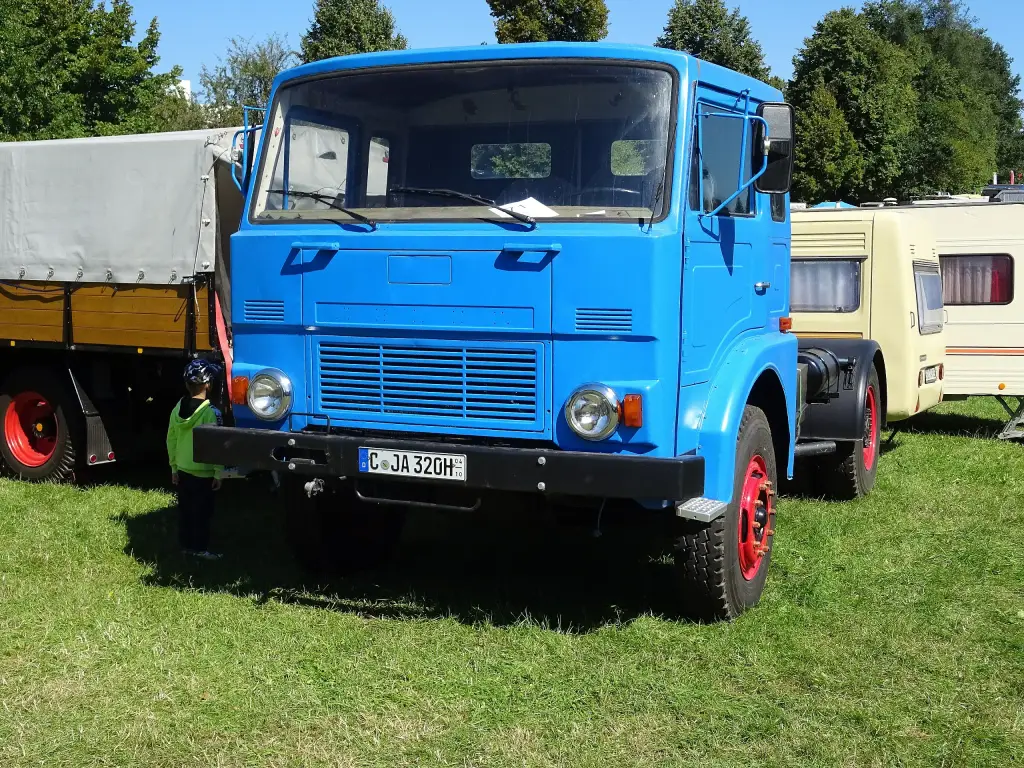
The Jelcz 300 was a series of Polish heavy trucks produced from 1968 to 1992 by the Jelczańskie Zakłady Samochodowe. The first model, the Jelcz 315, replaced the troublesome Żubr A80 and brought a Leyland-licence diesel, a Hungarian rear axle and integral power steering.
Jelcz 300 at a glance
| Maker | Jelczańskie Zakłady Samochodowe, Jelcz |
|---|---|
| Series | 300 |
| Production | 1968-1992 |
| First model | Jelcz 315 |
| Engine | SW 680/1, 11,100 cm³, 147 kW (200 hp) |
| Torque | 743 Nm at 1,200 rpm |
| Gearbox | five-speed, FPS Tczew |
| Rear axle | Raba P018, ratio 7.07 |
| Payload | 8,000 kg |
| Top speed | 87 km/h |
| Fuel consumption | about 28 l/100 km |
| Later models | 316 three-axle, 317 tractor, 325 |
The Polish Wikipedia article covers the 315 and 316 in one page; this article follows it and adds the expedition journeys recorded on the English page about the company.
History of the Jelcz 300
The 315 was designed as the successor of the Żubr A80, whose most failure-prone assemblies were replaced one by one. The new engine was the six-cylinder vertical SW 680 diesel, which WSK Mielec began building under a licence bought from Leyland in 1966; a new five-speed gearbox was developed at the FPS plant in Tczew. Jelcz kept the imported Hungarian Raba rear axle with planetary hub reduction, and added integral hydraulic power steering, imported from Bendibenca in Spain or Csepel in Hungary, together with a two-circuit pneumatic service brake using Westinghouse-licensed parts. The clutch, auxiliary brake and towing hitch were adapted, and the cab was improved with doors hinged at the front edge, a new heating and ventilation system, lower noise, two extra seats, a new dashboard and larger wipers.
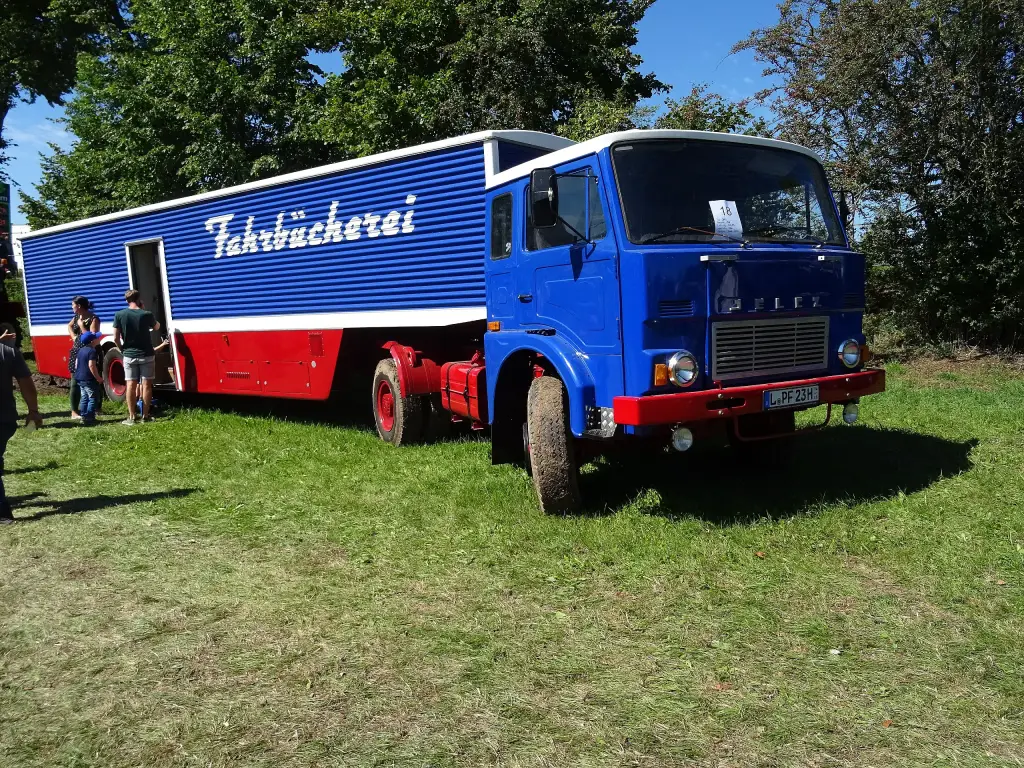
Prototypes were tested in 1966 and 1967, and in early January 1968 fifteen pre-series trucks were handed to users. Series production began in the fourth quarter of 1968, the year in which the last series of the Żubr A80 was also built; in total the works produced 1,623 trucks in 1968. The 315 remained in production until 1982, when the 325 took over. It was the base for the rest of the family: the 316 three-axle truck with a longer chassis, the 317 tractor unit, and the 315E with a metal-sided cargo box, all intended to eliminate imported components.
The SW 680/1 sat above the front axle. With a 127 mm bore and a 146 mm stroke it displaced 11,100 cm³ and, at a compression ratio of 15.8, produced 147 kW (200 hp) at 2,200 rpm and 743 Nm at 1,200 rpm. The forged crankshaft ran in seven plain bearings, fuel was injected directly into toroidal chambers in the piston crowns, first by CAV equipment and later by domestic Friedmann-Meyer-licensed pumps, and the dry engine weighed 970 kg. The five-speed gearbox had a direct fourth gear and synchronized second to fifth, and drove a Raba P018 axle with a bevel final drive and planetary hub reduction at a ratio of 7.07. The welded longeron frame widened at the front, both axles used semi-elliptic leaf springs with extra leaves at the rear, and the truck ran on 11.00-20 tyres. The 315 weighed 6,440 kg with an 8,000 kg payload, reached 87 km/h and used about 28 l/100 km, or 36 l/100 km with a 14-tonne trailer. Two 315s also became expedition vehicles: in 1974 a Jelcz 316 carried the Polish Lhotse expedition from Warsaw to Nepal, and in May 1975 a Jelcz 315-M took the Wrocław mountain club expedition to Broad Peak Central from Wrocław to Islamabad, covering up to 9,000 km.
Design and features
- SW 680 diesel: the Leyland-licence six-cylinder of 11,100 cm³ and 200 hp, built at WSK Mielec.
- Raba rear axle: the Hungarian P018 unit with planetary hub reduction and a 7.07 ratio.
- Integral power steering: a ball-and-nut gear with hydraulic assistance and a Hobourn-Eaton pump.
- Better workplace: a redesigned cab with new heating, a new dashboard and two extra seats.
Jelcz 300 versions
- Jelcz 315: the basic two-axle truck, built until 1982.
- Jelcz 316: the three-axle truck with a longer chassis.
- Jelcz 317: the tractor unit of the family.
- Jelcz 315E: a version with a metal-sided cargo box.
The 300 series was replaced by the Jelcz 410 and shared its engine technology with the heavy Jelcz 640 dump truck. More trucks are in the Jelcz collection.
Video: Jelcz 317 W3 prawie skończony !!!
Video by janek jelcz on YouTube.
Sources
- Jelcz 300, Polish Wikipedia: development of the 315, engine, transmission, dimensions and performance
- Jelcz, English Wikipedia: the 1974 Lhotse and 1975 Broad Peak expeditions