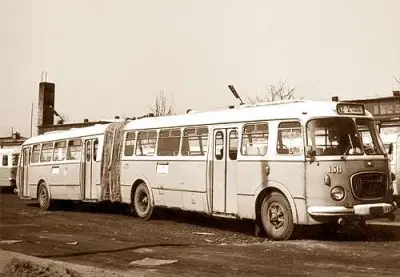
The Jelcz AP-02 was a Polish articulated city bus produced in series from 1964 to 1967 by the Jelczańskie Zakłady Samochodowe. It was the factory version of the MPA AP-62, a jointed bus designed and assembled in Warsaw from two crashed vehicles.
Jelcz AP-02 at a glance
| Maker | Jelczańskie Zakłady Samochodowe, Jelcz |
|---|---|
| Type | articulated city bus |
| Predecessor | MPA AP-62, built in Warsaw |
| Series production | 1964-1967 |
| Capacity | 154 passengers, 48 seated |
| Weight saving | 500 kg against the AP-62 |
| Joint | ball joint with an internal rotating plate |
| Front section | city bus body |
| Rear section | city bus body |
| Successor | Jelcz 021 |
This page is based on a single source, the Polish Wikipedia article on the Jelcz AP-02.
History of the Jelcz AP-02
Growing demand for transport in Polish cities, Warsaw above all, pushed operators towards high-capacity articulated buses. No Polish maker offered such a vehicle, so in 1962 the Warsaw municipal bus enterprise began work on the first Polish two-section articulated bus, designated MPA AP-62. The work was done at the Redutowa depot under its manager Aleksander Wist and used two crashed buses, one city bus and one intercity Škoda 706 RTO MEX with a Karosa body: one section came from the city bus and the other from the intercity vehicle. In the front section the frame was cut behind the rear axle and a crossmember carrying the joint bowl was fitted, while in the rear section the frame was shortened at the front and the joint holder was attached to it. The two sections were joined by a ball joint with a rotating plate above it forming the connection inside the bus, and to improve manoeuvrability the original rear axle in the second section was replaced by a front axle from a French Chausson APH 521, whose folding doors were also fitted into the narrower door openings of the intercity-derived sections.
The AP-62 was arranged for 142 passengers, 46 of them seated, and 22 articulated buses were assembled in Warsaw in 1962 and 1963 before the technical documentation was handed to the Jelczańskie Zakłady Samochodowe. The factory improved the design and put it into series production in 1964 as the Jelcz AP-02. Compared with the Warsaw original, the serial bus was 500 kg lighter and had a changed seat layout, which raised capacity to 154 passengers, 48 of them seated, and both sections were now of the city type.
The AP-02 did not stay in production for long. Its joints and its long rear section caused problems in service, and in 1966 the factory built prototypes of a modernised articulated bus with a shortened rear section and a steering rear axle, the Jelcz 021, which replaced the AP-02 in 1967. The AP-02 remains the starting point of the Polish articulated bus line that led through the 021 to later Jelcz articulated models.
Design and features
- Two city sections: the production bus used city bodies for both halves, unlike the intercity rear section of the AP-62.
- Ball joint: a ball joint with a rotating plate inside and a canvas cover outside.
- Higher capacity: 154 passengers, 48 of them seated, 500 kg lighter than the Warsaw original.
- Short career: replaced in 1967 by the improved Jelcz 021.
Jelcz AP-02 versions
- MPA AP-62: the 22 Warsaw-built prototypes with a city front section and an intercity rear section.
- Jelcz AP-02: the factory series version with two city sections.
The AP-02 was replaced by the Jelcz 021 and used the body technology of the Jelcz 043. More buses are in the Jelcz collection.
Sources
- Jelcz AP-02, Polish Wikipedia: origin of the AP-62, construction, capacity and the change to the 021