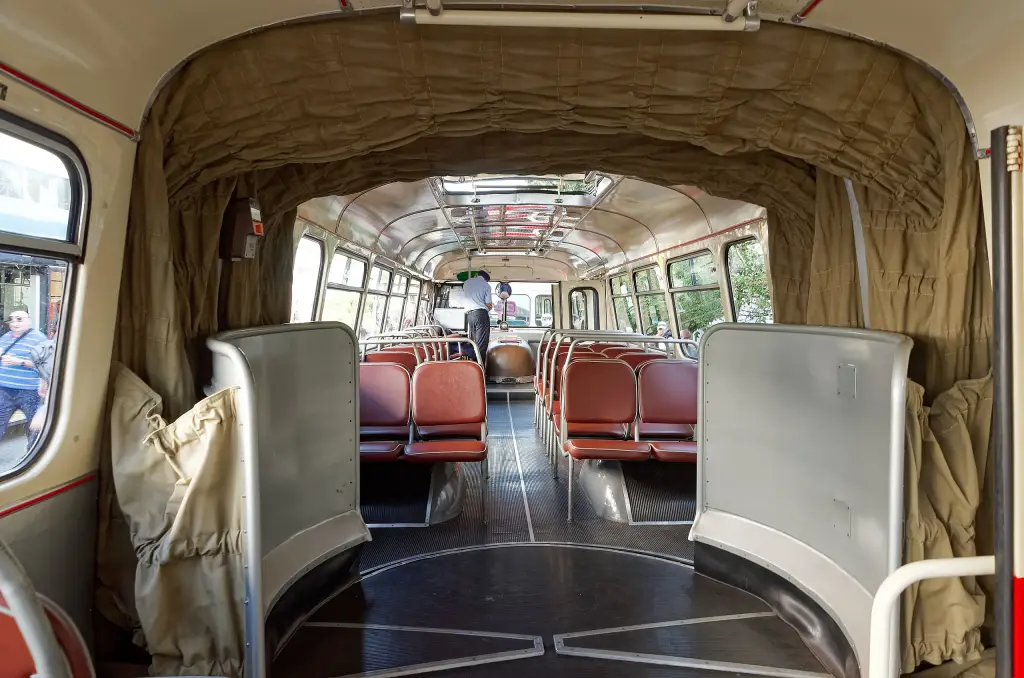
The Jelcz 021 was a Polish articulated city bus produced in series between 1967 and 1979 by the Jelczańskie Zakłady Samochodowe. It was developed from the earlier AP-02 articulated bus, whose manoeuvrability and rear overhang had caused problems in service.
Jelcz 021 at a glance
| Maker | Jelczańskie Zakłady Samochodowe, Jelcz |
|---|---|
| Type | articulated city bus |
| Prototypes | two, built in 1966 |
| Series production | 1967-1979 |
| Predecessor | Jelcz AP-02 |
| Rear section | 187 cm shorter than the AP-02 |
| Wheelbase, second to third axle | 145 cm shorter |
| Middle doors | four-leaf, 1,260 mm wide |
| Rear axle | steering, from the Żubr A80 |
| Capacity | 136 passengers, 42 seated |
| Engine | Škoda 706RT, 11,781 cm³, 160 hp |
| Export version | Jelcz 021E for the GDR, 1969 |
This page is based on a single source, the Polish Wikipedia article on the Jelcz 021.
History of the Jelcz 021
Service with the articulated MPA AP-62 and Jelcz AP-02 buses exposed weaknesses in both designs. The main problems were poor manoeuvrability and the rear section swinging over the kerb on bends, a consequence of the long second section and the large rear overhang. In 1966 the Jelcz designers built two prototypes of a modernised bus designated Jelcz 021. The rear section was shortened by 187 cm and the distance between the second and third axles was cut by 145 cm, which made the bus far easier to handle in narrow streets.
To speed up the exchange of passengers, the two-leaf middle doors of the predecessor were replaced by four-leaf doors 1,260 mm wide. The running gear was changed as well: the imported French rear axle gave way to a steering rear axle taken from the Żubr A80 truck. The prototypes went into trial service with MPK Wrocław, and the positive results led to series production starting in 1967.
The body of the 021 sat on a riveted longeron frame of pressed steel sheet. The front and rear sections were joined by a ball joint with a rotating plate that formed the connection between the two sections inside the bus, while on the outside the joint was hidden under an apron of impregnated canvas. The skin was made of steel sheets riveted to the skeletal body structure. The 1,900 mm high interior carried 136 passengers, 42 of them seated, and was finished in lacquered fibreboard. Power came from the imported Czechoslovak Škoda 706RT six-cylinder diesel of 11,781 cm³ and 117.6 kW (160 hp), mated to a five-speed synchronized gearbox; the engine sat at the front over the front axle and drove the middle axle through a two-part tubular shaft. In 1969 an export version designated Jelcz 021E was added for customers in the German Democratic Republic, and series production of the 021 ended in 1979.
Design and features
- Shorter rear section: 187 cm less body and a 145 cm shorter second wheelbase than the AP-02.
- Wider middle doors: four-leaf doors of 1,260 mm for quicker passenger exchange.
- Steering rear axle: a Żubr A80 unit replaced the imported French component.
- Large capacity: 136 passengers, 42 of them seated.
Jelcz 021 versions
- Jelcz 021: the standard articulated bus.
- Jelcz 021E: the export version for the GDR, offered from 1969.
The 021 followed the Jelcz AP-02 and shared its body technology with the Jelcz 043. More buses are in the Jelcz collection.
Video: Jelcz 021 #549 KLM 2013 Linia B
Video by Bajbukaj on YouTube.
Sources
- Jelcz 021, Polish Wikipedia: development, body, interior, engine and export version