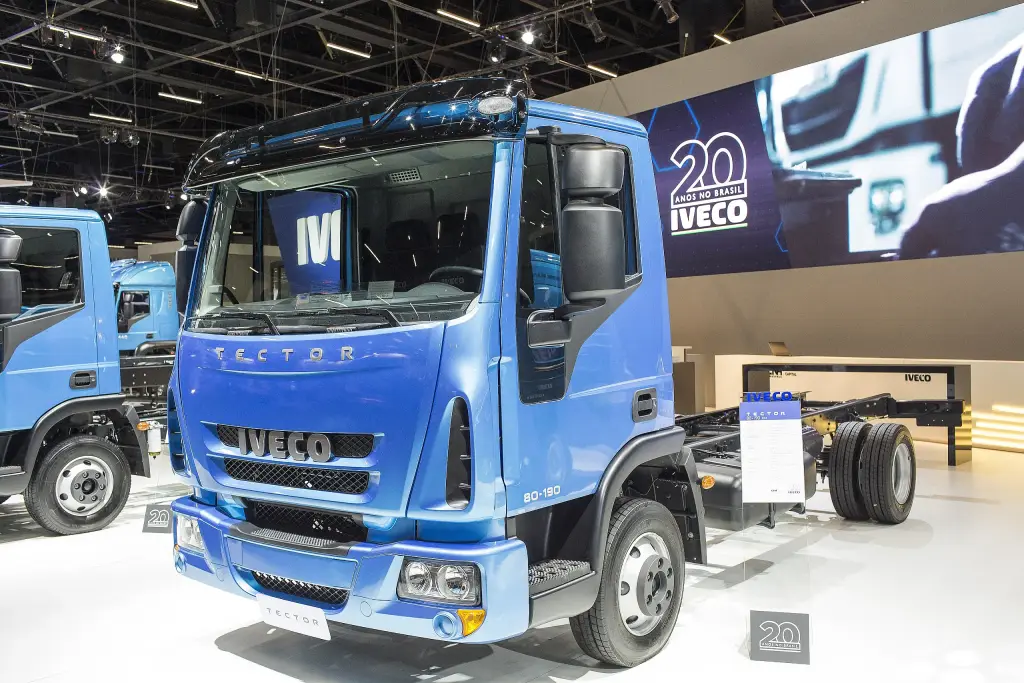
Tector is the name of a generation of Iveco engines and also of a medium lorry that Iveco builds in South America from 2008, in Argentina and Brazil, with complete knock-down assembly in Venezuela. The lorry is the South American counterpart of the European Iveco Eurocargo.
Iveco Tector at a glance
| Type | engine family and medium lorry |
|---|---|
| Engines created | 2000 |
| Engine sizes | 3.9 and 5.9 litres, four or six cylinders in line |
| Engine output | 95 to 220 kW (129 to 299 hp) |
| Engine construction | common rail, four valves per cylinder, wastegate turbocharger |
| Emissions | Euro 3 at first, Euro 4 and Euro 5 with SCR from 2006 |
| Lorry production | since 2008, Argentina and Brazil, CKD in Venezuela |
| Lorry weights | 17 to 26 tonnes |
| Lorry engine | 4.9-litre common-rail six of 250 hp |
| Brazilian models | Vertis of 9 and 13 tonnes, Tector tractor, Cavallino and Cursor tractors |
| 2014 addition | Tector 150E21 Economy, 206 hp, 15 tonnes |
Based on one source: the Italian Wikipedia article.
History of the Iveco Tector
The Tector engine series was created by Iveco in 2000 and later passed to FPT Industrial. It was designed for lorries and gives between 95 and 220 kW, or 129 to 299 hp, and like all Iveco engines it is used not only in medium commercial vehicles such as the Eurocargo but also in other machines. The engines have four or six cylinders in line of 3.9 and 5.9 litres, common-rail injection, four valves per cylinder, a camshaft driving the overhead valves through gears and a wastegate turbocharger. They were born under the Euro 3 rules in 2000 and met Euro 4 and Euro 5 from 2006 with selective catalytic reduction.

The Iveco Tector lorry is a different matter: it is the medium range that Iveco builds in South America, at Iveco Argentina and Iveco Brazil, from 2008, and it was also assembled in complete knock-down form in Venezuela by FIAV. Its name is specific to that market, where the European equivalent is the Eurocargo.
The lorry keeps the robust structure of the European Eurocargo with capacities from 17 to 26 tonnes, and its cab is the same as the Eurocargo of 2008 apart from longer 4×2 and 6×2 versions and a bunk for the 6×4 intended for long journeys. The engines are Tector units already meeting Euro 5 and running on B5 biodiesel, as used in Argentina and Brazil, built by FPT and in the lorry taking the form of a 4.9-litre common-rail six of 250 hp at 1,900 rpm. The models available in South America are the 4×2 Iveco Vertis at the bottom of the range in 9 and 13-tonne form, the Iveco Tector tractor unit, and the Cavallino tractor in Brazil and the Cursor tractor in Argentina.
Whereas European tractor units for articulated lorries often exceed 400 hp, in South America the Tector range runs from 200 to 300 hp. On 18 November 2014 Iveco added the Tector 150E21 Economy of 210 hp, again on the Eurocargo platform, with an FPT NEF 45 engine of 4,500 cc and 206 hp DIN and a gross weight of 15 tonnes, in a 15-tonne lorry and a 27-tonne articulated version.
Design and features
- One name, two things: an engine family and a South American lorry.
- Eurocargo base: the same structure and cab as the European medium lorry.
- Biofuel ready: engines running on B5 biodiesel in Argentina and Brazil.
- SCR emissions: Euro 3 at first, then Euro 4 and Euro 5 from 2006.
Iveco Tector versions
- Tector 3.9 and 5.9: the four- and six-cylinder engines from 129 to 299 hp.
- Iveco Vertis: 4×2 light models of 9 and 13 tonnes.
- Iveco Tector tractor: the articulated lorry version.
- Cavallino and Cursor tractors: Brazilian and Argentine tractor units.
- Tector 150E21 Economy: 206 hp and 15 tonnes, added in 2014.
The Tector engines also power the European EuroCargo and the Trakker. More Iveco lorries are in the Iveco collection.
Sources
- Iveco Tector, Italian Wikipedia: engines, lorry, models, weights