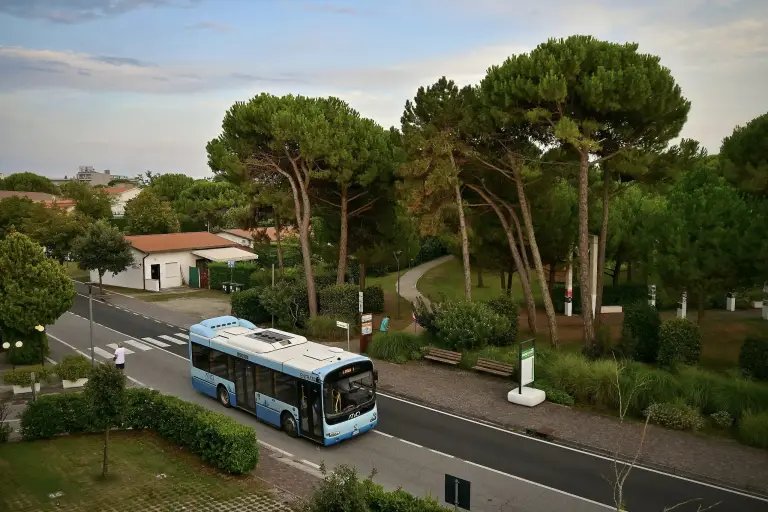
The Iveco 315 was an interurban bus 7.5 metres long, built from 1978 to 2001. It appeared first under the Fiat badge to replace the Fiat 314 on low-traffic country routes and on narrow roads, mountain passes among them, and took the Iveco name in 1983. Its urban twin was the Iveco 316.
Iveco 315 at a glance
| Maker | Fiat, then Iveco from 1983 |
|---|---|
| Production | 1978–2001 |
| Length | 7.5 m, the only length offered |
| Use | interurban lines with low passenger numbers and narrow or mountain roads |
| First series | Fiat 315.8.13, 1978–1981, Fiat 8060.04 six of 5,499 cc, 130 hp |
| Second series | Iveco 315S.8.17 Turbo, 1983–1991, Fiat 8060.24 six of 5,499 cc, 168 hp |
| Third series | Iveco 315S.8.18 Turbo, 1993–2001, Fiat 8060.24 turbo, 180 hp |
| Doors | two, of the outward-opening type |
| Bodybuilders | Iveco, Menarini, Orlandi, Padane, Garbarini, Van Hool, Magirus |
| Urban twin | Iveco 316 |
Based on one source: the Italian Wikipedia article.
History of the Iveco 315
The 315 was presented in 1978 under the Fiat marque to replace the Fiat 314 on interurban work. It was designed for lines with little traffic and for roads too narrow for full-size buses, such as mountain routes. In 1983 the model adopted the Iveco badge alone, and in 1985 the whole Iveco range, buses and lorries alike, received turbocharged engines, after which the buses were sold as the 315S Turbo.
The model was built in three series that differed mainly in their engines: the first was naturally aspirated, the two later ones turbocharged. The number after 315 gave the length and the last figures the power in tens of horsepower. In addition to its own bodywork, the chassis was bodied by Italian coachbuilders Menarini, Orlandi, Padane and Garbarini and by foreign firms Van Hool and Magirus.
Production of the version with the original Iveco bodywork ended in 1991, but the bare chassis for outside coachbuilders was made until 2001. One of the most widespread versions was the 315 Poker, with bodywork by Orlandi that repeated the design already used on the chassis of the Iveco 370. The last series had air conditioning and a stereo system as well.
Design and features
- Compact size: 7.5 metres, short enough for mountain roads and narrow village streets.
- Three engine steps: 130 hp naturally aspirated, then 168 and 180 hp with a turbocharger.
- Chassis for coachbuilders: the bare frame outlived the factory-bodied bus by a decade.
- Shared family: the same mechanicals served the urban Iveco 316.
Iveco 315 versions
- Fiat 315.8.13 (1978–1981): 5,499 cc six-cylinder, 130 hp, no turbocharger.
- Iveco 315S.8.17 Turbo (1983–1991): turbocharged 5,499 cc six, 168 hp.
- Iveco 315S.8.18 Turbo (1993–2001): the final series, 180 hp, chassis only.
- 315 Poker: Orlandi bodywork taken from the design made for the Iveco 370 chassis.
The urban version of the same design was the Iveco 316, and the larger coach of the period was the Iveco 370. More Iveco buses are in the Iveco collection.
Sources
- Iveco 315, Italian Wikipedia: dates, engines, bodybuilders, versions