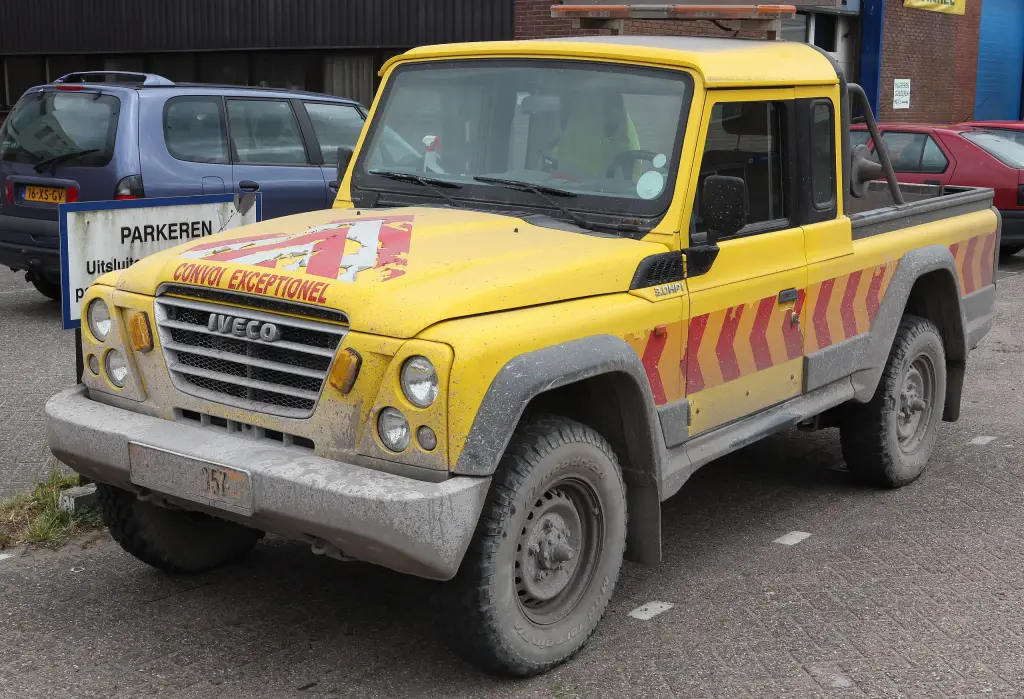
The Iveco Massif is a utility four-wheel-drive vehicle aimed mainly at the utility services and military markets. It was produced by Santana Motor in Linares, Spain, from 2007 to 2011 and was a rebadged and restyled version of the Santana PS-10. It competed with the Land Rover Defender at the utility end of the four-wheel-drive market.
Iveco Massif at a glance
| Maker | Santana Motor, Linares, Spain |
|---|---|
| Production | 2007–2011 |
| Based on | Santana PS-10, itself derived from the Land Rover Series |
| Styling | Giorgetto Giugiaro and the Iveco Style Centre |
| Engines | Iveco 3.0-litre diesel from the Daily, 150 hp HPI or 176 hp HPT |
| Torque | 350 Nm for the HPI, 400 Nm for the HPT with variable-geometry turbo |
| Gearbox | ZF 6S400 six-speed overdrive manual with high and low range |
| Drive | selectable four-wheel drive, rear-wheel drive normally |
| Wheelbases | 2,768 mm long and 2,452 mm short |
| Bodies | hardtop, station wagon, pickup and chassis cab |
| Construction | body on a ladder chassis |
| Built | 6,692 in 2007, 1,197 in 2009 and 769 in 2010 |
History of the Iveco Massif
The Massif grew out of the joint venture between Iveco and Santana. Iveco announced in Madrid in May 2006 that it was taking over the PS-10 product, which had already used Iveco engines and drivetrains, and the Massif was built alongside the Santana PS-10. The PS-10, like the Land Rover Defender, was a descendant of the Land Rover Series that Santana had once built under licence.
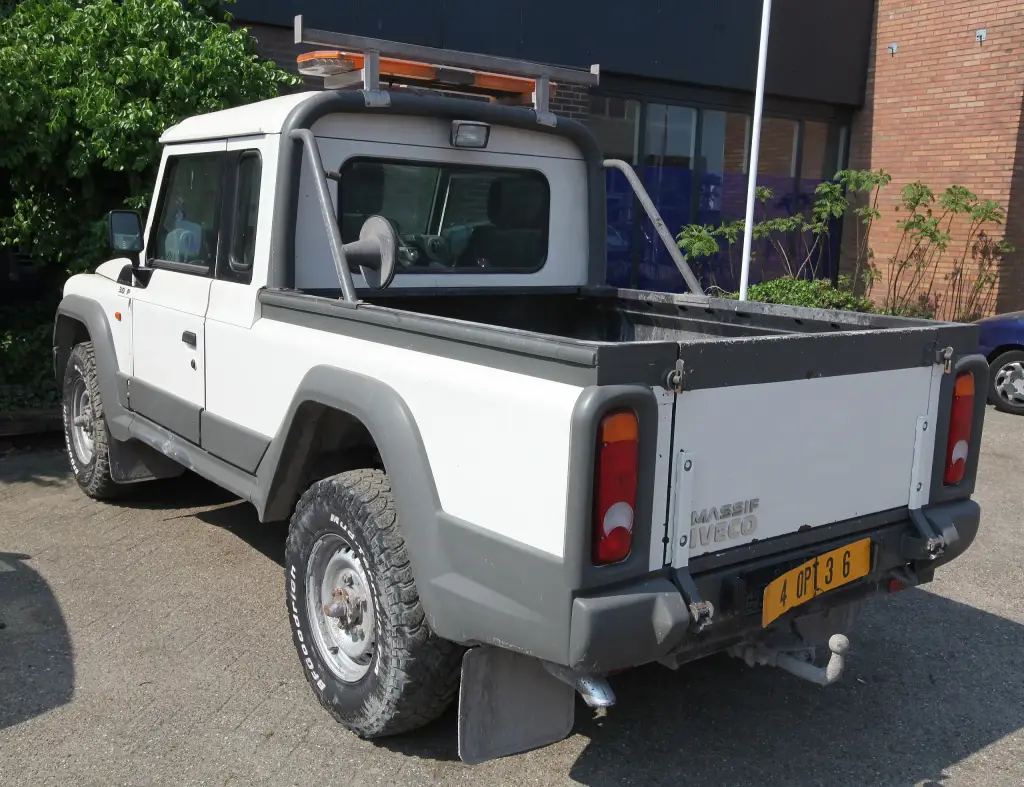
The vehicle was styled by Giorgetto Giugiaro and the Iveco Style Centre and kept a clear family resemblance to the PS-10 and, beyond its modernised front, to the Defender. Two versions of the 3.0-litre Iveco diesel from the Daily were offered: a 150 hp HPI unit with 350 Nm and a 176 hp HPT with 400 Nm, the extra power coming from a variable-geometry turbocharger. Both met the Euro IV emission standard and were paired with a six-speed ZF 6S400 overdrive gearbox with high and low ratios; no automatic was offered.
Four-wheel drive could be selected rather than being permanent, which kept the Massif in rear-wheel drive in normal use and, according to Iveco, saved up to 10 per cent in fuel; the front axles had manual-locking free-wheeling hubs, and a limited-slip rear differential was optional. The brakes were discs all round, ventilated at the front and solid at the rear, with the handbrake acting on the transmission, and the suspension used parabolic springs, double-bladed at the front and four-bladed at the rear, with anti-roll bars at both ends. The body sat on a ladder chassis rather than a monocoque, and the rear door was designed with a full metre-wide opening so that a standard Euro pallet could be carried, while power take-offs and body connections were available for commercial users.
The Massif came in long and short wheelbases with hardtop, station wagon, pickup and chassis cab bodies, and the long station wagon seated up to seven. Launch cars were promoted with the All Blacks, the New Zealand rugby team that Iveco sponsored, and shown in black with tribal graphics. Sales were poor, and in 2010 Iveco ended the agreement with Santana because Fiat could supply the European market with imported Jeeps such as the Wrangler. In 2011 the owner of Santana, the government of Andalusia, closed the company and its factory, and 1,341 people were laid off or retired early.
Design and features
- Defender rival: a utility 4×4 in the mould of the Land Rover.
- Iveco diesel: a 3.0-litre unit of 150 or 176 hp from the Daily.
- Choice of drive: selectable four-wheel drive and free-wheeling hubs to save fuel.
- Practical body: a one-metre rear door that takes a Euro pallet.
Iveco Massif versions
- HPI: 150 hp and 350 Nm.
- HPT: 176 hp and 400 Nm with a variable-geometry turbocharger.
- Long wheelbase: 2,768 mm, up to seven seats in the station wagon.
- Short wheelbase: 2,452 mm.
- Bodies: hardtop, station wagon, pickup and chassis cab.
The Massif was the car-like member of the Iveco off-road range, next to the LMV and the Daily 4×4. More Iveco vehicles are in the Iveco collection.
Sources
- Iveco Massif, English Wikipedia: origin, engines, chassis, models, end of production