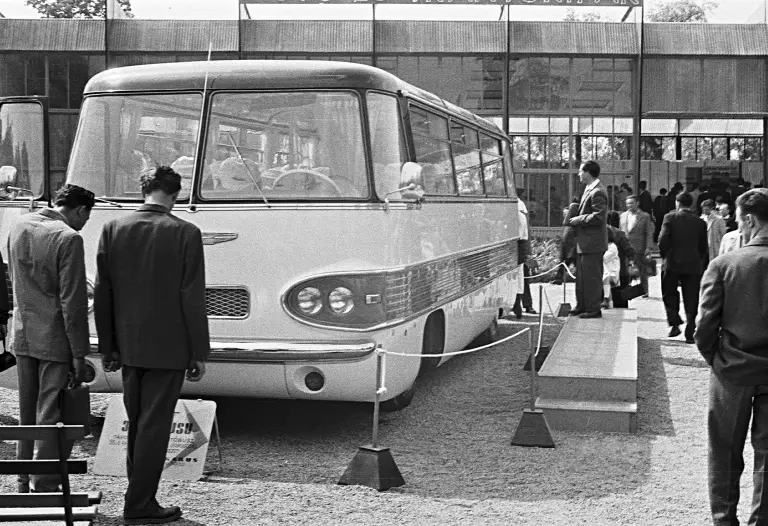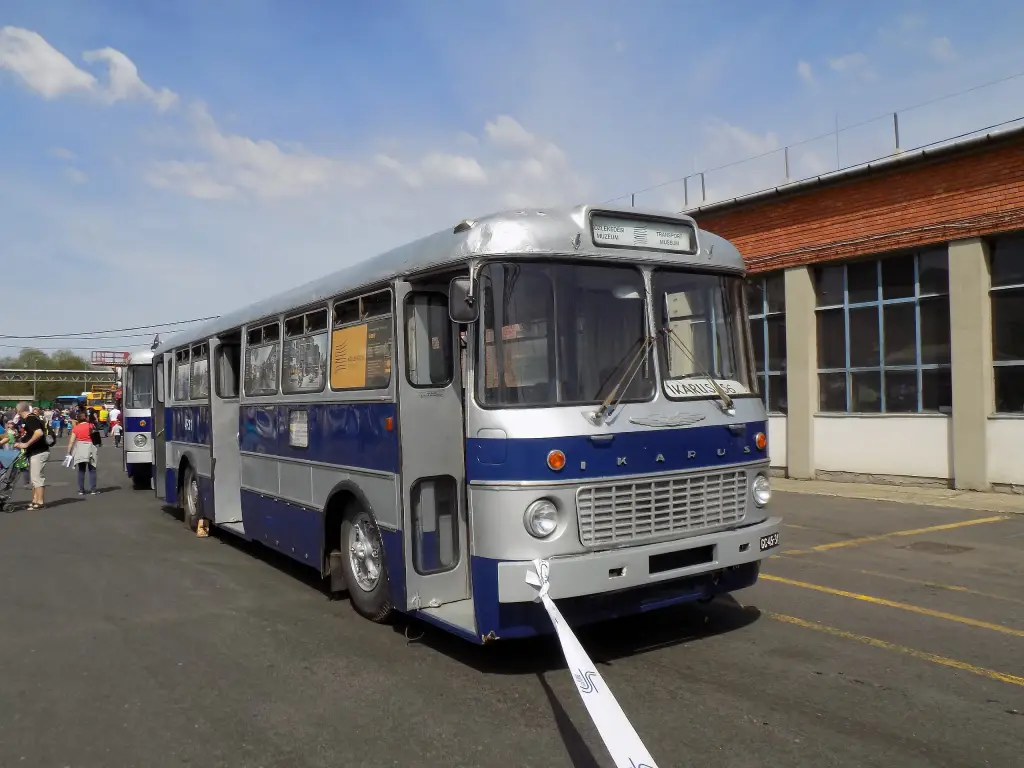
The Ikarus 556 was the first city bus the factory built with a self-supporting body. Made from 1965 to 1973, it also became the base of the long-distance Ikarus 557 and the articulated Ikarus 180, and the three were the first Ikarus buses designed to look like one family.
Ikarus 556 at a glance
| Maker | Ikarus, Budapest-Mátyásföld |
|---|---|
| Type | city bus |
| Production | 1965–1973 |
| Body | self-supporting, engine under the floor between the axles |
| Pre-series | five buses with Csepel engines, 1963–1964 |
| In Budapest | 275 buses from 1964 to 1972 |
| Engines | Csepel, later Rába-MAN D2156; JáFI P1-619 in the 556.70 |
| Doors | 1-2-2, of 800, 1,100 and 1,600 mm |
| Relations | Ikarus 557 long-distance, Ikarus 180 articulated |
Based on one source: the Hungarian Wikipedia article on the Ikarus 556.
History of the Ikarus 556
The 556 was the first Ikarus bus with a self-supporting body and the first city bus of the family that also gave the long-distance 557 and the articulated 180. The three were designed with a common look, an idea that later became one of the guiding principles of the 200 family. The five-bus pre-series with Csepel engines, GA-81-01 to GA-81-05, was finished in 1963 and entered service in 1964 on route 4. The early troubles that plagued the first buses — burst air springs and a rear door that tore out or hung open — meant that later batches were bought in smaller numbers.
The Rába-MAN D2156 engine was the big improvement: quieter and more powerful than the earlier Csepel. Between 1964 and 1972, 275 buses entered service in Budapest with the FAÜ and then the BKV. The 556 had an unusual subtype too, the 556.70, which used the JáFI P1-619.00 direct-injection diesel.
The type’s novelty was the engine under the floor between the two axles, which cut the noise level in the passenger compartment considerably. The interior was wider than in earlier types, but the driver’s cab, entered from the passenger compartment, was smaller. A middle door was used as well, giving a 1-2-2 door arrangement, though the door sizes did not quite match their task: the front door was 800 mm wide, the middle one 1,100 mm and the rear one 1,600 mm, so the first was wide for one passenger, the middle narrow for two and the rear wide for two but narrow for three. Large windows gave good light and a more comfortable journey, and three glass specifications were offered: sliding side windows for tropical cities, horizontally divided windows with the lower two-thirds sliding and the upper third fixed for temperate cities, and horizontally divided windows with the lower two-thirds fixed and the upper third tilting inwards for colder cities. One curiosity of the type was a double-decker: in 1968 the BKV handed GA-81-16 and GA-81-17 to the 20th AKÖV, which used the upper part of one bus and the lower part of the other to build a single double-decker that kept the second registration; it served in Pécs until June 1976, and after Volánbusz acquired it in 2020 its restoration was finished in May 2022.
Design and features
- Self-supporting body: the first Ikarus city bus built this way.
- Underfloor engine between the axles: much quieter than the front-engined buses it replaced.
- Three climate specifications: sliding, divided and tilting windows for tropical, temperate and cold countries.
- Family design: shared with the Ikarus 557 and 180, a principle later central to the 200 series.
Ikarus 556 versions
- Pre-series (1963–1964): five buses with Csepel engines.
- Series with Rába-MAN D2156: quieter and more powerful than the early buses.
- 556.70: the subtype with the JáFI P1-619.00 direct-injection diesel.
- Ikarus 557: the long-distance version.
- Ikarus 180: the articulated version.
- Double-decker: a single bus built in 1968 from two Ikarus 556s.
The 556 was the city member of the family whose long-distance version was the Ikarus 557 and whose articulated version was the Ikarus 180. More buses are in the Ikarus collection.
Sources
- Ikarus 556, Hungarian Wikipedia: history, production, doors, windows, double-decker