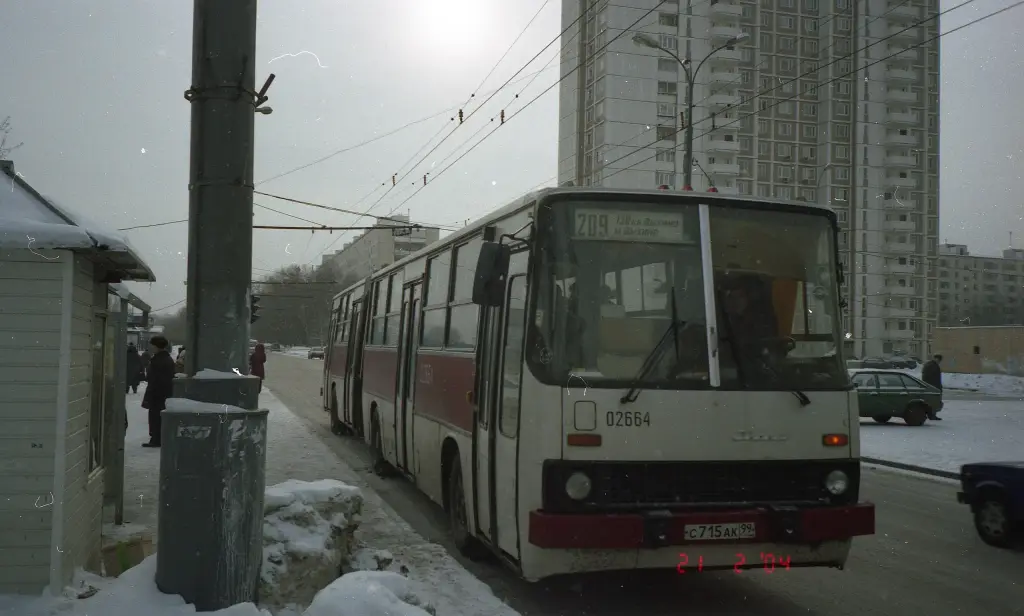
The Ikarus 283 was the 18-metre version of the articulated 280 and the longest bus of the family. Its layout followed the 280, but the third axle was not force-steered, so it needed more room to turn — a compromise that still found 1,003 buyers, above all in Russia.
Ikarus 283 at a glance
| Maker | Ikarus, Budapest-Mátyásföld and Székesfehérvár |
|---|---|
| Type | articulated city and suburban bus |
| Length | 18 m |
| Built | 1,003 |
| Layout | engine between the A and B axles, B axle driven |
| Steering | C axle not force-steered, so a larger turning circle than the Ikarus 280 |
| Rear axle | twin wheels for the higher axle load |
| Solo version | Ikarus 263 |
| Right-hand-drive version | Ikarus 285 |
| Main customers | Russia, Bratislava, Tallinn |
Based on one source: the Hungarian Wikipedia article on the Ikarus 283.
History of the Ikarus 283
The 283 grew out of the 280 by adding length: the body reached 18 metres, but the mechanical layout stayed the same, with the engine between the A and B axles and the B axle driven. The difference that mattered in service was the C axle, which unlike the 280 was not force-steered, so the turning circle was larger. Twin wheels at the rear carried the higher axle load. On most buses the second door sat further forward than usual because the larger MAN engine needed the space. The solo version of the design was the Ikarus 263, and the right-hand-drive version the Ikarus 285.
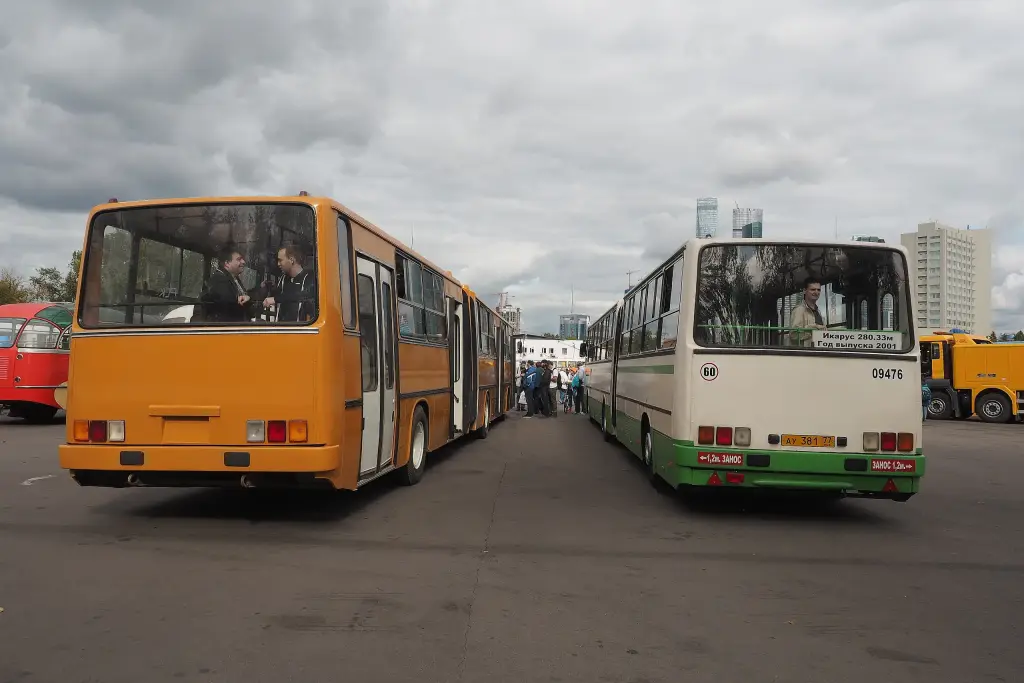
Russia bought most of the type: the 283.00 went to Moscow and the 283.10 to Yekaterinburg, with a few buses reaching other cities. Moscow bus 17248 has been restored and is kept as a heritage vehicle, and in 1991 five 283s in Moscow were converted into trolleybuses. Tallinn had fourteen 283.00 buses, bought in 1991 and 1995 and all scrapped by 2003. Bratislava received 21 buses of the 283.01 type with planetary doors in 1991; after an accident in 1995 and a fire in 1997, twelve were overhauled around the turn of the millennium and all were withdrawn by 2008, replaced by Mercedes and SOR buses. Bus 1512 was set aside and joined the heritage fleet, and the Bratislava operator recalled that both passengers and drivers liked the type for its reliability and capacity.
In Hungary only four 283s ever ran. At Székesfehérvár the Alba Volán had two 283.10 buses, one scrapped in 2011 and the other still with the successor company KNYKK and in service in February 2018. In Salgótarján a K2 prototype ran in Nógrád Volán colours from 1995 to 2010, and a second K2 prototype belonged to Trans-Tour in Nyíregyháza until it was scrapped in 2008. The last Hungarian 283 ran in Tatabánya. Tunisia ordered the type in 1997, but high customs meant that Ikarus supplied only frames and parts, which the local STIA works assembled as the Ikarus-STIA 283: 435 buses by 2004, fifty with DAF engines and the rest with Rába D10 engines. In 2001 the factory also tried a modernised version, the C83, but only five were built.
Design and features
- Eighteen metres: the longest body in the 280 family, with the same puller layout.
- Simpler rear steering: the C axle was not force-steered, which made the turning circle larger than the 280’s.
- Second door moved forward: on most buses, to make room for the larger MAN engine.
- Long service life: Bratislava kept its buses until 2008 and overhauled twelve of them.
- Local assembly abroad: in Tunisia the type was built from Ikarus frames and parts as the Ikarus-STIA 283.
Ikarus 283 versions
- 283.00: the standard version, used in Moscow and Tallinn.
- 283.01: the version with planetary doors delivered to Bratislava in 1991.
- 283.10: the version used in Yekaterinburg and by Alba Volán.
- Ikarus 263: the solo version of the same design.
- Ikarus 285: the right-hand-drive version.
- Ikarus C83: the 2001 facelift, of which five were built.
The 283 was the long version of the Ikarus 280 and shared its body with the facelifted Ikarus C83. More buses are in the Ikarus collection.
Video: Ikarus 283 in Bratislava – #1512
Video by klasIK280 on YouTube.
Sources
- Ikarus 283, Hungarian Wikipedia: construction, production total, operators, Tunisia