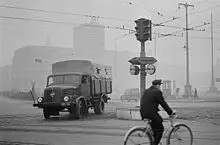
The IFA H3A was a light lorry built at the VEB Horch works in Zwickau from 1950 to 1958. A 3.5-tonne vehicle with the long-bonnet cab that also appeared on the larger H6, it was the first lorry designed in East Germany.
IFA H3A at a glance
| Maker | VEB HORCH Kraftfahrzeug- und Motorenwerke, Zwickau |
|---|---|
| Production | 1950–1958 |
| Payload | 3.5 tonnes |
| Position in the range | above the Phänomen Granit 27, below the IFA H6 |
| Cab | long bonnet, with the driver behind the engine |
| Engine | EM 4 swirl-chamber diesel, four cylinders |
| Development | from March 1948 at Zwickau |
| First production | 1950, early vehicles still badged Horch |
| Predecessor | IFA H3 |
based on one source (German Wikipedia).
History of the IFA H3A
The Soviet occupation zone had no manufacturer of diesel engines left, which made a modern lorry difficult. In 1947 the former chief designer of Vomag was recruited for engine development at Horch in Zwickau. He knew that Vomag had drawn up a family of swirl-chamber diesels with four and six cylinders, the Einheitsmotoren or EM series, before the end of the war, and on that basis the EM 4 and EM 6 were developed; the four-cylinder EM 4 entered series production at the Horch works in 1950.
Work on the lorry itself began at Zwickau in March 1948. Series production started in 1950 and the first vehicles still carried the Horch emblem. The H3A was the first lorry developed in the GDR, and its main distinction from the earlier H3 was the long-bonnet cab, similar in form to that of the larger IFA H6, together with the change to the new diesel engine.
The H3A was a three-and-a-half-tonner that sat between the Phänomen Granit 27 and the IFA H6 in the East German lorry programme. It remained in production until 1958, by which time the range had been reorganised around the Werdau-built H6 and the smaller S 4000.
Design and features
- EM 4 diesel: a four-cylinder swirl-chamber engine developed from pre-war Vomag drawings, in series from 1950.
- Long-bonnet cab: the visual mark of the H3A, shared in form with the larger IFA H6.
- First of its kind: the first lorry designed in East Germany rather than derived from wartime projects.
- Horch badge: the earliest production vehicles were still sold as Horch lorries.
IFA H3A versions
- H3A lorry (1950–1958): the standard 3.5-tonne version.
- H3 (1947–1949): the predecessor with a short bonnet and a petrol engine.
- Fire-engine bodies: the chassis was used for fire appliances as well as general haulage.
The H3A followed the H3 and shared its cab style with the larger IFA H6. More lorries are in the IFA collection.
Video: Feuerwehr IFA H3A LF 15
Video on YouTube.
Sources
- IFA H3A, German Wikipedia: production, engine development, cab