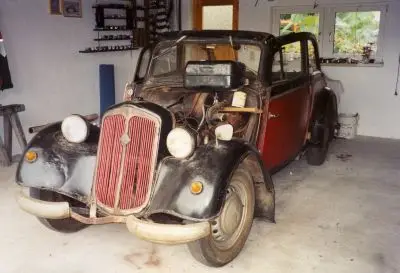
The IFA F8 was the East German continuation of the pre-war DKW F8. It appeared at the Leipzig Fair of 1947 as the DKW-IFA F8 and was built at Zwickau from 1949, with a 690 cc two-stroke engine driving the front wheels.
IFA F8 at a glance
| Maker | VEB Automobilwerke Zwickau (AWZ) |
|---|---|
| Production | 1949 to about 1955 |
| Predecessor | DKW F8, built 1939–1942 |
| Engine | two-cylinder two-stroke, 690 cc (692 cc in the DKW) |
| Power | 20 PS (14.7 kW) |
| Top speed | 85 km/h (53 mph) |
| Drive | front wheels |
| Gearbox | three-speed manual with lockable freewheel |
| Bodies | saloon, cabriolet, estate, panel van |
| Body build | steel and fabric-covered timber, duroplast panels after 1953 |
| Built | about 26,267 by 1955 |
The English article covers the DKW F8 as a whole; this page uses its sections on the post-war IFA F8 together with the short German article on the IFA F 8.
History of the IFA F8
The DKW F8 had been introduced in 1939 as a compact front-wheel-drive saloon with a two-stroke engine, slightly shorter than the F7 it replaced despite a marginally longer wheelbase. The basic Reichsklasse was built only until 1940 and the Meisterklasse saloon until 1942, alongside cabriolet versions; by the time passenger-car production at Zwickau ended, about 50,000 F8s had been made. The letter F stood for Front, and the publicity of 1939 simply called the car the DKW Front.
After the war the car reappeared. It was shown at the Leipzig Fair in 1947 as the DKW-IFA F8, and production of the eastern car, without DKW badges, restarted in or before 1949 at the Zwickau factory, now expropriated as the VEB Automobilwerke Zwickau. The larger 692 cc engine of the pre-war Meisterklasse was used, calculated by IFA as 690 cc, and the claimed top speed was unchanged at 85 km/h.
The F8 was sold in more body styles than before the war: saloon and cabriolet were joined by an estate and light commercial variants on the box-frame chassis. The outer skin combined steel panels with a fabric-covered timber frame in the central section; after 1953 key panels were made from duroplast, reducing weight and anticipating the techniques used for the Trabant. Under an inter-zone trade agreement of 1950/51 about 1,000 cars were exported to West Germany. In 1953 a Luxus-Cabriolet with streamlined bodywork by VEB Karosseriewerk Dresden (Gläser) was added, intended mainly for western export.
By 1955 about 26,267 IFA F8s had been built. After the IFA brand was phased out the last cars were badged as Wartburgs: a handful of Luxus-Cabriolets were completed in 1956 and 1957, and replacement bodies for F8 Kombis were still being made in 1964. The two-cylinder 700 cc two-stroke engine lived on in the Trabant.
Design and features
- Front-wheel drive: inherited from the DKW layout, with a three-speed gearbox and a lockable freewheel on all ratios.
- Two-stroke engine: the 690 cc two-cylinder unit started by a Dynastart combined starter and generator.
- Box-frame chassis: made it easy to fit the estate, panel van and light truck bodies of the IFA period.
- Duroplast panels: used for key body parts after 1953, a forerunner of Trabant construction.
- Luxus-Cabriolet: a streamlined export special by Karosseriewerk Dresden from 1953.
IFA F8 versions
- Saloon: the standard four-door body.
- Cabriolet: open version offered before and after the war.
- Estate (Kombi): added in the IFA period; replacement bodies were still built in 1964.
- Panel van and light truck: commercial bodies on the same chassis.
- Luxus-Cabriolet (1953): streamlined body by VEB Karosseriewerk Dresden for export.
The F8 was followed by the more modern IFA F9, and its engine line ended in the Wartburg. More vehicles are in the IFA collection.
Video: Eine Ausfahrt mit dem IFA F8
Video on YouTube.
Sources
- DKW F8, English Wikipedia: production history, engines, bodies
- IFA F 8, German Wikipedia: East German production