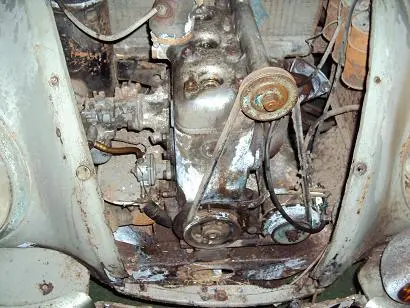
The IFA F9 was the first modern saloon of East Germany, developed from the DKW F9 prototype and built at Zwickau from 1949 or 1950. In 1953 production moved to Eisenach, where it continued as the EMW 309 until 1956, and its underpinnings later went into the Wartburg 311.
IFA F9 at a glance
| Maker | VEB Automobilwerke Zwickau, later EMW Eisenach |
|---|---|
| Production | 1949/50–1956 |
| Later name | EMW 309, from 1953 |
| Body | compact saloon; sports and cabriolet versions also built |
| Engine | three-cylinder two-stroke, 910 cc, water-cooled |
| Power | 28 bhp (21 kW) at launch |
| Cooling | radiator mounted behind the engine |
| Drive | front wheels, four-speed gearbox with freewheel |
| Successor | Wartburg 311, which used the F9 underpinnings |
based on one source (English Wikipedia). Sources differ on whether production began in 1949 or 1950.
History of the IFA F9
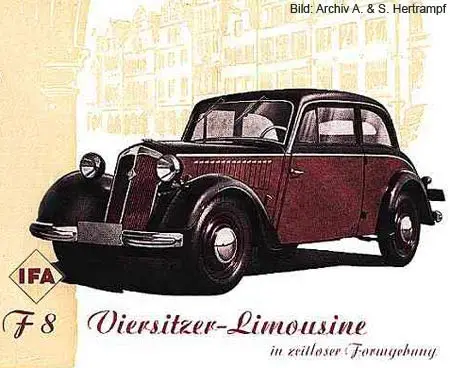
Mechanically the F9 came from the DKW F8, which had been built between 1939 and 1942, but its body closely followed the DKW F9 prototype that Auto Union would have put on the Zwickau lines had the war not intervened. After 1945 the first car assembled at Zwickau was the pre-war DKW F8; the modern F9 appeared in 1949 or 1950, with sources differing on the exact date.
Material shortages delayed the car in both German states, but the eastern version reached the market first. It used the three-cylinder engine of the 1938 F9 prototype rather than the two-cylinder unit that had been in series production in 1942, and East Germany had it on the road at least three years before Auto Union in Düsseldorf fitted the same engine to its F91. The western group, by contrast, had access to the original F9 body tooling, which had been ordered before the war and stayed at the supplier Allgaier in Uhingen rather than being delivered or scrapped.
The F9 was a compact saloon, and surviving cars are largely restricted to that body, although sports and cabriolet versions were also produced. Steel for consumer goods was in short supply across much of Europe, so the body increasingly used plastic panels, especially after production moved to Eisenach in 1953; the car was usefully lighter than the western-built Auto Union equivalent.
From 1953 the car was built at the former BMW plant in Eisenach as the EMW 309 and remained in production there until 1956. Its mechanical layout then passed to the Wartburg 311.
Design and features
- Three-cylinder two-stroke: 910 cc and 28 bhp at launch, with the radiator placed behind the engine.
- Modern body: the steel-bodied DKW F9 shape, developed before the war but never built in series at Zwickau.
- Light construction: plastic body panels were used increasingly after 1953, making the F9 lighter than the western Auto Union car.
- Long life: the layout continued in the Wartburg 311 after 1956.
IFA F9 versions
- IFA F9 saloon: the standard four-door car built at Zwickau.
- Sports and cabriolet versions: produced in small numbers alongside the saloon.
- EMW 309 (1953–1956): the same car built at Eisenach after the move.
The F9 replaced the IFA F8 and led to the Wartburg 311. More cars are in the IFA collection.
Video: IFA F9
Video on YouTube.
Sources
- IFA F9, English Wikipedia: development, engine, bodies, production move