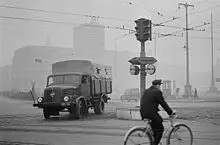
The H3 — Horch, three tonnes — was the lorry with which the Zwickau Horch works restarted after the Second World War. Built from 1947 to 1949, it was assembled largely from parts made for the Sd.Kfz. 11, and production ended when those parts ran out after 852 vehicles.
IFA H3 at a glance
| Maker | VEB HORCH Kraftfahrzeug- und Motorenwerke, Zwickau |
|---|---|
| Production | 1947–1949 |
| Payload | 3 tonnes |
| Based on | AU 1500 design of 1941, never built in series |
| Cab | short bonnet, half front control |
| Engine | Maybach HL 42, six-cylinder petrol |
| Capacity | 4,198 cm³ (90 × 110 mm) |
| Power | 74 kW (100 PS) at 3000 rpm |
| Electrical | 12 V, 130 W generator |
| Drive | two axles, rear-wheel drive |
| Built | 852 |
based on one source (German Wikipedia).
History of the IFA H3
The H3 was largely based on the drawings of the AU 1500, a 1.5-tonne lorry developed in 1941 at the Siegmar works (formerly Wanderer) of Auto Union but never put into production. Reusing that design was the quickest route to a lorry for the Soviet-occupied zone, and the Zwickau Horch works, now the VEB HORCH Kraftfahrzeug- und Motorenwerke, built it from 1947 to 1949.
The vehicles were made mainly from parts left over from wartime production of the Sd.Kfz. 11 half-track, which determined both how quickly the H3 could be assembled and when it had to stop. When the essential components were used up, production ended; in total 852 lorries were built.
The H3 was a two-axle lorry with rear-wheel drive in short-bonnet, half front-control form, with the engine ahead of the cab and a short nose. Its replacement, the H3A presented in 1951, was the first lorry designed independently in East Germany and could be recognised at once by its long-bonnet cab.
Design and features
- Wartime parts: built mainly from components of the Sd.Kfz. 11, which is why only 852 could be completed.
- Maybach HL 42 engine: a 4,198 cm³ six-cylinder petrol unit giving 100 PS.
- Short bonnet: a half front-control layout with the cab set well forward.
- Stopgap design: based on the unbuilt 1941 AU 1500, it served until the purpose-designed H3A arrived.
IFA H3 versions
- H3 lorry (1947–1949): the only production version, on the AU 1500 design.
- H3A (from 1950): the successor with a long-bonnet cab and a diesel engine.
The H3 was replaced by the H3A, and the larger Werdau lorry of the period was the IFA H6. More lorries are in the IFA collection.
Sources
- IFA H3, German Wikipedia: production, origins, engine data