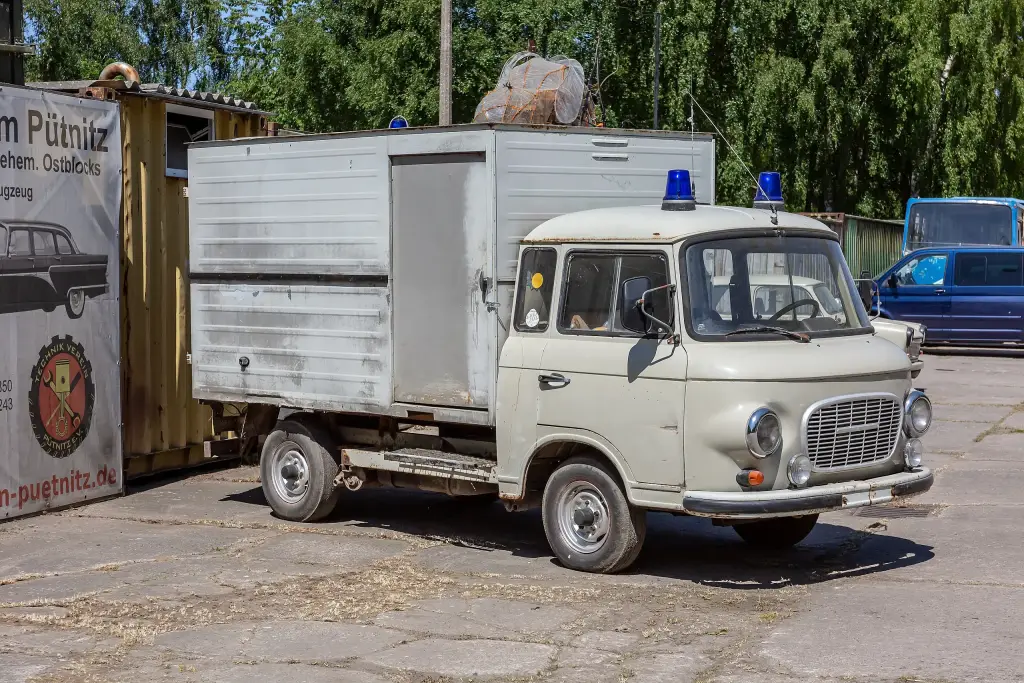
The Barkas B 1000 was the small van of the German Democratic Republic, built in Karl-Marx-Stadt between 1961 and 1991. It sat in the DDR range above the Multicar and below the Robur LO, and its front-mounted engine allowed a loading floor far lower than that of conventional vans.
Barkas B 1000 at a glance
| Maker | VEB Barkas-Werke Karl-Marx-Stadt |
|---|---|
| Production | 1961–1991 |
| Class | one-tonne light van |
| Position in the DDR range | above the Multicar, below the Robur LO |
| Layout | front-mounted engine, front-wheel drive |
| Engine | two-stroke petrol |
| Loading floor | extremely low, the reason for the front engine |
| From 1990 | B 1000-1 with a four-stroke engine under VW licence |
| Name | Barkas, the Punic word for ‘lightning’ |
based on one source (German Wikipedia).
History of the Barkas B 1000
Work on a completely new light van, known internally as the L1, began in 1954. A study by the VEB IFA Forschungs- und Entwicklungswerk Chemnitz had concluded in 1951 that the basic layout of the vans then in production was completely out of date. The new design had one non-negotiable requirement: a loading floor extremely low by the standards of conventionally laid-out transporters.
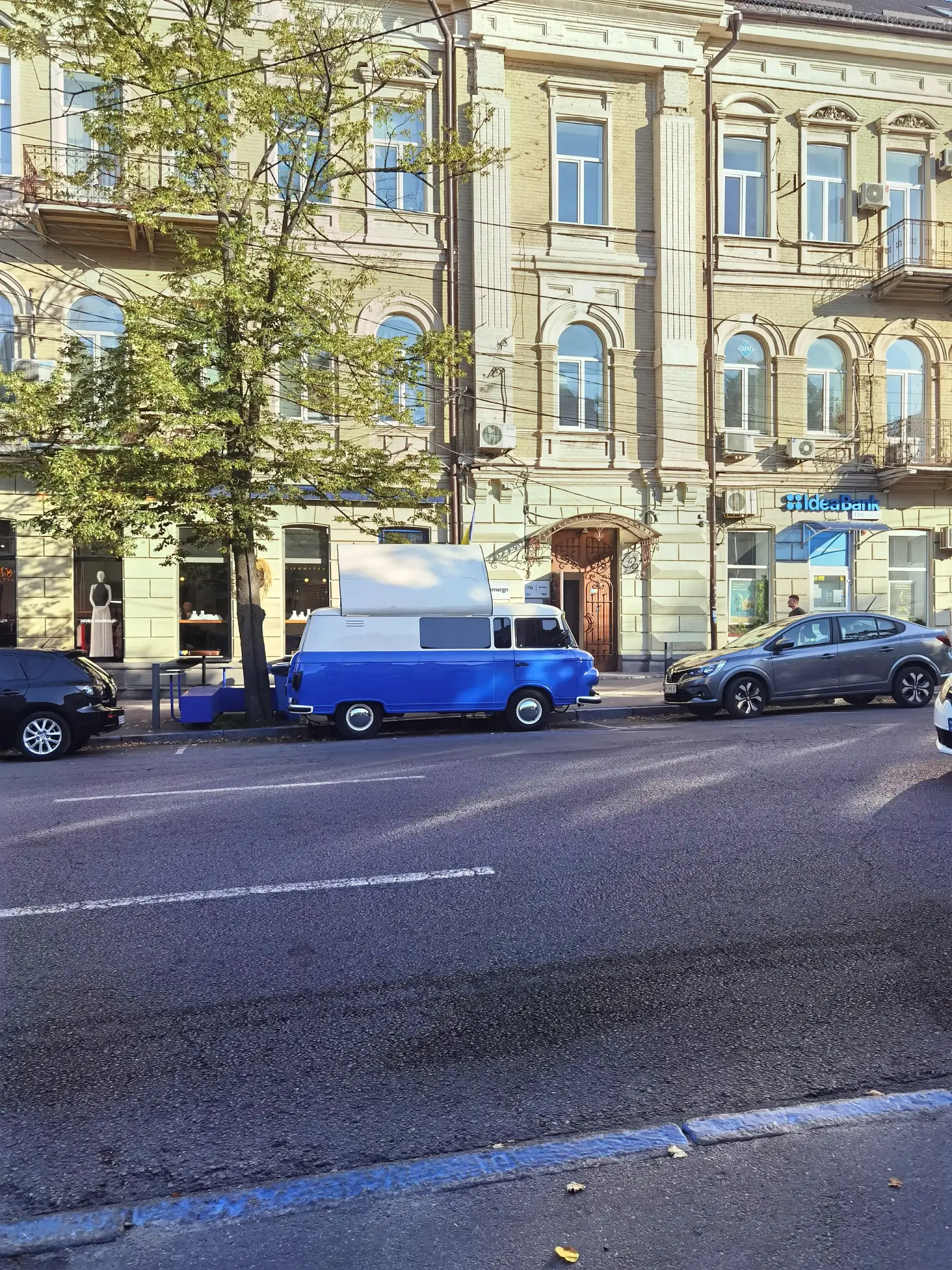
Such a low floor could only be achieved by putting the engine in the front of the vehicle, contrary to previous practice. Sceptics doubted that a front-wheel-drive vehicle could climb steep gradients when fully loaded; the chief designer, Schmieder, answered them with a loaded front-wheel-drive Framo that climbed a 20 per cent slope, and the layout was approved.
The result, the Barkas B 1000, entered production in 1961 and stayed in the catalogue for three decades. Its two-stroke engine and simple body were typical of DDR vehicle building, and the van became a familiar sight as an ambulance, a post van, a police vehicle and a delivery van. In 1990, as the country opened to western technology, the model was revised as the B 1000-1 with a four-stroke engine built under Volkswagen licence. Production ended in 1991.
The name comes from Punic: Barkas, familiar as the name of Hannibal’s father, means ‘lightning’.
Design and features
- Front-mounted engine: the key to the very low loading floor that the 1951 study demanded.
- Front-wheel drive: proven on a loaded Framo prototype on a 20 per cent gradient before production was approved.
- One-tonne payload: the middle of the DDR range, between the small Multicar and the Robur LO.
- Three decades of production: from 1961 to 1991, with a four-stroke B 1000-1 at the very end.
Barkas B 1000 versions
- B 1000 (1961–1990): the standard two-stroke van.
- B 1000-1 (1990–1991): four-stroke engine under VW licence.
- Body styles: the B 1000 chassis was used for vans, minibuses and specialised bodies.
The B 1000 grew out of the Framo light-van tradition, and it sat between the Multicar and the Robur LO in the DDR range. More vehicles are in the IFA collection.
Video: DDR IFA Barkas B 1000
Video on YouTube.
Sources
- Barkas B 1000, German Wikipedia: production years, layout, development history, name