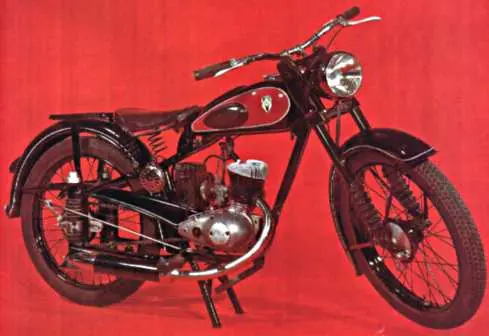
The IFA RT 125 was the East German continuation of the pre-war DKW RT 125. Built at Zschopau from 1950 and sold later as the MZ 125, it became one of the most influential light motorcycles ever made: 324,561 were produced, and its design was copied in at least six countries.
IFA RT 125 at a glance
| Maker | IFA-Motorradwerk Zschopau, from 1953 VEB Motorradwerk Zschopau |
|---|---|
| Series | IFA-DKW / IFA / MZ (RT) 125 |
| Production | 1950–1965 |
| Built | 324,561 motorcycles |
| Origin | copy of the DKW RT 125 built at Zschopau 1940–1944 |
| Type designation | changed several times, finally MZ 125 |
| Nickname | ‘IFchen’ |
| RT stands for | Reichstyp |
| Famous copies | M1A Moskwa, BSA Bantam, Harley-Davidson Hummer, Yamaha YA-1 |
History of the IFA RT 125
The motorcycle was a copy of the DKW RT 125 that Auto Union had built at the same Zschopau works between 1940 and 1944. The design had become free: Auto Union was struck from the commercial register in August 1948, and the construction was no longer protected. The eastern plant went on making the machine, first under the IFA-DKW name, then as an IFA and finally as an MZ.
The works themselves had been reorganised by the Soviet military administration. On 1 July 1946 the Zschopau factory was renamed IFA-Motorradwerk Zschopau, IFA standing for the Industrieverband Fahrzeugbau founded the same day; on 21 October 1953 it became the VEB Motorradwerk Zschopau. The type designation changed several times during the long production run, ending as the MZ 125. In everyday speech the machine was known as the ‘IFchen’.
The RT 125 of the 1930s was technically important. DKW had pioneered the Schnürle two-stroke loop scavenging process, which dispensed with the deflector piston, and developed an efficient arrangement of transfer ports. Both features were used in the RT 125 to great commercial advantage, and competitors such as Adler and TWN copied the flat-topped piston and tried to develop equally efficient porting without infringing the patent.
The design travelled far. After the war the Soviet Union took plans, tooling and even several dozen personnel to Moscow and to Kovrov, where the RT 125 was copied as the M1A Moskwa and the K-125. WFM in Poland built modified versions as the SHL 125 and Sokół 125, developed into a 125/175 cc family made until 1985. The plans also reached Britain, where they became the basis of the BSA Bantam, and the United States, where they formed the basis of the Harley-Davidson Hummer. In Japan, Nippon Gakki reverse-engineered the RT 125 as its first motorcycle, the Yamaha YA-1 of 1955 to 1958, nicknamed the Red Dragonfly.
Meanwhile DKW had reorganised in Ingolstadt and began building its own RT 125 W in 1949, so the same design was produced on both sides of the inner German border. The East German series ran from 1950 to 1965 and accounted for 324,561 motorcycles.
Design and features
- Schnürle loop scavenging: the two-stroke principle that made the RT 125 efficient and copied worldwide.
- Long production: fifteen years at Zschopau, from 1950 to 1965, under three brand names.
- Free design: unprotected after Auto Union left the commercial register in 1948, which allowed production to continue.
- Global influence: the basis of the BSA Bantam, the Harley Hummer, the Yamaha YA-1 and Soviet copies.
IFA RT 125 versions
- IFA-DKW RT 125: the earliest post-war version from Zschopau.
- IFA RT 125: the same machine under the IFA name.
- MZ 125: the final designation of the series before production ended in 1965.
- Foreign copies: M1A Moskwa and K-125 in the USSR, SHL 125 and Sokół 125 in Poland, BSA Bantam, Harley-Davidson Hummer and Yamaha YA-1.
The RT 125 engine also powered East German scooters, and the Zschopau works later built the MZ range. More motorcycles and vehicles are in the IFA collection.
Video: Motorrad Reichstyp IFA (RT) 125/0 brought back to life
Video on YouTube.
Sources
- MZ 125, German Wikipedia: production figures, factory history, designations
- DKW RT 125, English Wikipedia: technical background, copies abroad