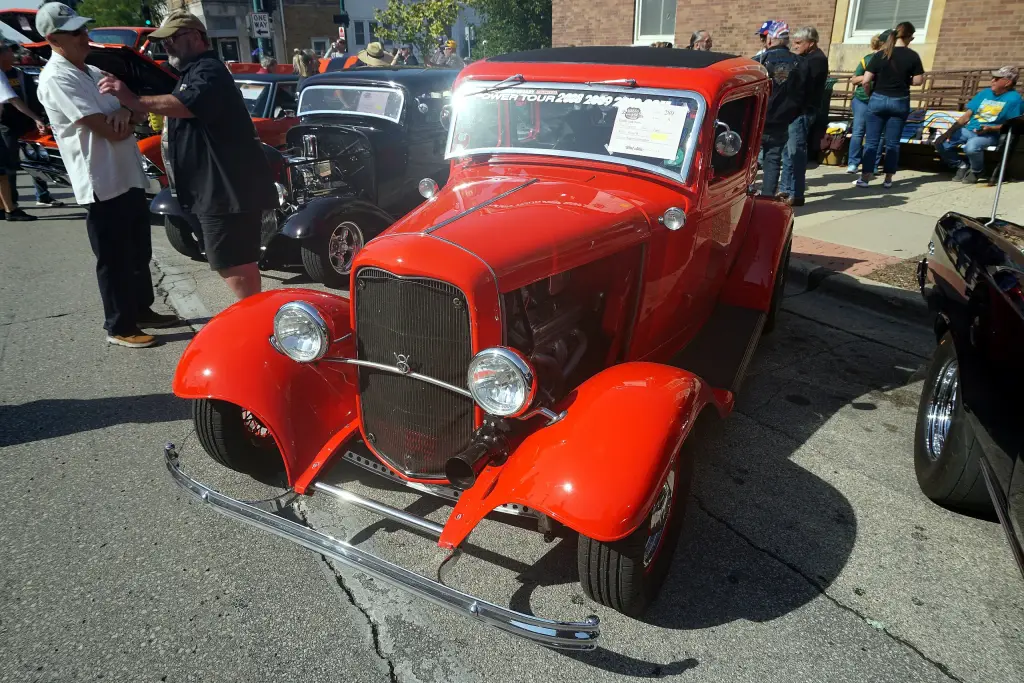
The 1932 Ford was not a facelift of the Model A but a completely new car, sold in two forms: the four-cylinder Model B and the Model 18 with Ford’s first flathead V8. The V8 cost only about ten dollars more than the four, and it made the cheaper car almost irrelevant.
1932 Ford at a glance
| Maker | Ford Motor Company, Detroit |
|---|---|
| Production | 1932–1934 |
| Predecessor | Ford Model A |
| Model B engine | 201 cu in (3.3 L) four, 50 hp |
| Model 18 engine | 221 cu in (3.6 L) flathead V8, 65 hp |
| Chassis | longer wheelbase, outward-curved double-dropped frame |
| Fuel tank | moved to the rear, engine-driven pump |
| Prices | US$490 for the coupes, US$495 roadster, US$650 convertible sedan |
| 1932 sales | 298,647 V8 cars, 133,539 four-cylinder cars |
| Bodies | roadster, coupe, sedan, Victoria, phaeton, woodie, pickup |
| Rarest body | B400 cabrio coach, 842 built |
| Successor | Model 48 (1935) |
This page is based on English Wikipedia only; its article on the 1932 Ford covers the Model B, the Model 18 and the Model 40 together.
History of the 1932 Ford
A new car, not an update
Ford did not simply revise the Model A for 1932. The new car had a longer wheelbase and an outward-curved, double-dropped chassis, and the fuel tank moved from the cowl to the lower rear of the body, which required an engine-driven fuel pump instead of gravity feed. Design was supervised by Edsel Ford, while the flathead V8 was developed mostly under Henry Ford. The four-cylinder Model B kept a reworked 201 cu in Model A engine rated at 50 hp; the Model 18 introduced a 221 cu in V8 rated at 65 hp.
The V8 for the masses
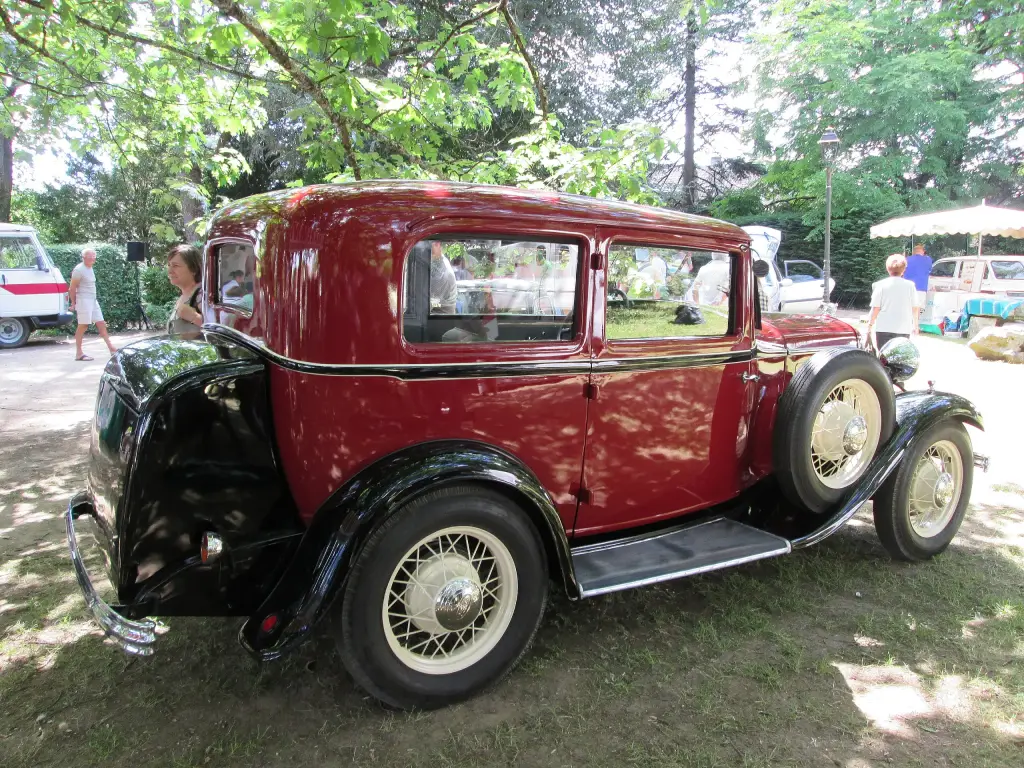
The Model 18 was the first low-priced, mass-marketed car with a V8 engine. Until then the V8 had been exclusive to Lincoln, which in 1932 switched to V12 engines only. The V8 was far more popular than the four: Ford sold 298,647 V8 cars in 1932 against 133,539 Model Bs, even though the eight cost just US$10 more. The B was dropped because buyers disliked four-cylinder cars in general and because of the V8’s success, not because it was an inferior car; in Europe, where taxes favoured small engines, it lasted a little longer.
Bodies, prices and the B400
Both models shared frames, bodies and most trim, and most body styles came in Standard or Deluxe form with either engine. The list ran from two-door roadster and cabriolet through four-door phaeton and sedans, the woodie station wagon, panel and sedan deliveries, five-window coupe and the three-window Deluxe Coupe to a pickup. Prices ranged from US$490 for the coupes and US$495 for the roadster to US$650 for the convertible sedan, and production of individual styles ran from 12,597 roadsters to 124,101 two-door sedans. The rarest 1932 Ford was the B400, a flathead V8 two-door cabrio coach of which 842 were built, mostly for export. The B, the 18 and the BB truck were replaced by the Model 48 in 1935.
Design and features
- Flathead V8: 221 cu in (3.6 L), 65 hp, the first V8 in a low-priced mass-market car.
- New chassis: longer wheelbase and a double-dropped frame instead of the Model A’s two straight rails.
- Rear fuel tank: moved behind the cabin and fed by an engine-driven pump.
- Body choice: roadster, coupe, Victoria, phaeton, woodie, deliveries and pickup in Standard or Deluxe trim.
1932 Ford versions
- Model B (1932–1934): 201 cu in four-cylinder, 50 hp, the price leader.
- Model 18 (1932): the first Ford with the flathead V8.
- Model 40 (1933–1934): the V8 car under its later designation.
- Model BB: truck replacement for the Model AA, with four or eight cylinders.
- B400: two-door cabrio coach, 842 built, the rarest body.
The 1932 Ford replaced the Model A, and its flathead V8 went on to power the 1949 Ford. More cars are in the Ford collection.
Sources
- 1932 Ford, English Wikipedia: models, engines, prices, sales, bodies