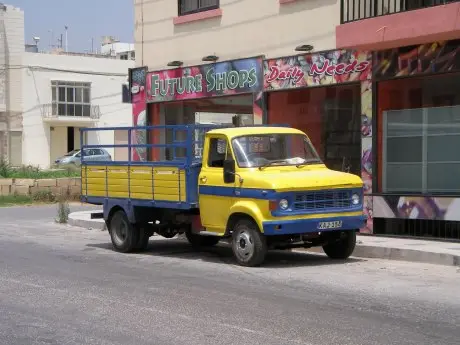
The Ford A series was a range of light trucks built by Ford of Britain in the 1970s and 1980s at its Langley plant in Berkshire. Ford marketed it as “Ford’s Go-Between” because it filled the gap between the Transit van and the larger D series.
Ford A series at a glance
| Maker | Ford of Britain, Langley, Berkshire |
|---|---|
| Production | September 1973 – July 1983 |
| Market | light trucks of 3.5–5.5 tonnes GVW |
| Public debut | Frankfurt Motor Show, 1973 |
| Engines | 2.4 L four diesel, 3.5 L six diesel, 2.0 L V4 petrol, 3.0 L V6 petrol |
| Gearboxes | Ford 4-310, Turner T4-150 or ZF S5-24/3 |
| Wheelbases | 120, 130, 145 and 156 in |
| Body styles | over 350 basic variants, left- and right-hand drive |
| Cab | shares panels with the Transit, longer bonnet and wings |
| Chassis | separate frame, unlike the monocoque Transit |
| Also built | “Attack” fire appliance by G&T Fire Control |
This page is based on English Wikipedia only.
History of the Ford A series
Finding the gap
Ford identified a market for trucks between 3.5 and 5.5 tonnes gross vehicle weight, below the D series and above the Transit, and called the new range its “Go-Between”. In 1967 the company began a study of the 3.5 to 6.3 tonne sector, decided to build the range in 1970 and started development in early 1971. The truck made its public debut at the 1973 Frankfurt Motor Show and went on sale in Britain on 13 September 1973, after a three-year programme costing 12 million pounds in which some twenty vehicles covered over 500,000 miles each.
One cab, many trucks
The A series shared panels and components with the Transit, notably longer and wider wings, a longer bonnet and a different grille, but it sat on a separate chassis instead of the Transit’s monocoque body. Unlike the Transit, which was facelifted in 1977–78, the A series kept the same shape to the end. The range split into the smaller A04xx models on 14-inch wheels with four-cylinder engines and the larger A05xx and A06xx on 16-inch wheels with six-cylinder engines and a stronger frame. Four wheelbases, three gearboxes and three driving axles were listed, and a four-wheel-drive version was offered by Reynolds Boughton.
The end of the line
The A series sold well in France and West Germany, as intended, but always in smaller numbers in Britain, where the need for tachographs in vehicles over 3.5 tonnes deterred some customers and the Mercedes-Benz T2 and Dodge 50 proved strong competition. Production ended in July 1983. The market it had been built for was later covered by rebadged Iveco Daily vans, the heavier versions of the 1986 Transit and the lightest Ford Cargo.
Design and features
- Separate chassis: a proper truck frame under a Transit-style cab.
- Four engines: two diesels and two petrol units, from 2.0 to 3.5 litres.
- Many wheelbases: 120, 130, 145 and 156 inches.
- Special bodies: including the “Attack” fire appliance and a baby articulated tractor.
Ford A series versions
- A04xx: 14-inch wheels and four-cylinder engines.
- A05xx / A06xx: 16-inch wheels, stronger frame and six-cylinder engines.
- AA0709: baby articulated tractor unit, right-hand drive only.
- Reynolds Boughton 4×4: four-wheel-drive conversion for special uses.
- Attack fire appliance: built by G&T Fire Control from 1976.
The A series sat below the D series in Ford’s truck range and above the Transit. More Ford vehicles are in the Ford collection.
Sources
- Ford A series, English Wikipedia: development, variants, engines, production