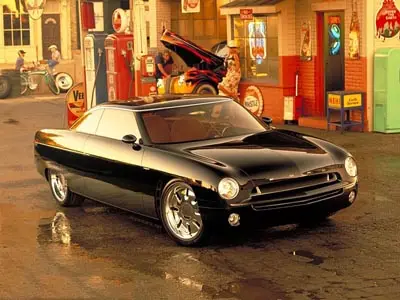
The 1949 Ford was the first Ford designed from scratch after the Second World War and the first post-war car line of the American Big Three, reaching showrooms six months before Chevrolet and nine before Plymouth. Its smooth, slab-sided body earned it the nickname “Shoebox Ford”.
1949 Ford at a glance
| Maker | Ford Motor Company, Dearborn |
|---|---|
| Model years | 1949–1951 |
| Launched | June 1948, Waldorf-Astoria, New York |
| Design | Richard Caleal, supervised by the Ford Executive Committee |
| Body | slab-sided “ponton” styling, running boards removed |
| Wheelbase | 114 in (2,896 mm), carried over |
| Engine | 226 cu in L-head six, optional 239 cu in flathead V8 |
| Front suspension | coil springs, independent |
| Trims | Standard and Custom, renamed Deluxe and Custom Deluxe for 1950 |
| New for 1950 | Crestliner hardtop, Country Squire name for the wagon |
| New for 1951 | Victoria hardtop, dual-bullet grille |
| 1949 sales | 1,118,740 Ford cars, first place in the United States |
This page is based on English Wikipedia only.
History of the 1949 Ford
The first postwar Ford
From 1946 to 1948 American makers had sold updated versions of their 1941–42 lines. The 1949 Ford broke with that: only the powertrain and the 114-inch wheelbase were carried over, and the car received a drop-centre ladder frame, coil-spring independent front suspension and longitudinal rear leaf springs instead of the transverse-leaf layout used since the Model T. The torque tube was replaced by a Hotchkiss drive. The 226 cu in L-head six remained standard, with the 239 cu in flathead V8 as an option.
Shoebox styling
The integrated body, advertised as a “lifeguard body”, removed running boards entirely and merged front and rear wings into one smooth form. The centre-mounted bullet-nose grille carried a red circle with a “6” or an “8” according to the engine. The design was successful enough to be echoed by Studebaker and, in the 1950s, by European makers including Mercedes-Benz, Borgward, Austin and Volvo. The 1949 Ford also brought the first keyed ignition and, from November 1950, the first automatic transmission in a Ford, the three-speed Ford-O-Matic.
Three model years
Trim names changed almost every year. For 1949 the range used Standard and Custom with Tudor and Fordor sedans, Club and Business coupes, a convertible and a two-door wagon; for 1950 these became Deluxe and Custom Deluxe, the Ford crest badge appeared, and the Crestliner sport sedan joined as Ford’s first stand-alone nameplate. For 1951 came the dual-bullet grille and the return of the Victoria name on a two-door hardtop, which outsold the Chevrolet Bel Air by nearly ten per cent. Ford finished 1949 back in first place among American manufacturers with 1,118,740 cars.
Design and features
- Shoebox body: slab sides, no running boards, wings merged into the body.
- Modern chassis: coil-spring independent front suspension and Hotchkiss drive.
- Bullet-nose grille: a central chrome bullet marked with the number of cylinders.
- Ford firsts: keyed ignition and, from late 1950, the Ford-O-Matic automatic.
1949 Ford versions
- Standard and Custom (1949): the two trim levels of the first year.
- Deluxe and Custom Deluxe (1950–1951): the renamed trims.
- Crestliner (1950–1951): two-tone sport sedan, Ford’s first stand-alone nameplate.
- Victoria (1951): two-door hardtop aimed at the Bel Air.
- Country Squire: the station wagon, with a steel inner body under the wood panels.
The 1949 Ford was replaced by the 1952 Ford and shared its flathead V8 with the first F-Series trucks. More cars are in the Ford collection.
Sources
- 1949 Ford, English Wikipedia: design, chassis, trims, sales