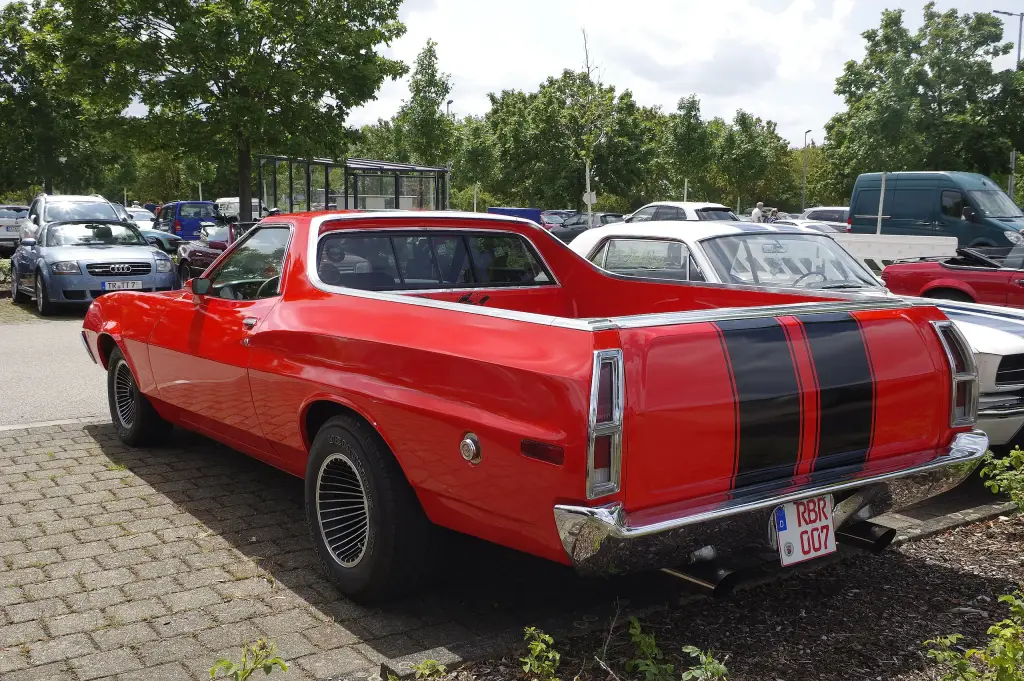
The Ford Ranchero was a coupe utility produced by Ford between 1957 and 1979. Unlike a standard pickup, it was adapted from a two-door station wagon platform that integrated the cab and the cargo bed into one body, and 508,355 were built.
Ford Ranchero at a glance
| Maker | Ford Motor Company |
|---|---|
| Production | 1957–1979 |
| Introduced | December 1956 |
| Built | 508,355 |
| First base | 1957 full-size Ford: Custom sedan, Ranch Wagon, Courier |
| Body | two-door coupe utility with integrated cab and bed |
| Engines | any Ford car engine, up to the 312 cu in Thunderbird Special |
| Cargo capacity | about 50 lb more than a half-ton F-Series |
| Rival it inspired | Chevrolet El Camino, from 1959 |
| Sold as | a truck through Ford’s truck division |
| Also in | Canada as a Meteor, and South Africa and Argentina with Falcon utilities |
This page is based on English Wikipedia only.
History of the Ford Ranchero
From the ute to the Ranchero
The earliest Ford pickups were made by putting a box behind a roadster body, and in 1934 Ford Australia’s designer Lew Bandt turned a coupe into a smoothly integrated load carrier that could take the family to church or pigs to market: the coupe utility, still known in Australia as the ute. In North America pickups grew into heavier, separate-cab designs, and the Ranchero was the first post-war American vehicle of its type adapted at the factory from a popular sedan, combining a sedan’s looks with the utility of a light pickup.
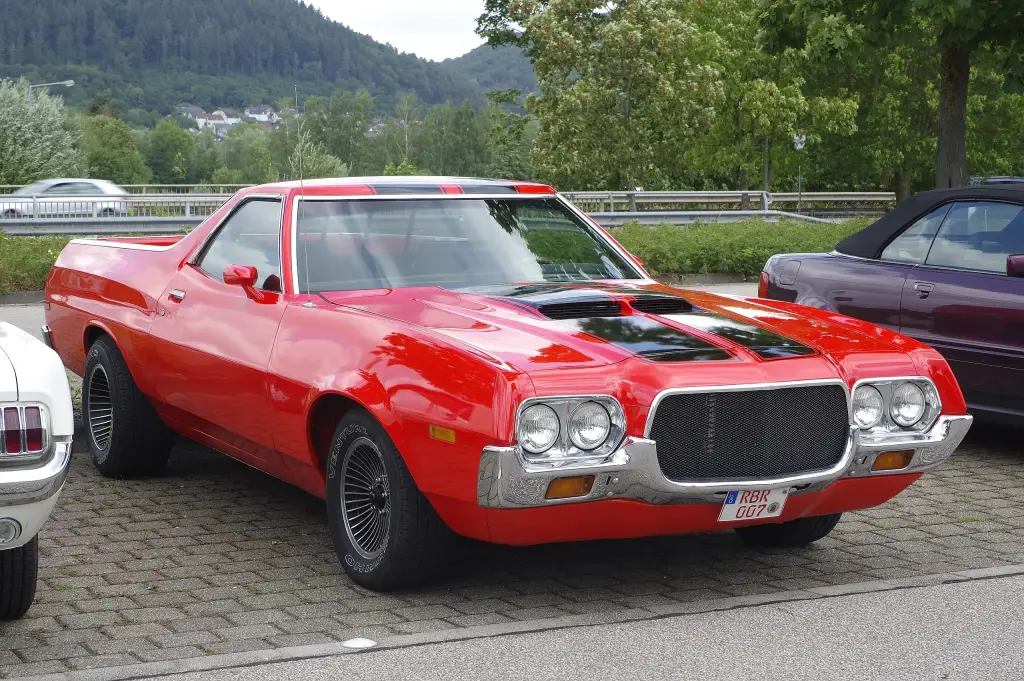
The first generation
Introduced in December 1956, three months after the usual September start of the model year, the Ranchero was based on the new 1957 full-size Ford platform, specifically the short-wheelbase Custom sedan, the two-door Ranch Wagon and the Courier sedan delivery. It was essentially a Courier with an open reinforced bed, its own rear window and an integrated cab and cargo box, offered in two trims and built on the corresponding car assembly line but sold as a truck through Ford’s truck division. A very basic standard model was aimed at traditional pickup buyers such as farmers, while the Custom took most of the Fairlane options, including stainless bodyside mouldings and two-tone paint. Upscale cars were badged as both Fairlane and Ranchero, with a stylised Longhorn on the tailgate, and advertising called it “More Than A Car! More Than A Truck!”.
A hit that made rivals
The Ranchero pleased both the press and the public, filling an untapped niche, and it carried about 50 lb more than a half-ton F-Series pickup. Buyers could order any engine offered in Ford cars, up to the 312 cu in Thunderbird Special, and seat belts and a padded instrument panel were optional. Its success brought a rival from General Motors in 1959, the Chevrolet El Camino. In Canada the Ranchero was also sold in the Meteor line, and during the 1970s the name was used in South Africa for a rebadged Australian Falcon utility assembled at Port Elizabeth, and in Argentina for a utility version of the local Falcon. Production ended in 1979 after 508,355 cars.
Design and features
- Coupe utility: a car body with an integrated cab and cargo bed.
- Fairlane trim: upscale versions with stainless mouldings and two-tone paint.
- Full engine choice: any Ford car engine, up to the 312 cu in V8.
- Segment starter: its success brought the Chevrolet El Camino in 1959.
Ford Ranchero versions
- Standard (1957): the basic model for traditional pickup buyers.
- Custom and Fairlane-badged cars: the better-equipped versions.
- Later generations: derived from compact and intermediate Fords.
- South African and Argentine Rancheros: local Falcon utilities using the name.
The Ranchero used the body of the Fairlane range and was the ancestor of the Durango coupe utility. More Ford vehicles are in the Ford collection.
Sources
- Ford Ranchero, English Wikipedia: origins, first generation, markets, production