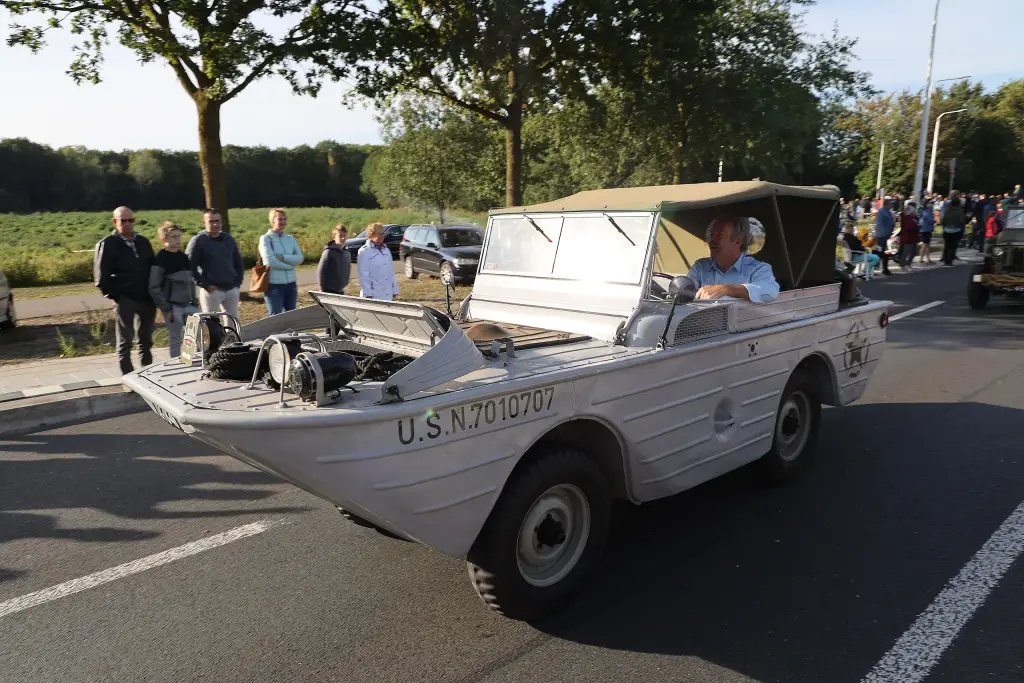
The Ford GPA “Seep”, short for Government ‘P’ Amphibious, was an amphibious version of the wartime Ford GPW jeep built under supply catalogue number G504. More than 12,000 were made, and they served with Allied forces from D-Day onwards in Europe and the Pacific.
Ford GPA at a glance
| Maker | Ford Motor Company |
|---|---|
| Project | QMC-4 1/4 Ton Truck Light Amphibian |
| Production | 1942–March 1943 |
| Hull design | Roderick Stephens Jr., Sparkman & Stephens |
| Engine | four-cylinder, about 60 hp |
| Drive | four-wheel drive, three-speed gearbox, two-speed transfer case |
| Water drive | propeller in a tunnel, driven by power take-off, with a rudder |
| Weight | about 3,500 lb in service, against 2,600 lb planned |
| Built | 12,778 vehicles |
| Lend-Lease | 4,486 sent to allies, 3,520 of them to the Soviet Union |
This page is based on English Wikipedia only.
History of the Ford GPA
Designing a jeep that floats
After the first jeeps were ordered in March 1941, the US Motor Transport Board set up a project under the National Defense Research Committee for a “QMC-4 1/4 Ton Truck Light Amphibian”. Roderick Stephens Jr. of the yacht designers Sparkman & Stephens was asked to shape a 2,700-pound amphibious jeep, in the same spirit as his later DUKW, and the hull looked like a miniature DUKW, with a screw propeller driven by a power take-off in a tunnel faired into the rear bodywork and a proper rudder. Marmon-Herrington and Ford competed for the contract: Marmon-Herrington welded its steel sheets into an integral unibody hull, while Ford used a sturdy chassis and frame with ordinary car-type sheet steel welded to it, making the GPA about 400 pounds lighter. Ford won and started production in 1942, basing the vehicle as far as possible on the Willys MB and Ford GPW, whose axles could later be salvaged to repair standard jeeps.
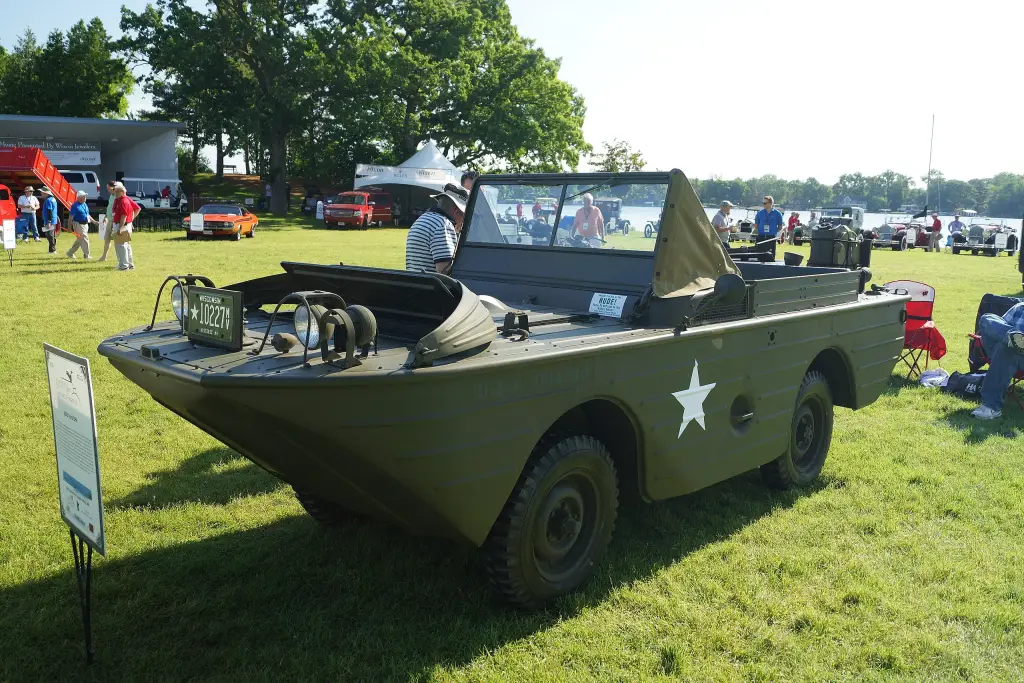
On land and in the water
The GPA had a four-cylinder engine of about 60 hp that also drove the propeller and a bilge pump, four-wheel drive with a three-speed gearbox and a two-speed transfer case, two live axles on leaf springs and four-wheel drum brakes. Its cabin was like the jeep’s but with almost twice as many levers, for two- and four-wheel drive, high and low range, the capstan winch, propeller deployment and the rudder.
Why it failed
The production vehicle weighed about 3,500 pounds rather than the 2,600 planned, but its volume had not grown, so freeboard was low: it could not handle more than a light chop or carry much cargo, which limited its intended job of ferrying troops and stores from ships to the beach and inland. On land it was too heavy and clumsy to be popular, and it often got stuck in shallow water that a normal jeep could ford. Production stopped in March 1943 after 12,778 vehicles, partly over financial disputes between Ford and the government and partly because of poor reports from the front. Even so, GPAs took part in the Sicily landings of September 1943 and served in the Pacific, and 4,486 were sent to allies under Lend-Lease, including 3,520 to the Soviet Union, which built its own GAZ-46 on the same idea.
Design and features
- Amphibious hull: a miniature DUKW shape with a propeller in a tunnel and a rudder.
- Jeep parts: as much Willys MB and Ford GPW engineering as possible.
- Many levers: separate controls for drive, range, winch, propeller and rudder.
- Too much weight: 3,500 lb in service with the freeboard of a much lighter design.
Ford GPA versions
- GPA production model: 12,778 vehicles built from 1942 to March 1943.
- Lend-Lease GPAs: 4,486 supplied to allies, 3,520 of them to the USSR.
- GAZ-46: the Soviet development inspired by the GPA.
- Post-war surplus: cars sold off for civilian and specialist work.
The GPA was the amphibious version of the Ford GPW jeep, and its layout followed the larger DUKW. More Ford vehicles are in the Ford collection.
Sources
- Ford GPA, English Wikipedia: development, specification, service, production