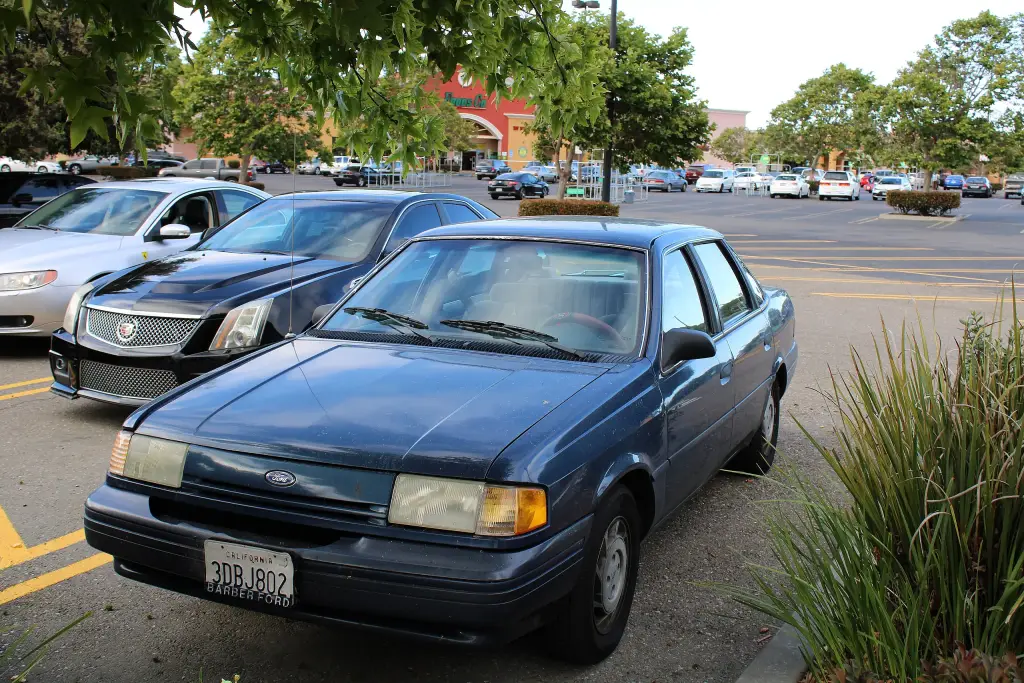
The Ford Tempo was a compact car manufactured by Ford for the 1984 to 1994 model years. The successor of the Fairmont, it was the fourth generation of Ford compact cars in North America and marked both downsizing and the switch to front-wheel drive.
Ford Tempo at a glance
| Maker | Ford, several North American plants |
|---|---|
| Model years | 1984–1994 |
| Predecessor | Ford Fairmont |
| Bodies | two-door coupe, four-door sedan |
| Twin model | Mercury Topaz |
| Chassis | from the front-wheel-drive Escort, wheelbase longer by 5.7 in |
| Chief engineer | Ed Cascardo |
| Wind tunnel testing | from December 1978, over 450 hours |
| Design changes tested | more than 950 |
| Firsts | all-wheel drive and an optional driver airbag |
| Replaced by | Ford Contour for 1995 |
This page is based on English Wikipedia only.
History of the Ford Tempo
From rear-drive Fairmont to front-drive Tempo
In the late 1970s Ford began planning a smaller front-wheel-drive car to replace the compact rear-wheel-drive Fairmont and Mercury Zephyr. It was expected to compete with General Motors’ X-body cars, though it ended up closer to GM’s J-cars, and Ed Cascardo was chief development engineer. The Tempo and Topaz shared some parts with the front-wheel-drive platform of the first North American Escort, with the wheelbase stretched by 5.7 inches and completely new bodies, and few common components because of their larger size. Front-wheel drive freed interior space that would otherwise have gone to a driveshaft and rear axle.
Shaped in the wind tunnel
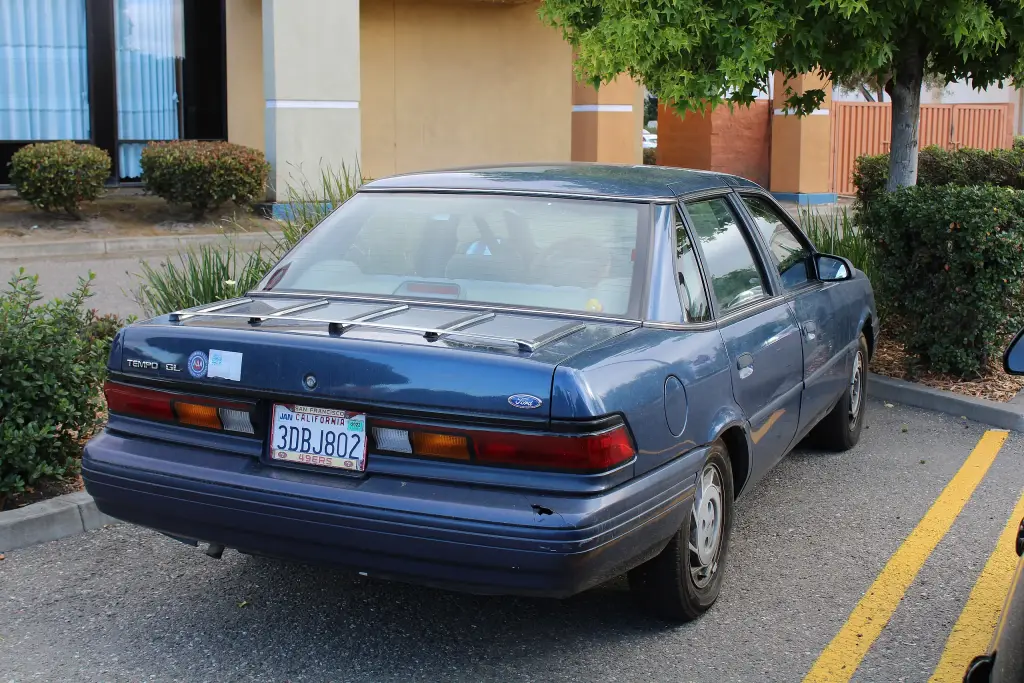
Wind tunnel testing began in December 1978 and more than 450 hours of work produced over 950 design changes. Both cars had windscreens inclined at 60 degrees and aircraft-inspired door frames, features first seen on the 1983 Thunderbird and Cougar; the frames wrapped into the roofline, improving sealing, allowing hidden drip rails and tidying the A-pillar area. The rear track was widened, the grille laid back and the leading edge of the bonnet tuned for clean airflow, the wheels were pushed out to the corners and the rear window laid down at 60 degrees with a raised boot lid to cut drag and fuel consumption. From the side that raised boot gave the car a wedge stance, most obvious on the two-door coupes.
Two firsts and the end
The Tempo was sold throughout as a two-door coupe and four-door sedan, with Lincoln-Mercury selling the Mercury Topaz as its divisional counterpart. It was the first Ford car line to offer all-wheel drive as an option and the first American automobile to offer a driver-side airbag as an option, and its aerodynamic exterior design was the first for a Ford sedan line. For 1995 the four-door Tempo and Topaz were replaced by the Mondeo-derived Ford Contour and Mercury Mystique, while the two-door Tempo was not directly replaced.
Design and features
- Aerodynamic body: the first Ford sedan line designed that way.
- Front-wheel drive: more interior space than the rear-drive Fairmont.
- Two firsts: optional all-wheel drive and an optional driver airbag.
- Mercury Topaz: the Lincoln-Mercury version of the same car.
Ford Tempo versions
- Tempo coupe: the two-door body with the most pronounced wedge.
- Tempo sedan: the four-door version.
- Mercury Topaz: the divisional twin.
- All-wheel-drive Tempo: the optional four-wheel-drive model.
- Airbag cars: the first American cars with an optional driver airbag.
The Tempo replaced the rear-wheel-drive Ford Fairmont in North America and was itself replaced by the Mondeo-based Contour, while the aerodynamic idea it introduced led to the Taurus. More Ford vehicles are in the Ford collection.
Sources
- Ford Tempo, English Wikipedia: development, aerodynamics, firsts, replacement