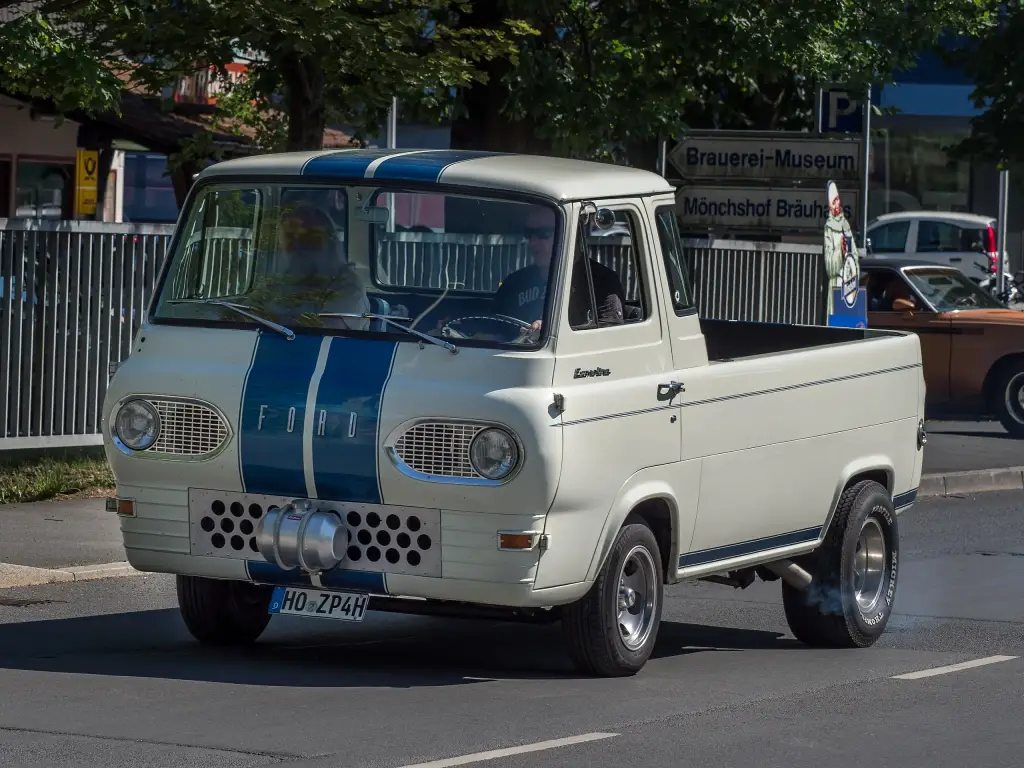
The Ford E-Series, long sold as the Ford Econoline and Ford Club Wagon, is a range of full-size vans produced since 1961. Introduced to replace the F-Series panel van, it has gone through four generations and over 8.2 million vehicles.
Ford Econoline at a glance
| Maker | Ford, Lorain then Ohio Assembly, Avon Lake, Ohio |
|---|---|
| Production | since 1961 |
| Also called | Econoline, Club Wagon, E-Series |
| Replaced | F-Series panel van and Ford Courier sedan delivery |
| First generation | 1961–1967, based on the Falcon |
| First wheelbase | 90 in |
| First engines | 144 cu in six, 85 hp; 170 cu in optional |
| Layout | mid-engine, engine between the front seats |
| Total sold | over 8.2 million |
| Passenger and cargo versions | retired after 2014, replaced by the Transit |
| Still produced | cutaway and stripped-chassis versions |
This page is based on English Wikipedia only; this page uses the opening and first-generation sections of the source.
History of the Ford Econoline
A van from a compact car
Development began in 1957, and the first Econoline was released on 21 September 1960 for the 1961 model year. It replaced two lines at once: the F-100-based panel delivery and the Courier sedan delivery. It became a three-vehicle family of cargo van, passenger van (also sold as the Station Bus and Club Wagon) and a forward-control pickup. The van was built on the Falcon compact car range, and to fit a 90-inch wheelbase — the shortest on a Ford since 1908 — Ford put the engine between the front seats instead of at the front.
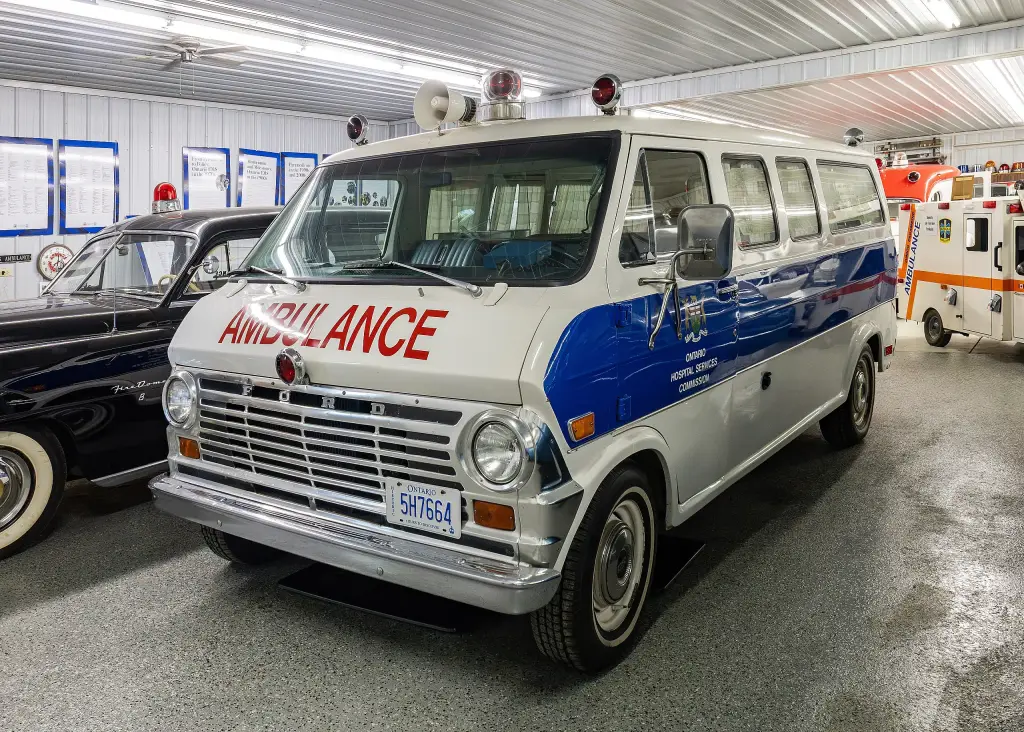
What the mid-engine layout gave
The layout gave a flat load floor apart from the engine compartment and let the rear doors run all the way down to the bumpers, and it ruled out a V8. At first there was an 85 hp 144 cu in six from the Falcon, with a 101 hp 170 cu in unit as an option; for 1965 the 170 became standard and a 240 cu in six was added. A three-speed manual was standard, with a Dagenham four-speed offered in 1963 and 1964 and automatics available with the larger engines. Unlike the Falcon the Econoline had solid axles and leaf springs at all four corners. Chevrolet and Dodge adopted the mid-engine idea for their own vans in 1964.
Growing into a van family
The first generation was offered as a six-door cargo van, an eight-door version from 1963 with two extra doors on the driver’s side, a windowless panel van from 1964 and, from 1965, a “Super Van” body extended 18 inches behind the rear axle. In Canada it was sold through both Ford and Lincoln-Mercury dealers. Later generations grew into the full-size E-Series the name is known for, built at Lorain until 2005 and at Ohio Assembly in Avon Lake since 1975; the line passed 60 years of continuous production in 2021. Ford retired the passenger and cargo vans after 2014 in favour of the Transit, keeping the E-Series only as a cutaway and stripped chassis for motorhomes, ambulances and buses.
Design and features
- Mid-mounted engine: the engine sat between the front seats for a flat load floor.
- Falcon base: compact-car mechanicals in a forward-control van.
- Many bodies: cargo, passenger, panel, pickup and the extended Super Van.
- Long production: more than sixty years, and still built as a chassis.
Ford Econoline versions
- Cargo van: the basic working version.
- Station Bus and Club Wagon: passenger versions, the latter aimed at families.
- Forward-control pickup: a pickup body on the van chassis.
- Super Van (1965): extended body with 18 inches added behind the rear axle.
- Cutaway and stripped chassis: the versions still produced today.
The Econoline replaced the F-Series panel van and later shared showroom space with the Transit, which took over the passenger and cargo versions, and with the Aerostar. More Ford vehicles are in the Ford collection.
Sources
- Ford E-Series, English Wikipedia: introduction, first generation, production