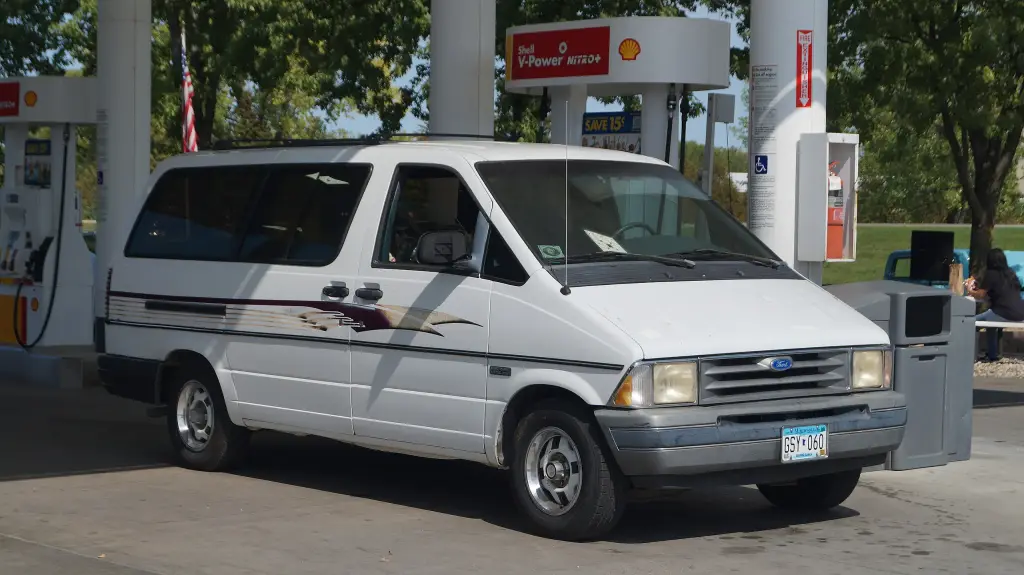
The Ford Aerostar was the company’s first minivan, sold from 1986 to 1997. It used a tall “one-box” body worked out to fit under a typical garage door, and it competed with the Chevrolet Astro and the first Chrysler minivans.
Ford Aerostar at a glance
| Maker | Ford, St. Louis Assembly, Hazelwood, Missouri |
|---|---|
| Model years | 1986–1997 |
| Layout | rear-wheel drive |
| Bodies | passenger and cargo vans, standard and extended length |
| Wheelbase | 119 in |
| Height | about 6 ft, for garage clearance |
| Drag coefficient | 0.37 |
| Towing | 5,000 lb |
| Seats | up to seven |
| Production total | 2,029,577 |
| Successor | Ford Windstar, sold alongside from 1995 |
This page is based on English Wikipedia only.
History of the Ford Aerostar
From the Carousel to the Aerostar
Ford began work on a smaller van in the early 1970s as a companion to the Econoline, under the name Ford Carousel: a “garageable van” with a lowered roof, a more raked windscreen and a wagon-style roofline. The prototype was tested from 1972 to 1974 but never reached production, as money went to the Fox and Panther platforms and the 1980 F-Series. Two Ghia show vans, the 1982 Aerovan and 1984 APV, then explored the idea on an Escort base.
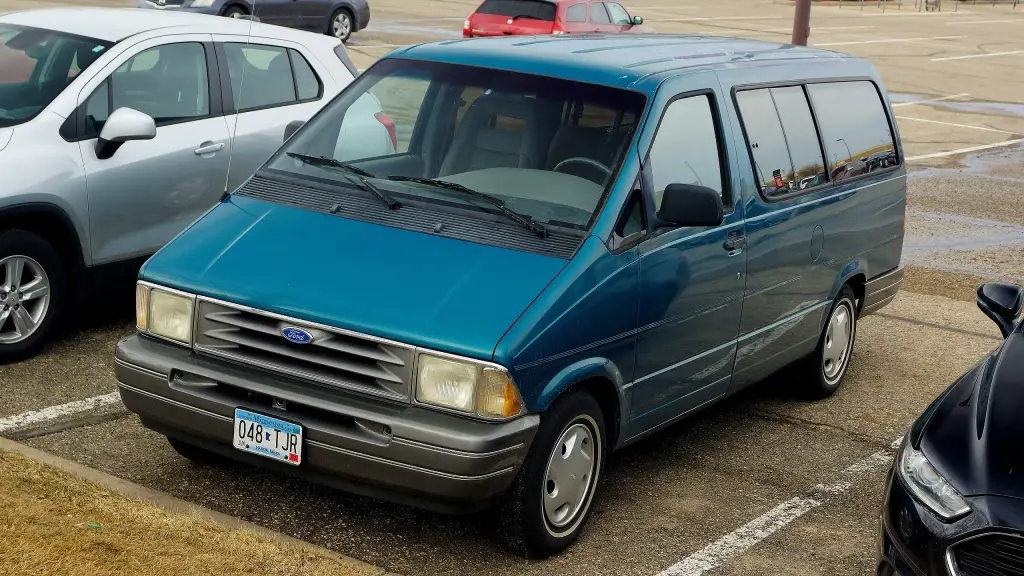
An all-new design
By 1980 Ford had committed to a smaller van of its own design, partly in response to the coming Chrysler minivans. The new van was rear-wheel drive for two reasons: to give the carlike ride of a 119-inch wheelbase with the wheels at the corners, and to allow 5,000 lb towing to match the then-new Ranger, while sharing mechanical parts with Ford light trucks. It received a chassis of its own, with model-specific front and rear suspension. The body was about six feet tall for garage clearance yet kept a drag coefficient of 0.37, better than the Lincoln Mark VII.
Ten years of production
The Aerostar was sold as a passenger and a cargo van, in standard and extended lengths, mainly in the United States and Canada. The front-wheel-drive Windstar arrived for 1995 as its intended replacement, but Ford sold both vans through 1997. The cargo role was left unfilled until the Transit Connect. All Aerostars were built at the St. Louis Assembly Plant in Hazelwood, Missouri, and 2,029,577 were made in a single generation.
Design and features
- Garageable body: about six feet tall, with a one-box shape and a low drag coefficient.
- Rear-wheel drive: a chassis of its own, not shared with a car line.
- Cargo and passenger versions: in standard and extended lengths.
- 5,000 lb towing: matching the Ranger pickup.
Ford Aerostar versions
- Passenger van: up to seven seats.
- Cargo van: windowless body for tradesmen.
- Extended length: a longer body added during the model run.
The Aerostar came before the Windstar and was the smaller alternative to the Econoline. More Ford vehicles are in the Ford collection.
Sources
- Ford Aerostar, English Wikipedia: development, design, production