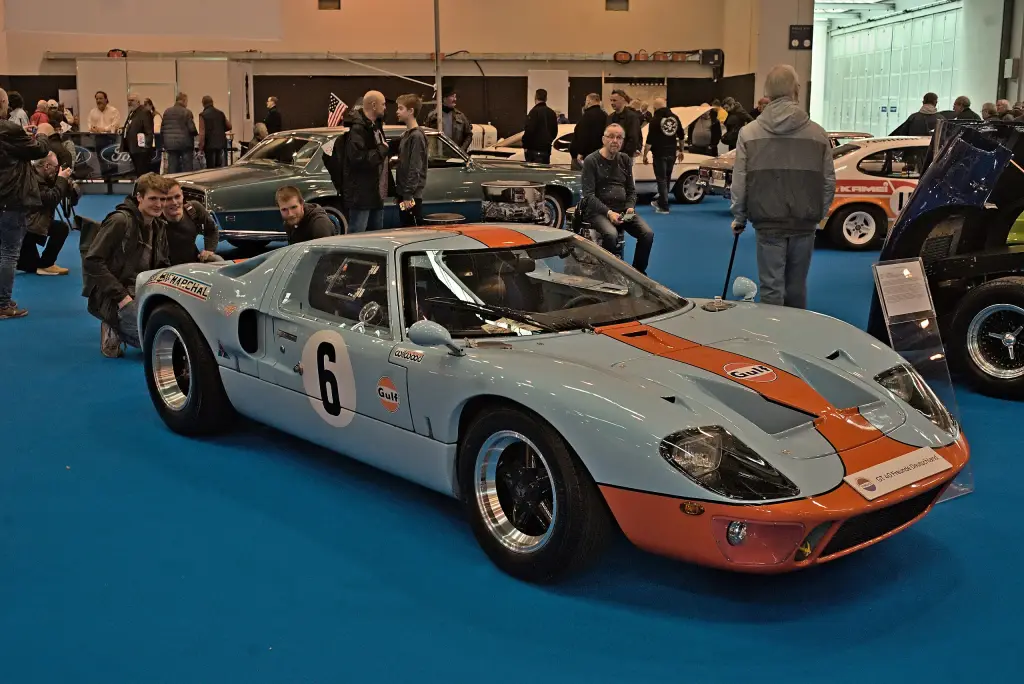
The Ford GT40 is a high-performance mid-engined racing car designed and built by Ford to compete in 1960s European endurance racing. Its aim was simple: beat Scuderia Ferrari, which had won the 24 Hours of Le Mans six years running from 1960 to 1965. It did, and then won the race four times in a row.
Ford GT40 at a glance
| Produced | 1964 to 1969 |
|---|---|
| Built by | Ford Advanced Vehicles, Slough, England; from 1964 development moved to Dearborn, Michigan, with Kar Kraft |
| Name | GT for grand touring; 40 for the car’s height of 40 inches (1.02 m) at the windscreen |
| Mk I engine | 4.7 L (289 cu in) Ford V8, as used in the Mustang |
| Mk II and Mk IV engine | 7.0 L (427 cu in) Ford V8 |
| Mk III | street-legal version, 306 hp, seven built |
| Price in 1964 | £5,200 for a completed competition car |
| Cars built | about 100 in the English-language account; other sources give a higher count, up to 134 |
| Le Mans wins | 1966, 1967, 1968 and 1969 |
| Top speed, 1967 Le Mans | 213 mph (343 km/h) on the Mulsanne Straight, Mk IV |
History of the Ford GT40
Henry Ford II had wanted a Ford at Le Mans since the early 1960s. In early 1963 Ford reportedly negotiated to buy Ferrari, only for Enzo Ferrari to cut off talks at a late stage over who would control the racing programme. Ford, angered, told its racing division to find a company that could build a Ferrari-beater for endurance racing.
Ford talked to Lotus, Lola and Cooper. Lola’s mid-engined Mk6 GT, powered by a Ford V8, had made a noted showing at Le Mans in 1963, so Lola was chosen. Eric Broadley, Lola’s owner and chief designer, agreed to a one-year collaboration, and Ford bought two Lola Mk6 chassis. Ford hired the former Aston Martin team manager John Wyer and sent the engineer Roy Lunn to England; they set up Ford Advanced Vehicles in Slough. The first chassis was delivered on 16 March 1964 and the first car, GT/101, was unveiled in England on 1 April.
1964 and 1965: the hard lessons
The GT40 first raced in May 1964 at the Nürburgring 1000 km, retiring with suspension failure. At Le Mans that year all three entries retired, though the Ginther/Gregory car led from the second lap until its first pit stop. The programme was handed to Carroll Shelby after the 1964 Nassau race, and his team won on its first outing: Ken Miles and Lloyd Ruby took the Daytona 2000 km in February 1965. The rest of that season was a disappointment, with another Le Mans failure.
1966: one, two, three
For 1966 the car was redeveloped as the 7.0-litre Mk II, built by Holman Moody and Shelby American. Ford won Daytona, finishing one-two-three, and Sebring, where GT40s again took the top three places. At Le Mans in June the three Mk II teams of Chris Amon and Bruce McLaren, Denny Hulme and Ken Miles, and Dick Hutcherson and Ronnie Bucknum finished one-two-three, making Ford the first American manufacturer to win a major European race since Jimmy Murphy’s Duesenberg in the 1921 French Grand Prix.
The finish was clouded in controversy. Miles and Hulme held a four-lap lead until a brake-rotor problem forced a pit stop, and in the final hours Ford decided on a staged side-by-side finish. The organisers then ruled that starting positions would count, so the McLaren and Amon car, which had started further back, was declared the winner. What happened on the last lap remains debated. Miles died two months later at Riverside testing the J-car, a GT40 prototype with an aluminium-honeycomb chassis.
1967: the all-American win
The J-car was redesigned as the Mk IV, with the Mk II’s engine but a different chassis and body, and a steel-tube roll cage added after Miles’s accident. At Le Mans in 1967 it reached 213 mph on the Mulsanne Straight, and Dan Gurney and A. J. Foyt won in a Shelby-American Mk IV. It remains the only all-American victory in Le Mans history: American drivers, team, chassis, engine and tyres.
1968 and 1969: the old Mk I wins again
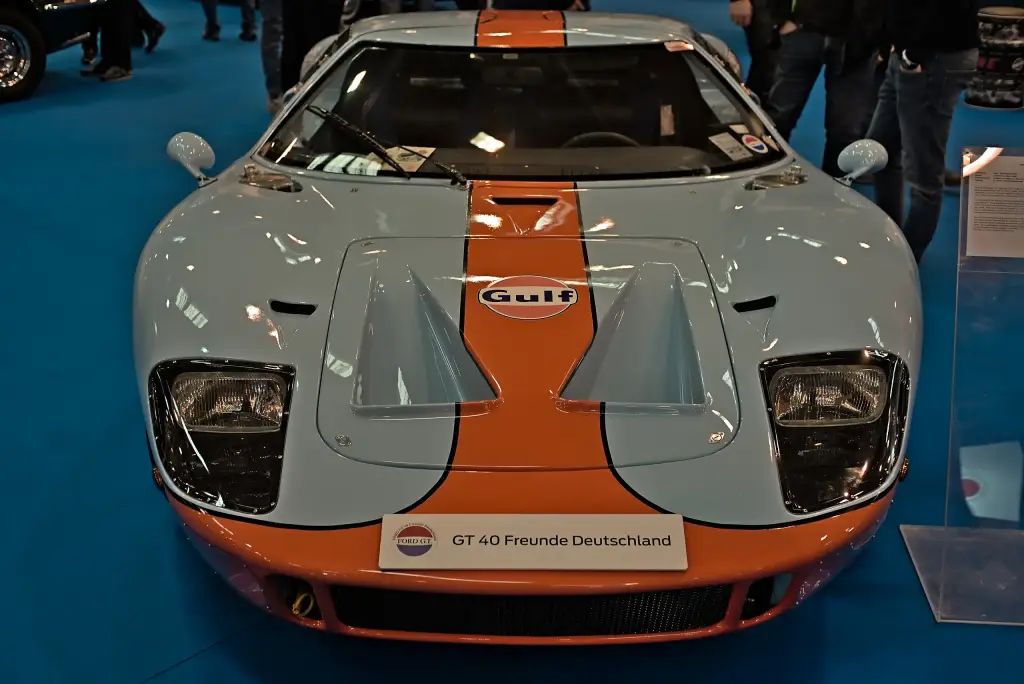
After 1967 the rules limited prototypes to 3.0 litres, which ruled out the 7.0-litre Fords and the 4-litre Ferrari 330 P4. Sports cars of up to 5.0 litres, built in at least 50 examples, were still allowed, and the old Mk I qualified. John Wyer’s Gulf-sponsored team bored its engine to 4.9 litres and won Le Mans in 1968. In 1969 Jacky Ickx and Jackie Oliver beat a Porsche 908 by a few seconds in the same car, chassis GT40P/1075. By 1970 the car had been overtaken by the Porsche 917.
Design and features
- Chassis: a steel frame with a fibreglass body on the Mk I; a bonded aluminium-honeycomb tub on the Mk IV.
- Suspension and brakes: double wishbones with coil springs at all four wheels, rack-and-pinion steering and disc brakes.
- Layout: mid-engined, with a transaxle: first a Colotti unit, then a ZF five-speed on the Mk I and a Ford-built four-speed on the Mk II and Mk IV.
- Drawbacks: poor ventilation and poor all-round visibility, according to the German source.
Ford GT40 versions
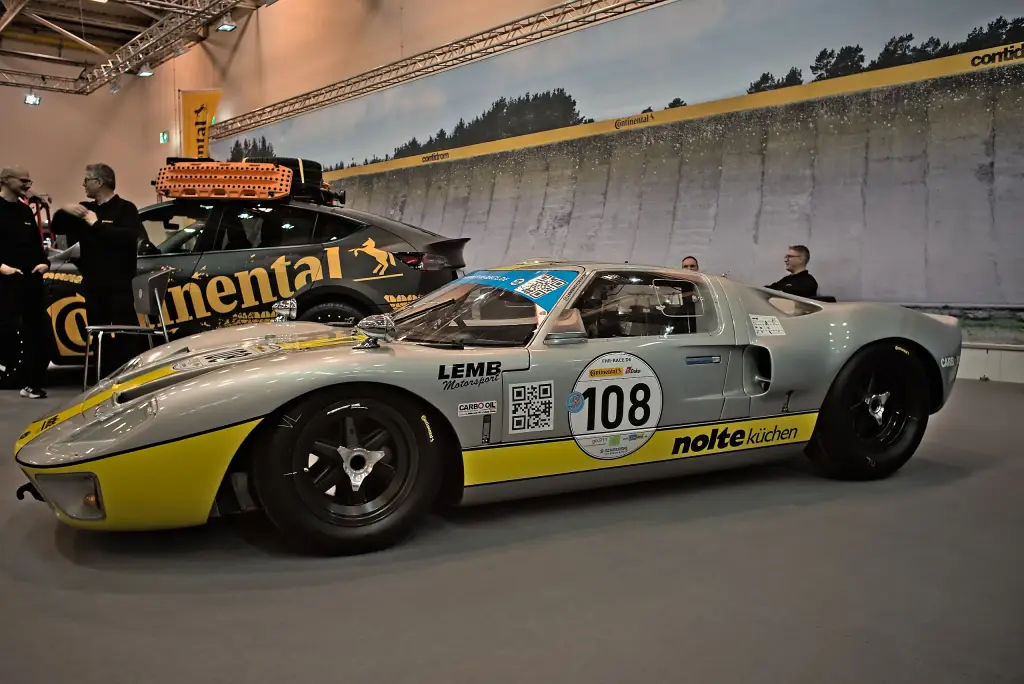
- Mk I (1964): the original, with a 4.2 L prototype or 4.7 L engine; the last type to win Le Mans, in 1968 and 1969.
- Mk II (1966): the 7.0 L car that won Le Mans one-two-three; the Mk IIB of 1967 had new bodywork and twin carburettors.
- Mk III: the road car, with four headlamps, a luggage area and a detuned 306 hp engine; seven were built.
- Mk IV (1967): the J-car-based American design that won Sebring and Le Mans in 1967.
The GT40 grew out of the Lola Mk6 GT and shares its V8 family with the Ford Mustang. Its rival at Le Mans was Ferrari, as in the Ferrari 250 GTO; later nameplate echoes are the Ford GT and the Spectre R42 road car. More Ford cars are in our Ford collection.
Ford GT40 questions and answers
What does GT40 stand for?
GT stands for grand touring, and 40 is the car’s height of 40 inches (1.02 m) at the top of the windscreen, the minimum allowed.
How many Le Mans wins did the GT40 take?
Four in a row: 1966 and 1967 with the 7.0-litre Mk II and Mk IV, then 1968 and 1969 with the Mk I.
Why did Ford build it?
To beat Ferrari at Le Mans after talks to buy Ferrari collapsed in 1963.
Was there a road-going GT40?
Yes, the Mk III, with a detuned engine, four headlamps and a luggage area. Seven were built.
Who won Le Mans in 1969?
Jacky Ickx and Jackie Oliver, in the Mk I that had won in 1968, by a few seconds over a Porsche 908.
Sources
- Ford GT40, English Wikipedia: history, racing record, Mk I to Mk IV
- Ford GT40, German Wikipedia: development, engine figures, production numbers
- Ford GT40, Italian Wikipedia: versions and results