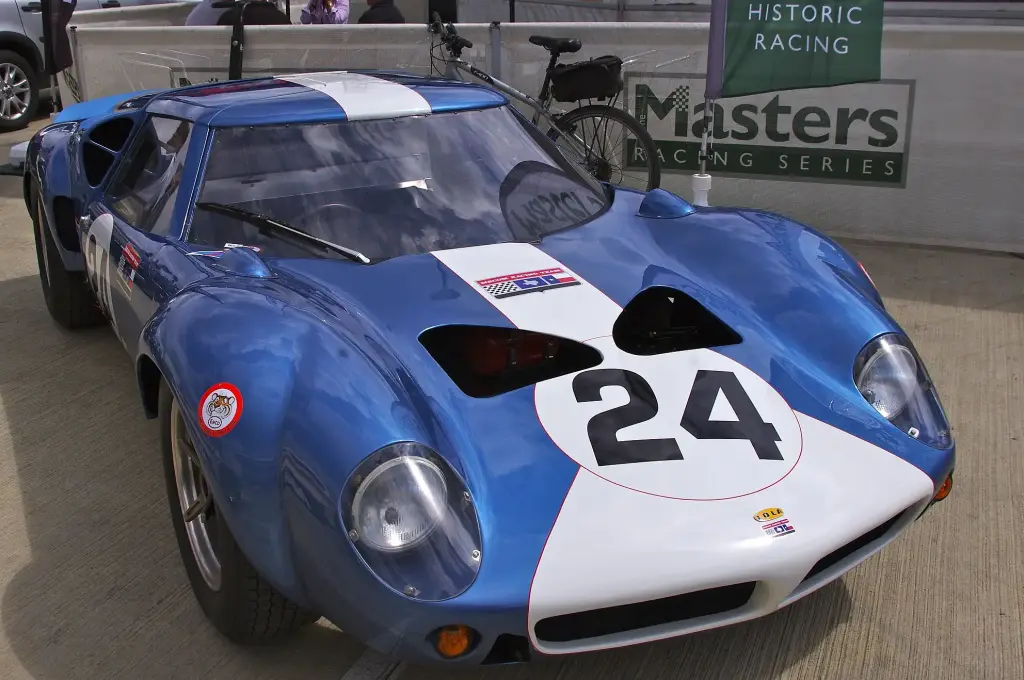
The Lola Mk6 GT was a racing car built in just three examples between 1962 and 1963. Mid-engined, powered by a 4.74-litre Ford V8 and built around an aluminium monocoque, it was so promising that Ford bought it and used it as the foundation of the GT40 project.
Lola Mk6 GT at a glance
| Maker | Lola Cars, Britain |
|---|---|
| Built | 1962–1963 |
| Number built | three cars |
| Engine | Ford 289 cu in (4.74 L) V8 |
| Power | about 400 hp |
| Chassis | aluminium monocoque; steel on the prototype |
| Gearbox | Colotti Tipo 37 |
| Designer | Eric Broadley |
| Coachwork | John Frayling, built by FRP |
| Shown | Olympia Racing Car Show, January 1963 |
| Raced at Le Mans | 1963, chassis LGT-1 |
based on one source (English Wikipedia).
History of the Lola Mk6 GT
Eric Broadley conceived the Mk6 GT at the end of 1962 for the Experimental Grand Touring class, which allowed cars without a minimum production run as long as they were roadworthy. The FIA had replaced its World Sports Car Championship with a championship for GT manufacturers, and experimental GT cars were left an open door. The arrival of the Colotti Tipo 37 gearbox, originally built for the Ford-engined Lotus 29 at Indianapolis, gave Lola a transaxle strong enough for a big V8.
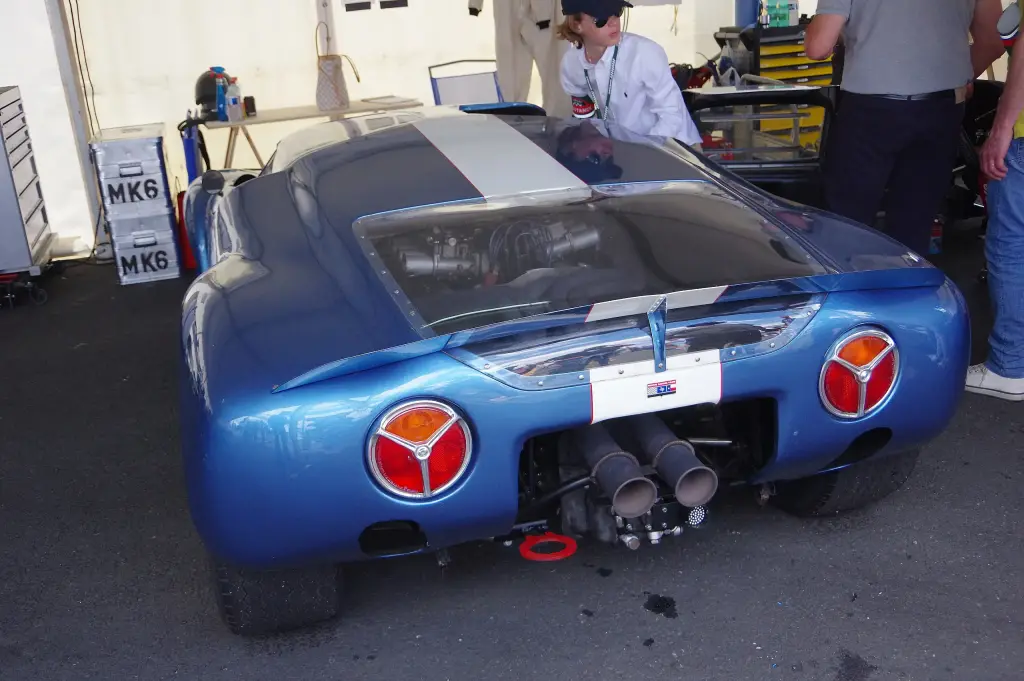
The car used some of the best technology of its time. The prototype had a steel monocoque to save development time, but the production cars used aluminium, at a period when almost every rival apart from Jaguar still relied on a space frame. The Ford-Colotti engine and gearbox formed a stressed member with the rear suspension mounted directly on it, a technique that only reached Formula One in full with the Lotus 49 in 1967. The result was so compact that the wheelbase was shorter than that of Lola’s own formula cars, despite the 4.74-litre pushrod V8 of about 400 hp.
The coachwork was designed by John Frayling and made by FRP, with short overhangs, a Kamm tail, an engine air intake in the roof and doors that extended into the roof for easier access — an idea carried over to the GT40. The prototype, chassis LGT-P with its steel monocoque, was shown at the Olympia Racing Car Show in January 1963 and raced by Tony Maggs at Silverstone, where he finished fifth from last on the grid, and at the Nürburgring 1000 km, where it retired. The second car, LGT-1 with an aluminium monocoque, went to Le Mans in 1963 short of preparation and with the wrong gear ratios; its drivers avoided full throttle on the Mulsanne Straight to prevent over-revving, losing about 30 mph of top speed, and the car retired after 15 hours with a broken gear selector. Ford bought the Mk6 to study it, which laid the foundation of the GT40 project, and Broadley joined that programme before leaving it. A third car, LGT-2, was completed later and sold to the American Mecom Racing Team.
Design and features
- Aluminium monocoque: advanced for 1963, when rivals still used space frames.
- Stressed engine and gearbox: suspension mounted directly on the Ford-Colotti unit, years before Formula One adopted the idea.
- Big V8 in a small car: a 400 hp 4.74-litre Ford engine in a wheelbase shorter than Lola’s formula cars.
- Frayling bodywork: Kamm tail, roof air intake and roof-hinged doors, ideas inherited by the GT40.
Lola Mk6 GT versions
- LGT-P (1963): the prototype with a steel monocoque, shown at Olympia and raced by Tony Maggs.
- LGT-1 (1963): the first aluminium monocoque car, raced at Le Mans.
- LGT-2 (1963): the second aluminium car, sold to the Mecom Racing Team.
The Mk6 was the bridge from the first Lola Mk1 to the T70 that followed it into big-engine sports car racing. More in the Lola collection.
Sources
- Lola Mk6, English Wikipedia: development, technical description, racing history