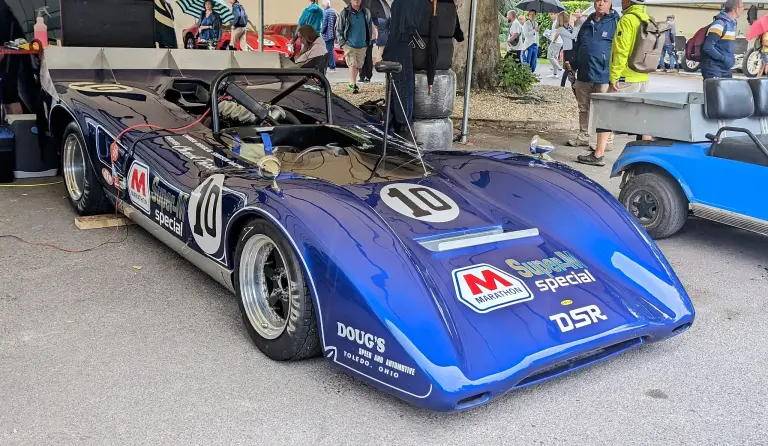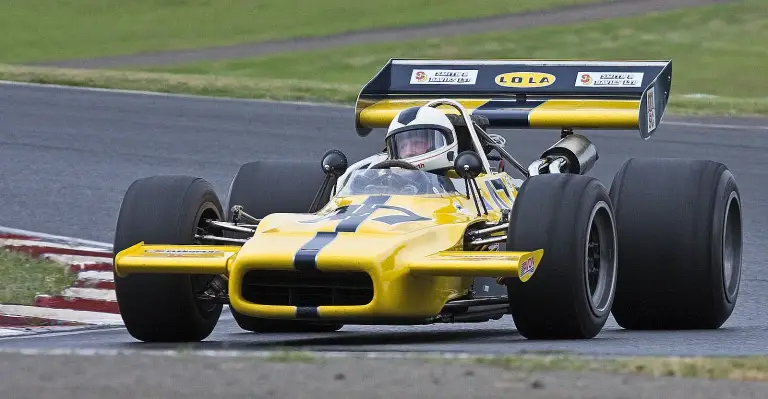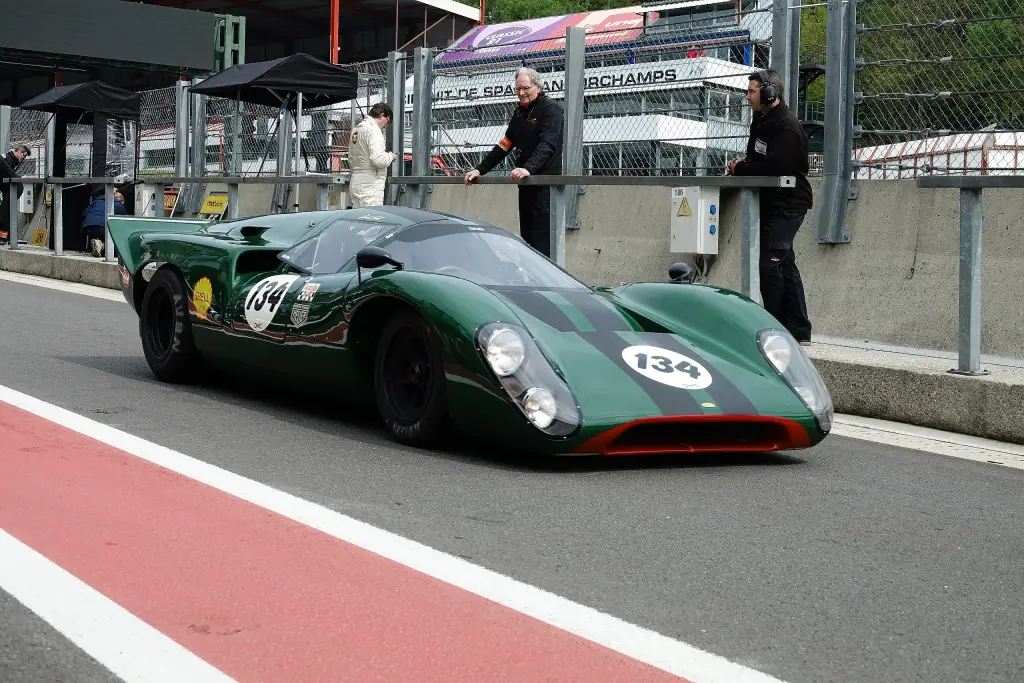
The Lola T70 was a sports prototype developed by Lola Cars in 1965 as the successor to the Mk6. Built around an aluminium monocoque and usually powered by a large American V8, it became one of the most popular sports racing cars of the late 1960s, with more than 100 examples built.
Lola T70 at a glance
| Maker | Lola Cars, Britain |
|---|---|
| Year | 1965 |
| Predecessor | Lola Mk6 |
| Chassis | aluminium monocoque |
| Engines | large American V8s, mainly Chevrolet and Ford |
| Versions | Mk I, Mk II, Mk III spyder, Mk III coupé, Mk IIIB |
| Built | more than 100 |
| First win | Monterey Grand Prix, Laguna Seca, October 1965 |
| Can-Am title | John Surtees, 1966 |
| Endurance win | 1969 24 Hours of Daytona |
| Replaced by | Lola T160 in Can-Am |
based on one source (English Wikipedia).
History of the Lola T70
The T70 was the successor to the Mk6, using an aluminium monocoque chassis and typically a large American V8. It was popular in the mid to late 1960s, with more than 100 examples built in three versions: the open-roofed Mk I, Mk II and Mk III spyder, followed by the Mk III coupé and finally a slightly updated Mk IIIB. The T70 was replaced in Can-Am by the lighter T160.
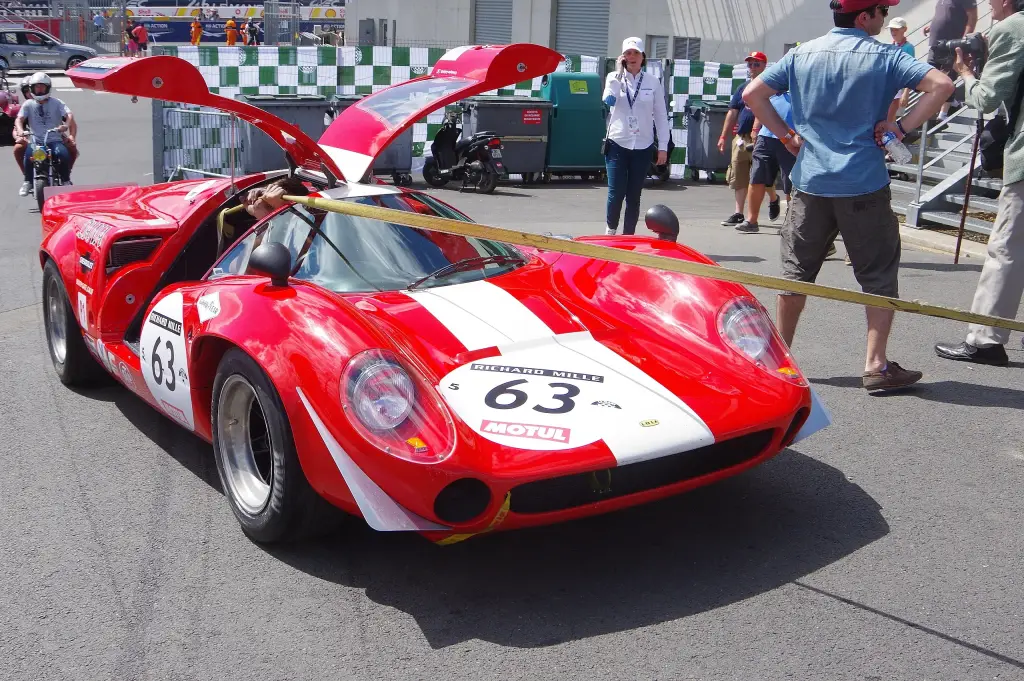
Early success came when Walt Hansgen won the Monterey Grand Prix at Laguna Seca on 17 October 1965 in John Mecom’s Lola T70-Ford. In 1966 the car to have in Can-Am was the T70 Chevrolet, which won five of six races; John Surtees took the title and Dan Gurney drove the only Ford-powered car ever to win a Can-Am race. In 1967 nothing could compete with the new McLaren M6.
When the FIA changed the sports car rules for 1968, limiting prototype engines to three litres but allowing five-litre sports cars if at least fifty had been made, the homologation rule let the outdated Ford GT40 and the T70 keep racing. Ford won Le Mans again in 1968 and 1969, while the T70’s only big endurance win was a one-two at the 1969 24 Hours of Daytona, where the Sunoco Lola T70-Chevrolet of Mark Donohue and Chuck Parsons beat the small-block American International Racing cars of Ed Leslie and Lothar Motschenbacher. When the minimum was lowered to twenty-five for 1969, the Porsche 917 and Ferrari 512 were homologated and outran the older cars.
Chevrolet-powered coupés did not run as well in Europe as in North America: the lower-octane pump fuel allowed there caused detonation-related engine failures. An Aston Martin-engined coupé entered by Lola for Le Mans in 1967 was a disaster even with John Surtees driving, the V8 failing after short runs. Lola chassis were disguised as Porsche 917s and Ferrari 512s for the filming of Steve McQueen’s Le Mans, and a T70 coupé appears as a car of the future in George Lucas’s THX 1138. A T70 Mk IIIB driven by Mike D’Udy set a South African land speed record on 13 January 1968 with a two-way average of 191.80 mph, which stood until 1988. In 2005 Lola announced a limited continuation series of the Mk IIIB; seven were built before the company closed in 2012.
Several companies have made replicas. Gardner Douglas builds a T70 Spyder on a tubular spaceframe, Broadley Automotive makes Mk3B replicas from original moulds and drawings with FIA Historic Technical Passports, Race Car Replicas offers MkII and MkIIIB copies on aluminium monocoques, Universal Products makes a spaceframe MkIIIB in South Africa, and Sbarro produced thirteen MkIII replicas.
Design and features
- Aluminium monocoque: the advanced construction that replaced the Mk6’s mixed chassis.
- Big V8 power: Chevrolet and Ford engines, with the Chevrolet the usual choice in Can-Am.
- Many versions: spyders and coupés from Mk I to Mk IIIB, more than 100 cars in all.
- Race winner: the 1966 Can-Am title with John Surtees and the 1969 Daytona 24 Hours.
- Long afterlife: a 2005 continuation series and replicas built from original drawings.
Lola T70 versions
- Mk I and Mk II spyder: the early open cars.
- Mk III spyder: the later open version.
- Mk III coupé: the closed car, including the Aston Martin-engined Le Mans entry of 1967.
- Mk IIIB: the slightly updated final version, revived as a continuation series in 2005.
The T70 followed the Mk6 GT and was replaced in Can-Am by the T160. More in the Lola collection.
Sources
- Lola T70, English Wikipedia: versions, racing history, record, replicas