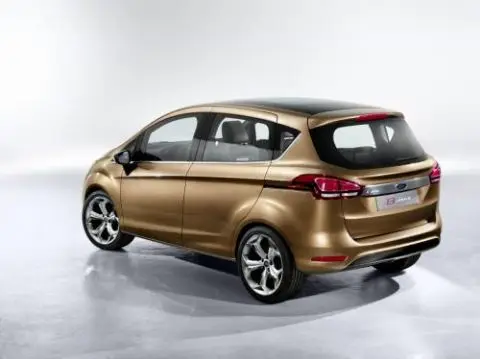
The Ford B-Max was a small MPV built by Ford of Europe from 2012 to 2017 on the global B platform shared with the Fiesta. It was shown as a concept at Geneva in 2011 and launched at the Mobile World Congress in Barcelona in 2012, and it stood out for its rear sliding doors and the complete absence of a B-pillar.
Ford B-Max at a glance
| Maker | Ford of Europe, Craiova, Romania |
|---|---|
| Production | June 2012 – September 2017 |
| Class | mini MPV |
| Platform | Ford global B, shared with the Fiesta |
| Concept shown | Geneva Motor Show 2011 |
| Launch | Mobile World Congress, Barcelona, 2012 |
| Doors | rear sliding doors, no B-pillar |
| Engines | 1.0 EcoBoost three-cylinder, 1.6 Duratec, 1.4 |
| Gearboxes | manual, or six-speed PowerShift dual-clutch |
| Trims | Studio, Zetec, Titanium |
| Safety | five stars in Euro NCAP, September 2012 |
| Rivals | Citroën C3 Picasso, Kia Venga, Vauxhall Meriva |
This page is based on English Wikipedia only.
History of the Ford B-Max
An MPV from a hatchback
The B-Max was built on the same small-car platform as the Fiesta and continued Ford’s Kinetic Design styling theme. Production started in June 2012, the first cars were marketed from late July and the model reached Britain on 1 September 2012. The first B-Max was bought by the President of Romania, Traian Băsescu, on 25 June 2012 directly from the Craiova plant. It was sold in more than thirty countries, mostly in Europe.
The doors that replaced a pillar
The car’s defining feature was its sliding rear doors with no B-pillar between front and rear doors, which opened up a wide side aperture for loading children or luggage in tight parking spaces. Under the skin the B-Max offered Ford’s 1.0-litre three-cylinder EcoBoost engine with turbocharging, direct injection and start-stop, an engine that was named International Engine of the Year in 2012. The 1.6-litre Duratec could be ordered with the six-speed PowerShift dual-clutch gearbox.
Equipment and the end
The B-Max came with Ford’s “Intelligent Protection” system, Torque Vectoring Control, SYNC and a Fold Flat system, and with Emergency Assistance, which alerts local emergency services after an accident in the right language for the region. Euro NCAP gave it five stars in September 2012. Production ended in September 2017 as demand for mini MPVs fell; unusually for a Ford, the car never received a mid-cycle facelift, and the EcoSport and Fiesta Active took over its role as buyers moved to SUVs.
Design and features
- No B-pillar: a wide side opening created by sliding rear doors.
- 1.0 EcoBoost: turbocharged three-cylinder of the 2012 International Engine of the Year family.
- Five-star safety: Euro NCAP rating from September 2012.
- Compact footprint: Fiesta-based packaging with MPV space.
Ford B-Max versions
- Studio: the basic trim, offered only with the 1.4-litre engine.
- Zetec: the mid-range trim.
- Titanium: the top trim.
- PowerShift version: 1.6 Duratec with a six-speed dual-clutch gearbox.
The B-Max was based on the Ford Fiesta and sat below the larger MPVs of the range. More Ford vehicles are in the Ford collection.
Sources
- Ford B-Max, English Wikipedia: launch, doors, engines, equipment, end of production