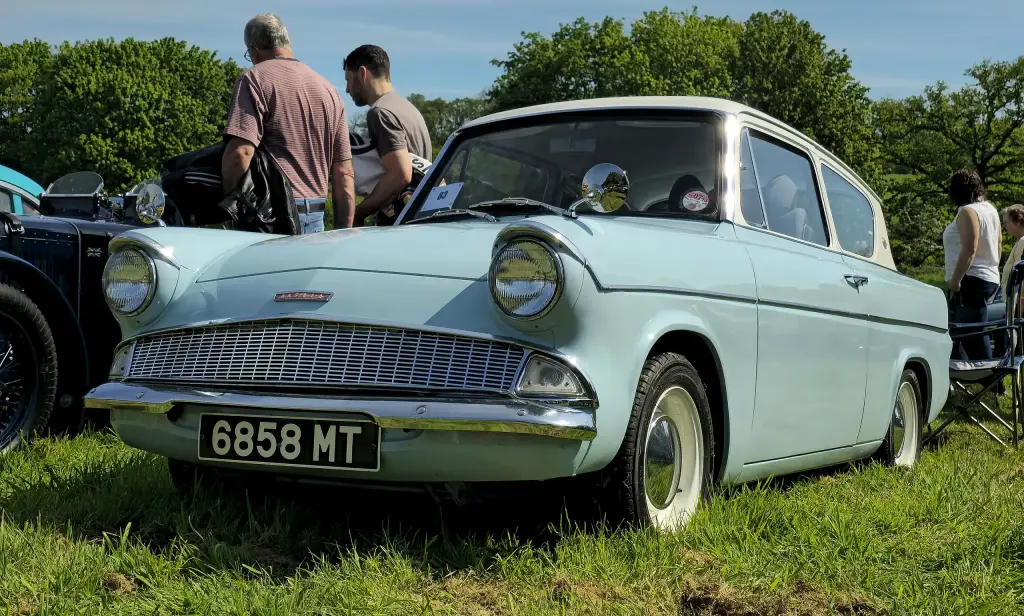
The Ford Anglia was the small car of Ford of Britain from 1939 to 1967, built alongside the Prefect and later the Popular. It went through four main generations and was replaced by the Escort, after a total of 1,594,486 cars.
Ford Anglia at a glance
| Maker | Ford of Britain, Dagenham |
|---|---|
| Production | 1939–1967 |
| Generations | E04A, E494A, 100E, 105E |
| Total built | 1,594,486 |
| Early engine | 933 cc side-valve four |
| Export engine | 1,172 cc four |
| E04A production | 55,807 |
| E494A production | 108,878 |
| Predecessor | Ford 7Y |
| Successor | Ford Escort |
This page is based on English Wikipedia only.
History of the Ford Anglia
Anglia E04A (1939–1948)
The first Anglia, the E04A, was released on 31 October 1939 as the smallest car in the British Ford range, replacing the 7Y as a facelift of it. It was a simple, spartan car, mostly painted black, with an upright radiator, transverse leaf springs at both ends and mechanical brakes. A bulge at the back let the spare wheel move from the outside of the boot lid to the boot floor, which gained luggage space at the cost of some rear legroom. The domestic engine was the 933 cc side-valve four, with the 1,172 cc unit from the Ford Ten for exports such as North America. Production, interrupted by the war, ended in 1948 after 55,807 cars; Australia built its own A54A version from 1946 to 1948.
Anglia E494A (1949–1953)
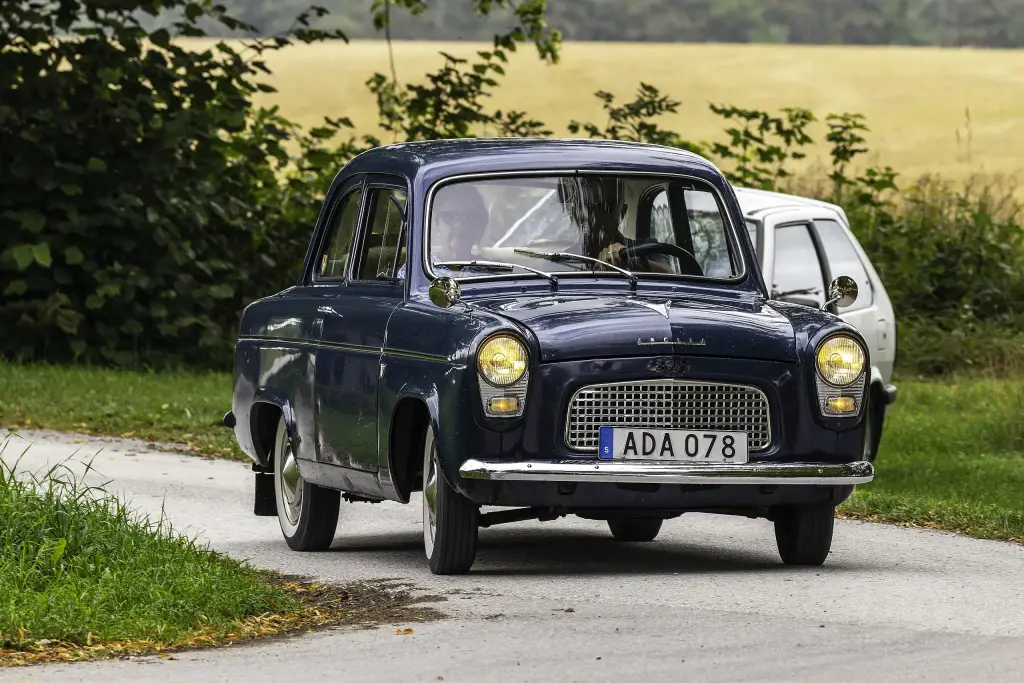
The 1949 car, the E494A, was a makeover of the E04A with a more 1940s front end and a sloped twin-lobed grille. It remained very spartan and in 1948 was Britain’s lowest-priced four-wheeled car. A test by The Motor in 1948 recorded a top speed of 57 mph, 0–50 mph in 38.3 seconds and 36.2 miles per imperial gallon, at a price of £309 including taxes. Including all production, 108,878 were built. When Anglia production ended in October 1953 the car continued as the even more basic Ford Popular until 1959.
The 100E and 105E
In 1953 Ford released the 100E, a completely new car whose style followed the larger British Fords. The last generation, the 105E of 1959, is the best remembered: its reverse-rake rear window and American-influenced lines made it a favourite with young drivers, and it stayed in production until 1967, when the Escort took its place. Ford Australia and Ford’s Italian subsidiary also built their own versions of the Anglia.
Design and features
- Simple engineering: side-valve engines, leaf springs and mechanical brakes on the early cars.
- Cheap motoring: the E494A was Britain’s cheapest four-wheeled car in 1948.
- Export engines: the 1,172 cc Ford Ten unit for overseas markets.
- Distinctive last generation: the 105E’s reverse-rake rear window.
Ford Anglia versions
- E04A (1939–1948): the first Anglia, 933 cc, 55,807 built.
- A54A (Australia, 1946–1948): saloon, tourer, coupe utility and panel van.
- E494A (1949–1953): new front end, 108,878 built.
- A494A (Australia, 1949–1953): four-door saloon, tourer and utilities.
- 100E (1953–1959): the completely new post-war shape.
- 105E (1959–1967): the reverse-rake model that ended the line.
The Anglia shared its basics with the Prefect and was continued in simplified form as the Popular. More cars are in the Ford collection.
Sources
- Ford Anglia, English Wikipedia: generations, engines, production, road test