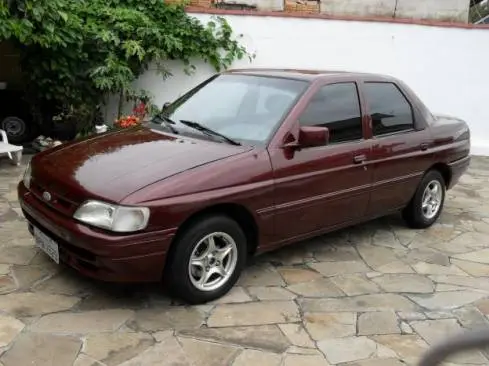
The Ford Verona and the Volkswagen Apollo were a pair of small family cars manufactured in Brazil by Autolatina, the joint venture of the Brazilian Ford and Volkswagen subsidiaries. The Verona was produced from 1989 to 1992 and again from 1993 to 1996, at first as a direct replacement for the ageing Ford Del Rey.
Ford Verona at a glance
| Maker | Autolatina, São Bernardo do Campo, Brazil |
|---|---|
| Production | 1989–1992 and 1993–1996 |
| Replaced | Ford Del Rey |
| Base | second-generation Ford Orion |
| Development cost | US$100 million, of which US$30 million for the line |
| Project code | Nevada |
| Bodies | two-door sedan only |
| Twin model | Volkswagen Apollo, from 1990 |
| Main rival | Chevrolet Monza |
| Replaced by | sixth-generation Escort saloon in 1996 |
This page is based on English Wikipedia only.
History of the Ford Verona
Why a two-door?
The first-generation Verona was released in November 1989, when Ford’s Brazilian subsidiary wanted a stronger competitor for the mid-size segment leader, the Chevrolet Monza, even though the car was based on a smaller-segment model. It was heavily based on the second-generation European Orion, which in turn used the front-wheel-drive “Erika” Escort platform of 1981. Compared with the Orion, the Verona had a unique body: a two-door sedan with a higher rear and horizontal tail lights whose styling strongly resembled the Sierra Sapphire, and it was the only derivation of the fourth-generation Escort with that body style. The two cars also differed mechanically, the Orion being four-door only and the Verona two-door only, and the Verona lacked some Orion equipment such as folding rear seats to cut costs. Ford considered building a four-door Orion in Brazil, but two-door sedans suited local demand better.
Autolatina and the Apollo
In 1986 the Argentine and Brazilian subsidiaries of Volkswagen and Ford formed the Autolatina joint venture, which led to a series of badge-engineered cars. The Verona was the first model to be rebranded in the alliance and its sibling was the Volkswagen Apollo, released in 1990. The alliance also gave Ford access to more powerful engines, better suited to the segment, since poor performance had been one of the most common complaints about the Del Rey it replaced. Codenamed Nevada, the Verona cost Ford do Brasil US$70 million to develop, with another US$30 million spent updating the São Bernardo do Campo assembly line; the aim was a competitive mid-size car without excessive spending, given the subsidiary’s weak finances. The final name was chosen by computer from 22 options including Stallion, Novara and the project code Nevada.
Two lives
Autolatina stopped making the Verona and Apollo in 1992 after only three years, but a year later the locally built third-generation Orion returned under the Verona nameplate, and that car lasted until 1996, when it was replaced by the sixth-generation Ford Escort saloon.
Design and features
- Two doors only: a body style unique to the Verona among Escort derivations.
- Orion base: the European second-generation Orion platform.
- Autolatina twin: sold as the Volkswagen Apollo from 1990.
- Value engineering: simplified equipment to keep the price down.
Ford Verona versions
- Verona Mk I (1989–1992): the two-door car based on the Orion Mk II.
- Volkswagen Apollo (1990): the VW-badged twin.
- Verona Mk II (1993–1996): the version based on the third-generation Orion.
The Verona was based on the Orion and shared the Brazilian range with the Versailles and Royale. More Ford vehicles are in the Ford collection.
Sources
- Ford Verona, English Wikipedia: origins, body, Autolatina, development cost