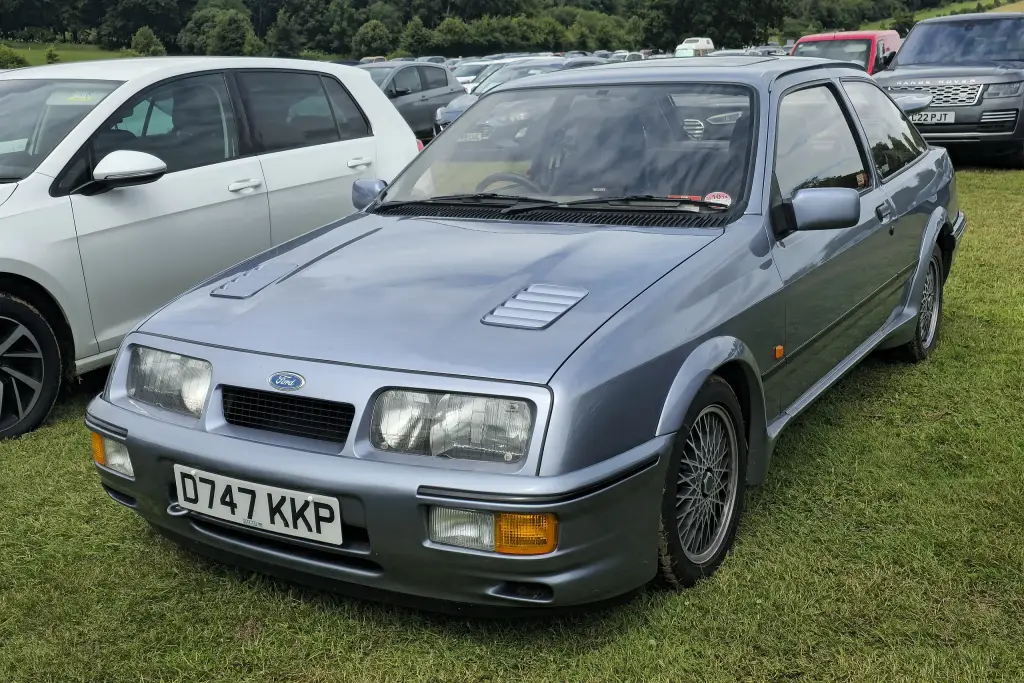
The Ford Sierra RS Cosworth is a high-performance version of the Ford Sierra, built by Ford Europe from 1986 to 1992. It was the result of a Ford Motorsport project aimed at producing an outright winner for Group A racing in Europe.
Ford Sierra RS Cosworth at a glance
| Built | 1986 to 1992 |
|---|---|
| Shown | Geneva Motor Show, March 1985; on sale July 1986 |
| First series | 5,545 built at Genk, Belgium, 500 of them converted to the RS500 |
| Engine | turbocharged Cosworth YB 2.0-litre four, 204 PS (150 kW) |
| Gearbox | Borg-Warner T5 five-speed manual, rear-wheel drive |
| Performance, 1986 catalogue | 149 mph (240 km/h) and 0–60 mph in 6.5 seconds |
| Drag coefficient | 0.345 |
| Colours | black, white and moonstone blue |
| RS500 | announced July 1987, homologated August 1987, 227 PS (167 kW), 500 built |
| RS500 race record | 84.6% of the races it entered won, according to Motorsport magazine |
History of the Ford Sierra RS Cosworth
The project was defined by Stuart Turner in the spring of 1983. He had just been appointed head of Ford Motorsport in Europe and realised that Ford was no longer competitive. Turner got the support of Walter Hayes, the Ford vice-president who had earlier driven the development of the Ford GT40 and the Cosworth DFV engine. Ford’s partner Cosworth then showed a project it had started on its own, the YAA engine, a twin-cam 16-valve unit based on Ford’s T88 “Pinto” block. Ford requested a turbocharged version capable of 180 hp on the street and 300 hp in race trim. Cosworth agreed on two conditions: the road engine had to produce at least 150 kW (201 hp), and Ford had to take no fewer than 15,000 engines. Turner needed only about 5,000, but Ford accepted, and the spare engines later became one reason for a four-door Sierra RS Cosworth.
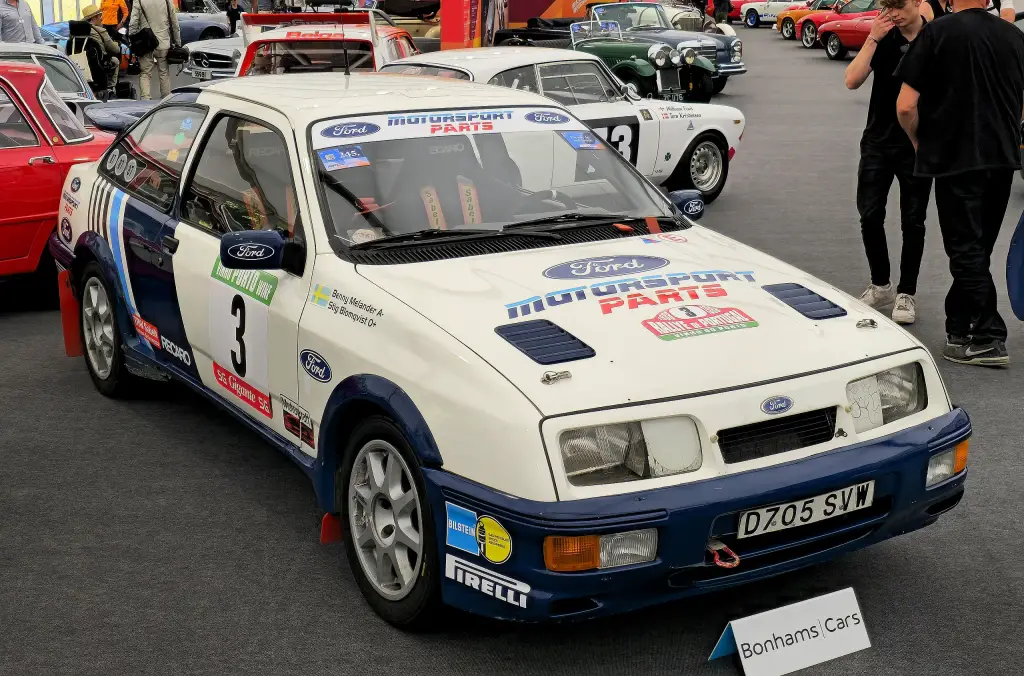
In April 1983 the team chose the Sierra, which met the need for rear-wheel drive and decent drag. A racing version could also repair the poor and somewhat undeserved reputation the Sierra had earned since 1982. Lothar Pinske, responsible for the bodywork, demanded carte blanche because the Sierra hatchback generated significant lift even at moderate speed. After wind-tunnel tests and runs at Nardò, a prototype was shown that raised little enthusiasm, especially the large rear wing. Pinske insisted that the wing was essential to keep contact with the road at 300 km/h, that the opening between the headlights fed air to the intercooler and that the wheel-arch extensions were needed for 10-inch-wide racing wheels. The designers agreed to try a production version.
Selling 5,000 cars
Group A required 5,000 cars to be built and sold. When Hayes surveyed European dealers in 1984 they estimated they could sell 1,500. He kept up his internal campaign, dealers were invited to test drives, and Ford cut the price by offering only three exterior colours and one interior colour, with just two equipment options. The car was shown in Geneva in March 1985 and launched in July 1986. The German source notes that series production of the Cosworth models began in early 1986, and that the road engine produced 204 PS.
RS500
To make the car unbeatable, Mike Moreton led a team that planned an evolution model, and in March 1987 Aston Martin Tickford was signed to convert 500 cars. The RS500 was announced in July 1987 and homologated in August. It had a thicker-walled engine block, a larger Garrett T04 turbocharger and intercooler, a second set of fuel injectors and a second fuel rail that was not functional in the road version, and it produced 227 PS and 277 N·m. Outside it had an extra lower spoiler on the tailgate, a gurney flap on the upper “whale tail” and a redesigned front bumper without fog lamps. Exactly 500 were built from cars produced at Genk in December 1986, all right-hand drive for the UK. Black was planned, but 56 white and 52 moonstone blue cars were also made.
Racing
Once the RS500 was homologated, Ford took pole position in all of the remaining six 1987 World Touring Car Championship events and the works Eggenberger team won the entrants’ title. Klaus Ludwig won the 1988 DTM drivers’ title in an RS500, Robb Gravett won the 1990 British Touring Car Championship, and the car won the Bathurst 1000 in 1988 and 1989 and the Spa 24 Hours in 1989. Its dominance is seen as the catalyst for the downfall of the Group A format, and with the Sierra due to be replaced by the Mondeo, Ford saw no reason to produce another evolution model. In rallying the rear-drive car never won a loose-surface World Rally Championship event but frequently finished in the top five with drivers such as Stig Blomqvist, Carlos Sainz and Ari Vatanen, and a young Didier Auriol won the 1988 Corsica Rally outright. A four-door Sierra RS Cosworth followed in February 1988.
Design and features
- Body: a three-door Sierra with a large rear wing, an opening between the headlights for the intercooler and wide wheel arches.
- Engine: a turbocharged 16-valve Cosworth four on the old Pinto block.
- Price cut: three colours, one interior and two equipment options.
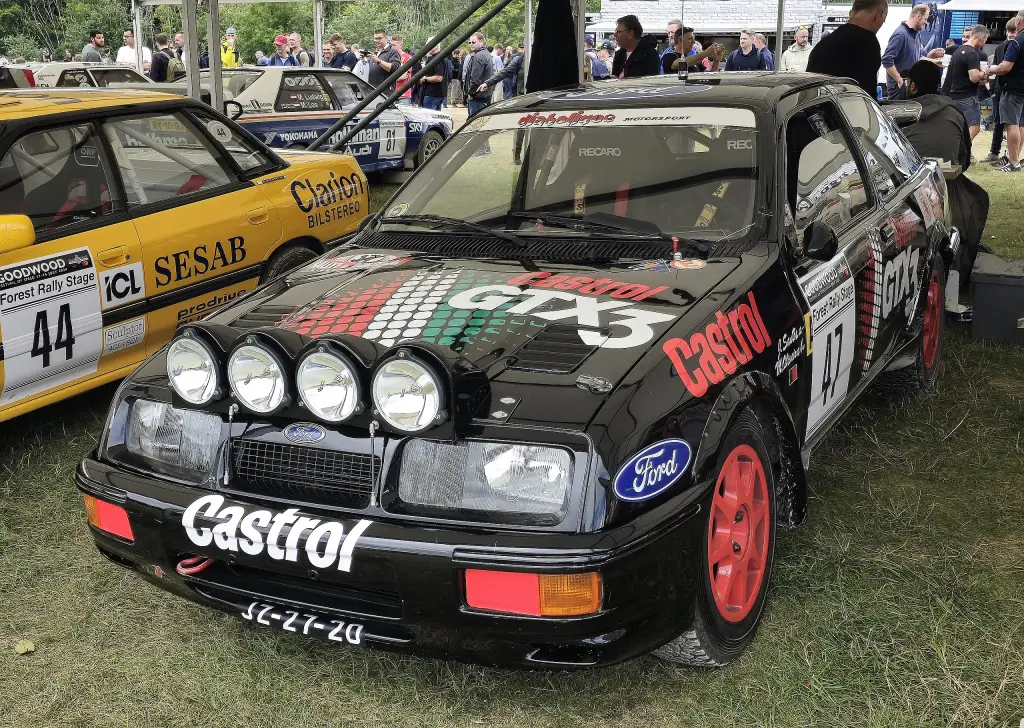
Ford Sierra RS Cosworth versions
- Sierra RS Cosworth (1986): the three-door homologation car.
- Sierra RS500 Cosworth (1987): 500 evolution cars converted by Tickford.
- Four-door RS Cosworth (1988): a saloon on the second-generation Sierra.
The Sierra was followed in the same spirit by the Ford Escort RS Cosworth, and its racing story belongs to the guide to homologation specials. See also the Ford Sierra and the Ford collection.
Sources
- Ford Sierra RS Cosworth, English Wikipedia: development, production, RS500, motorsport
- Ford Sierra, German Wikipedia: engine output, production, four-door car