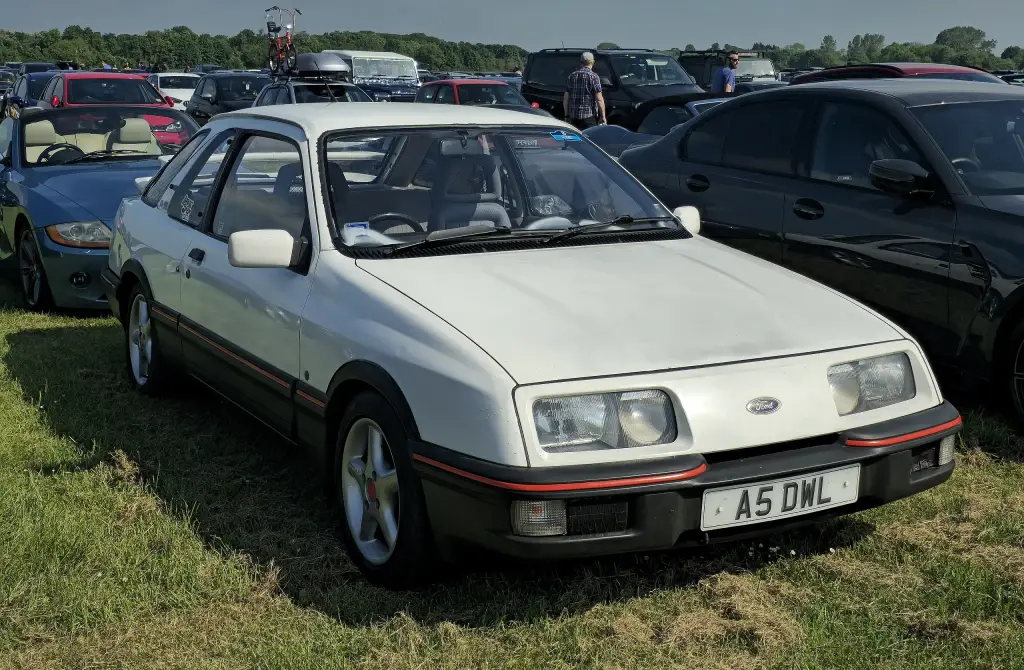
The Ford Sierra was a mid-size family car manufactured and marketed by Ford of Europe from 1982 to 1993. Launched as a three- or five-door hatchback or a five-door estate, it replaced the Taunus and Cortina, and its aerodynamic shape divided opinion.
Ford Sierra at a glance
| Maker | Ford of Europe, mainly Belgium and Britain |
|---|---|
| Production | 1982–1993 |
| Development code | Project Toni, from 1978 |
| Designers | Uwe Bahnsen, Robert Lutz, Patrick Le Quément |
| Launch bodies | three- and five-door hatchback, five-door estate |
| Van | car-derived van added in 1984 |
| Saloon | Sierra Sapphire, from 1987 |
| Drive | rear-wheel drive, four-wheel drive on some models |
| Drag coefficient | 0.34, against 0.45 for the Cortina and Taunus |
| Debut | British International Motor Show, Birmingham, 1982 |
| Sales began | 15 October 1982 |
| Also assembled | Cork, Argentina, Venezuela, South Africa, New Zealand |
This page is based on English Wikipedia only.
History of the Ford Sierra
Replacing two nameplates at once
By 1978 Ford of Europe was working on a new mid-range model, codenamed Project Toni, to replace the Cortina and Taunus twins in the early 1980s. Although still popular, the outgoing cars were 12 years old in design: the TC2 shape had arrived in 1976 and the lightly reworked TC3 and Mk 5 three years later, but both were reskinned versions of the 1970 TC and Mk 3 with few mechanical changes. Ford’s direction had already been shown by the Escort Mk III of 1980, which replaced conventional saloons with aerodynamically styled hatchbacks. In 1981 Ford confirmed the Sierra name, ending the Taunus and Cortina nameplates after 43 years and nine generations, and 20 years and five generations respectively, and in September 1981 it showed the Probe III concept at Frankfurt as a hint of the new car.
The jellymould
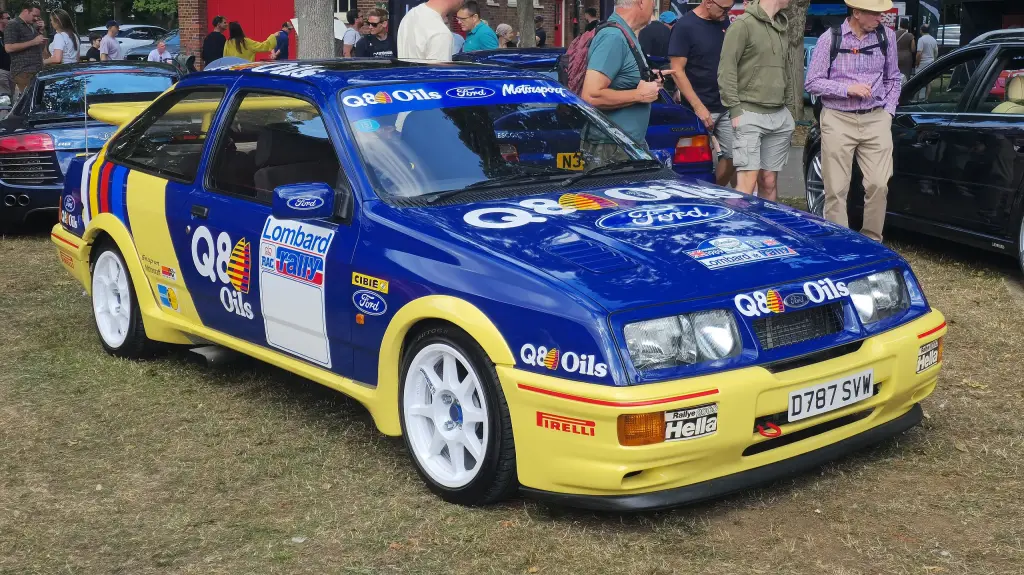
After the sharp-edged three-box styling of its predecessors the Sierra was nicknamed “the jellymould”, but the shape had a purpose: it produced a drag coefficient of 0.34 against 0.45 for the boxy Taunus and Cortina, which Ford said cut fuel consumption and even compensated for the V6 engines. The interior was more conventional, with a dashboard angled towards the driver in the manner of BMW. The car was designed by Uwe Bahnsen, Robert Lutz and Patrick Le Quément, and it debuted at the 1982 British International Motor Show in Birmingham before appearing at the Paris Salon; sales began on 15 October 1982. Its aerodynamic styling and the initial absence of a saloon alienated many conservative buyers, including company car drivers.
A saloon, a van and a long life
A car-derived van joined in 1984, and the four-door Sierra Sapphire saloon arrived in 1987 with a facelift of the range. Most cars were built in Belgium and Britain, and Sierras were also assembled in Cork in Ireland, Argentina, Venezuela, South Africa and New Zealand. Production ran until 1993, when the Mondeo took over.
Design and features
- Aerodynamic shape: a drag coefficient of 0.34 instead of 0.45.
- Hatchback first: no saloon at launch, which cost it conservative buyers.
- Sapphire: the four-door saloon added in 1987.
- Driver-focused cabin: a dashboard angled towards the driver.
Ford Sierra versions
- Three-door hatchback: the launch body style.
- Five-door hatchback and estate: the practical versions.
- Car-derived van (1984): a commercial version.
- Sierra Sapphire (1987): the four-door saloon.
- Four-wheel-drive models: offered on certain versions.
The Sierra replaced the Cortina and the Taunus, was replaced by the Mondeo, and its platform carried the Scorpio. More Ford vehicles are in the Ford collection.
Sources
- Ford Sierra, English Wikipedia: development, design, launch, bodies