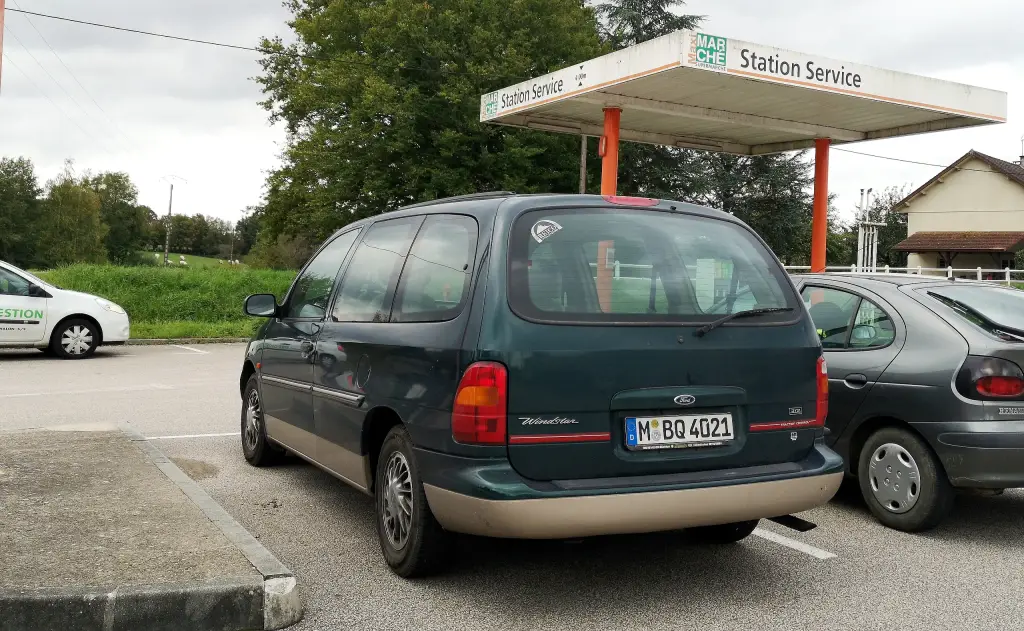
The Ford Windstar, later the Ford Freestar and Mercury Monterey, was a minivan produced and sold by Ford from the 1995 to 2007 model years. Ford’s second minivan line, it moved closer to the front-wheel-drive, two-box design of the Chrysler minivans and succeeded the Aerostar.
Ford Windstar at a glance
| Maker | Ford, Oakville Assembly, Ontario |
|---|---|
| Model years | 1995–2007 |
| Predecessor | Ford Aerostar |
| Layout | front-wheel drive, two-box body |
| Development code | WIN88, work from 1988 |
| Design | Camilo Pardo, frozen in 1990 |
| Name trademarked | 13 April 1992 |
| Total production | 1,984,232, including 1,704,786 Windstars |
| Later names | Ford Freestar and Mercury Monterey from 2004 |
| End | after 2007 with no direct replacement |
This page is based on English Wikipedia only.
History of the Ford Windstar
Why front-wheel drive
Ford launched the rear-wheel-drive Aerostar in 1985 with some success: it outsold the Chevrolet Astro, the Volkswagen Vanagon and its Japanese rivals but stayed second in the minivan segment behind Chrysler. To compete better, Ford decided its next minivan would use the front-wheel-drive layout Chrysler had popularised. Codenamed WIN88, development began in 1988 with a projected 1993 introduction for the 1994 model year, the design theme was settled by December 1989, and the exterior design by Camilo Pardo was frozen in 1990 with prototypes tested from early 1991. The Windstar name was trademarked on 13 April 1992 and development ended in 1993.
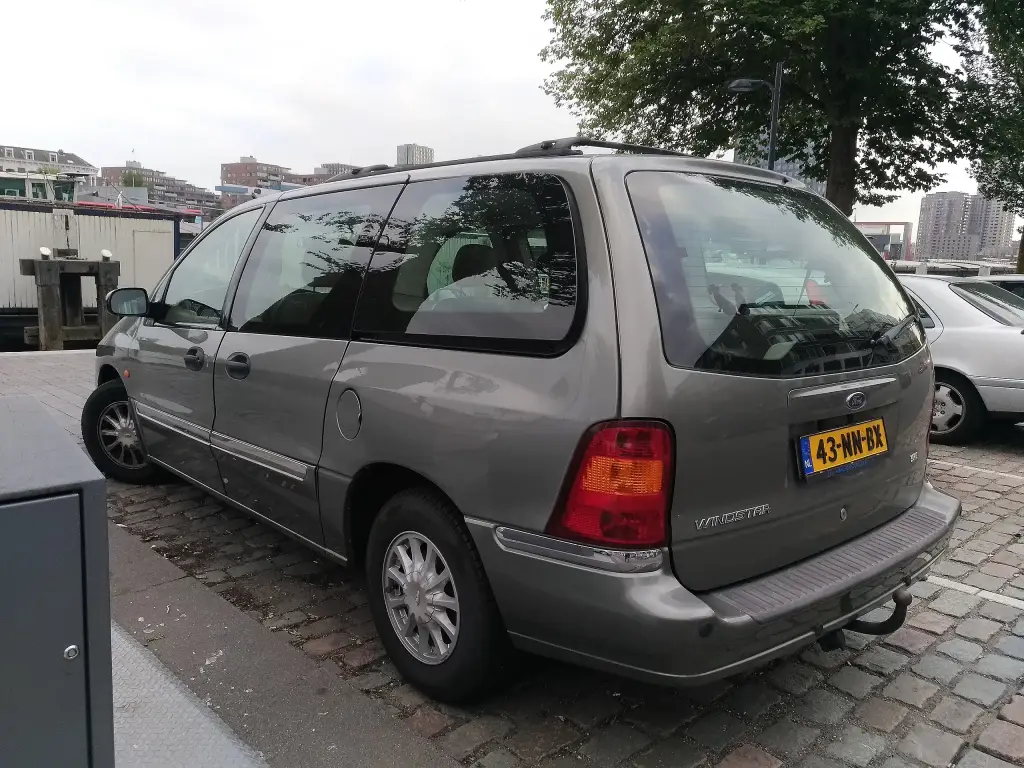
A two-box minivan
The Windstar adopted a two-box body and front-wheel drive, a clear break from the Aerostar’s rear-drive one-box shape, and it was the second minivan line designed by Ford. It was unrelated to the Nissan-developed Mercury Villager and was marketed without a Lincoln-Mercury counterpart at first, unlike the later Monterey.
Freestar, Monterey and the end
For 2004 the minivan took the Ford Freestar nameplate, and Mercury introduced its first Ford-produced minivan by reviving the Monterey name. All three were built at Oakville Assembly in Ontario: in total 1,984,232 were produced, of which 1,704,786 were Windstars, 246,493 Freestars and 32,953 Montereys. Following a decline in the minivan segment in the mid-2000s, the Freestar and Monterey were discontinued after the 2007 model year with no direct replacement; in North America their place was taken functionally by the seven-passenger 2008 Taurus X, and in Mexico by the Transit and Tourneo.
Design and features
- Front-wheel drive: Ford’s answer to the Chrysler minivans.
- Two-box body: a different shape from the Aerostar.
- Three names: Windstar, Freestar and Mercury Monterey.
- Nearly two million: total production at Oakville.
Ford Windstar versions
- Windstar (1995–2003): the original minivan, 1,704,786 built.
- Ford Freestar (2004–2007): the renamed version, 246,493 built.
- Mercury Monterey (2004–2007): the Mercury version, 32,953 built.
The Windstar replaced the Aerostar and shared the North American minivan market with the Econoline full-size vans. More Ford vehicles are in the Ford collection.
Sources
- Ford Windstar, English Wikipedia: development, design, production, end