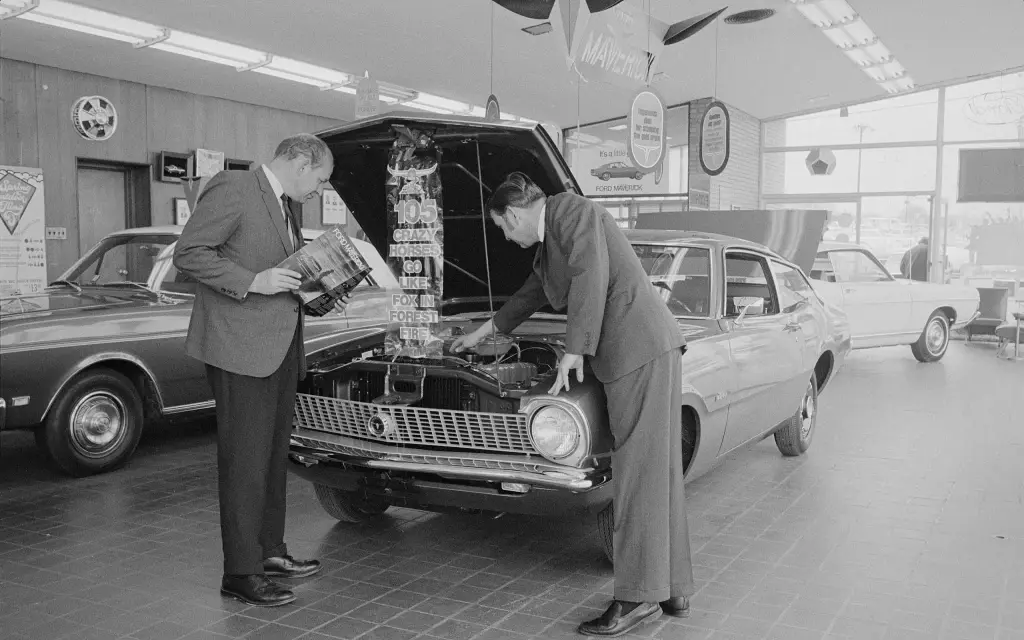
The Ford Maverick was a compact car manufactured and marketed by Ford from the 1970 to the 1977 model years. Its name came from unbranded range animals, and it replaced the Falcon in North America as Ford’s smallest car line for a time.
Ford Maverick at a glance
| Maker | Ford, North America, Venezuela and Brazil |
|---|---|
| Model years | 1970–1977 |
| Project name | Dragonfly II, from 1967 |
| Budget | US$100 million |
| Base price | US$1,995 |
| Chassis | Falcon, shortened to a 103-inch wheelbase |
| First body | two-door fastback coupe |
| Sedan | four-door added for 1971 |
| Twin model | Mercury Comet, 1971–1977 |
| Replaced by | Ford Fairmont for 1978 |
This page is based on English Wikipedia only.
History of the Ford Maverick
An import fighter
The Maverick was conceived as a subcompact “import fighter” to take on Japanese rivals in North America, mainly the Datsun 610 and Toyota Mark II. Ford’s research in the late 1960s found imports close to a million sales in 1968, and although the Pinto was already being developed, a gap existed for a car bigger than the Pinto and the Volkswagen Beetle but slightly smaller than the Falcon: large for import-minded buyers, small for buyers who preferred American brands. Development began in 1967 as Project Dragonfly II on a US$100 million budget, and by the end of that year the exterior design was nearly finished.
The simple machine
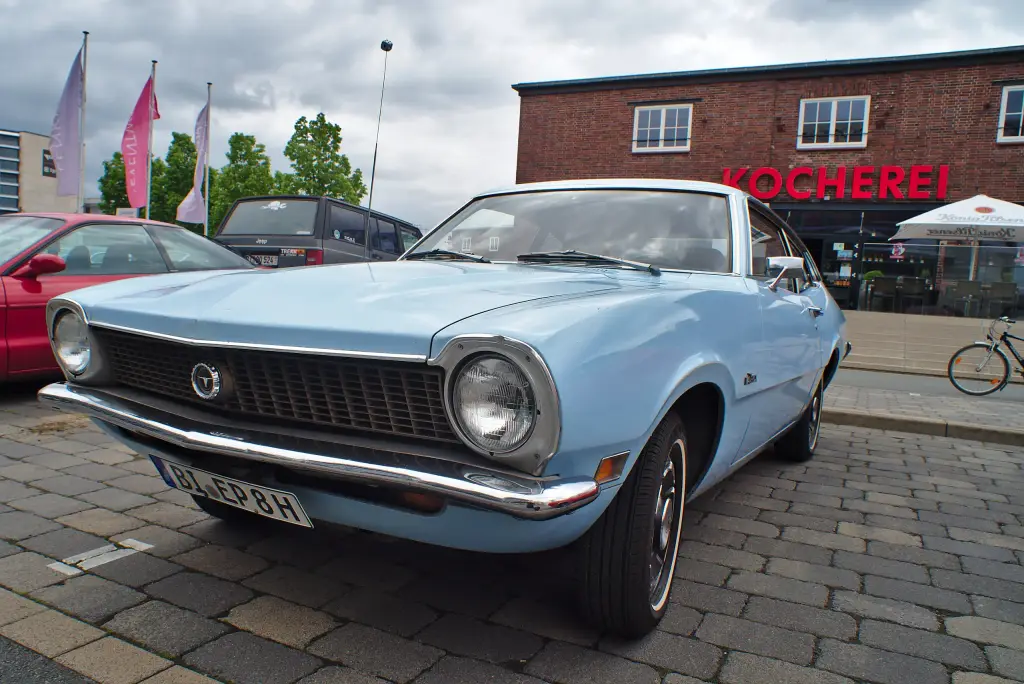
Although it replaced the Falcon, the project was effectively a continuation of it, using the same chassis shortened to a 103-inch wheelbase with the Falcon and Mustang brakes, suspension and drivetrain. The body was a two-door fastback with the long-hood, short-deck profile of the 1965–1968 Mustang and as little chrome as possible. A key goal was a base price under US$2,000, and the final US$1,995 came within US$500 of the Volkswagen Beetle and was only US$83 more than the 1960 Falcon. Badging was limited to the hubcaps and the nameplate, and the interior had an instrument cluster with only a speedometer and fuel gauge, no glovebox and a European-style shelf under the dashboard. The name was trademarked at the end of 1968 and taken from the free-range cattle of the American Southwest.
Sales and replacement
The car began as a two-door fastback coupe, with a four-door sedan added for 1971, and Lincoln-Mercury sold the Mercury Comet as its divisional counterpart from 1971 to 1977. Ford intended the Granada to replace the Maverick for 1975, but demand rose after the 1973 fuel crisis, so the Maverick stayed as the entry-level compact while the Granada was repackaged as a premium car. The Maverick was replaced by the Fairmont, the first car on the Fox platform, after the 1977 model year, and was built in North America, Venezuela and Brazil.
Design and features
- Import fighter: designed to beat Japanese compacts on price and size.
- $1,995: within US$500 of a Volkswagen Beetle at launch.
- Falcon chassis: shortened running gear shared with the Falcon and Mustang.
- Minimal trim: hubcap badging and a speedometer-and-fuel-gauge cluster.
Ford Maverick versions
- Two-door fastback (1970): the original body style.
- Four-door sedan (1971): the added body style.
- Mercury Comet: the Lincoln-Mercury version, 1971–1977.
- South American cars: built in Venezuela and Brazil.
The Maverick replaced the Falcon in North America and used its chassis, and it was meant to give way to the Granada before staying on as the entry-level car. More Ford vehicles are in the Ford collection.
Sources
- Ford Maverick (1970-1977), English Wikipedia: development, price, chassis, replacement