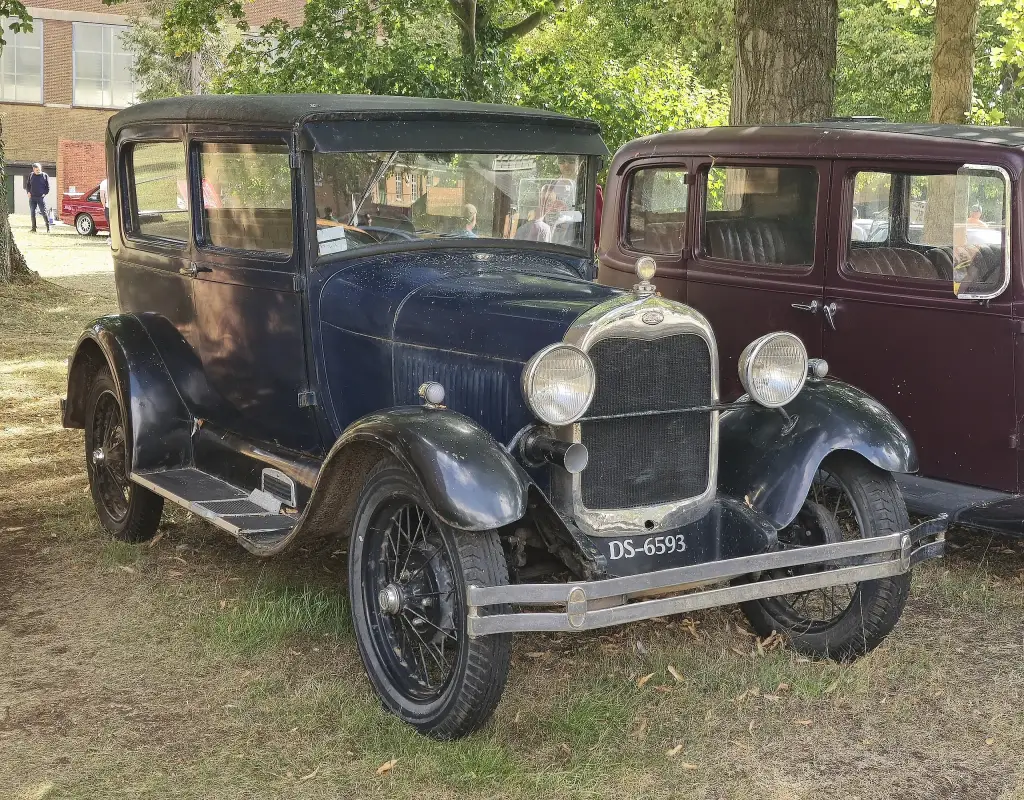
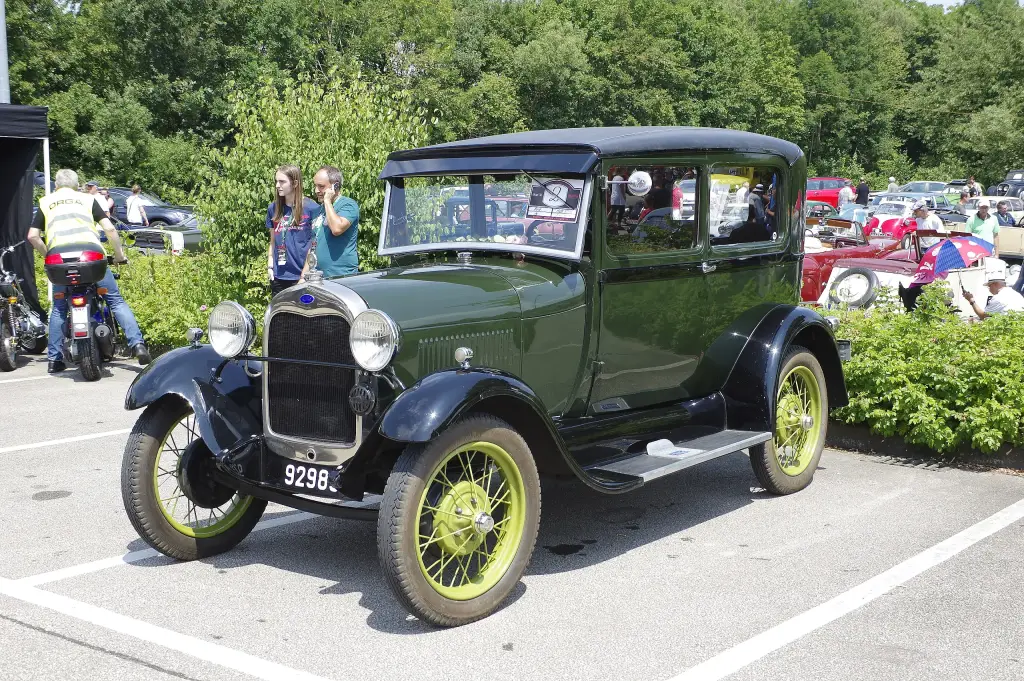
The Ford Model A was built by Ford as the replacement for the Model T, which had been in production for 18 years. First produced on 20 October 1927 but not introduced until 2 December, it was sold as a 1928 model, and it used a name Ford had already given to a car in 1903–04.
Ford Model A at a glance
| Maker | Ford Motor Company |
|---|---|
| Production | October 1927 – March 1932 |
| Designated | 1928 model |
| Built | 4,858,644 in all body styles |
| Engine | 201 cu in (3.3 L) L-head four, 40 hp |
| Top speed | around 65 mph |
| Wheelbase | 103.5 in |
| Gearbox | three-speed sliding-gear manual, unsynchronised |
| Prices | US$385 roadster to US$1,400 town car |
| Body styles | nine by March 1930, from Tudor to town car |
| Replaced by | Model B and Model 18 |
| Licensed version | GAZ-A in the Soviet Union, 1932–1936 |
This page is based on English Wikipedia only.
History of the Ford Model A
A million before the first birthday
The Model A was a complete replacement for the Model T, first produced on 20 October 1927 and introduced on 2 December that year as a 1928 model in four standard colours. Sales were enormous: one million Model As had been sold by 4 February 1929 and two million by 24 July, and in March 1930 the total passed three million with nine body styles on offer. The range ran from a Tudor at US$500 to a town car with a dual cowl at US$1,200, and prices started at US$385 for a roadster.
How it was built
The engine was a water-cooled L-head four of 201 cubic inches and 40 hp, giving a top speed of about 65 mph, with a 103.5-inch wheelbase, a final drive ratio of 3.77:1, an unsynchronised three-speed sliding-gear manual gearbox and four-wheel mechanical drum brakes. It was the first Ford to use the standard set of driver controls with a conventional clutch and brake pedals, throttle and gearshift, although the brake and throttle pedals were reversed compared with modern cars. The fuel tank sat in the cowl with a visual gauge and fed the carburettor by gravity, and the Model A was one of the first production cars with safety glass in the windscreen.
Bodies and the end
The Model A came in a huge range of styles: standard and deluxe coupes, a business coupe, sports coupe, roadster coupes, convertible cabriolet and sedan, phaetons, Tudor and Fordor sedans, town car and town sedan, Victoria, station wagon, taxicab, truck and commercial bodies, with the rare special coupe built from about March 1928 to mid-1929. Production ended in March 1932 after 4,858,644 cars in all body styles, and the replacement was the Model B with an updated four and the Model 18 with Ford’s new flathead V8. In the Soviet Union, GAZ built a licensed version called the GAZ-A from 1932 to 1936, while in Britain Ford used a smaller 2,043 cc engine because of the tax rules, which made the car expensive to own and no match for the mass market.
Design and features
- Modern controls: the first Ford with a conventional pedal and gear lever layout.
- Massive demand: a million cars sold within 14 months of launch.
- Huge choice: nine body styles by 1930, from roadster to town car.
- Safety glass: among the first production cars with a safety-glass windscreen.
Ford Model A versions
- Tudor and Fordor: the two- and four-door sedans, from US$500.
- Roadster and phaeton: open bodies from US$385.
- Town car: the most expensive body, up to US$1,400.
- Special coupe: the rare body built from 1928 to 1929.
- GAZ-A: the Soviet licensed version.
The Model A replaced the Model T and was followed by the 1932 Ford, with a truck version in the Model AA. More Ford vehicles are in the Ford collection.
Sources
- Ford Model A (1927-1932), English Wikipedia: production, engine, bodies, prices