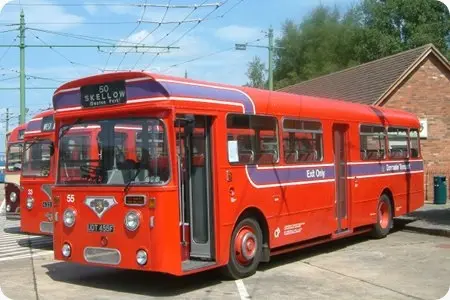
The Ford R series was a range of single-decker bus and coach chassis built by Ford, developed from designs made by Thames Trader until the mid-1960s. It shared components with the D series lorry, including an engine mounted vertically at the front ahead of the front axle so that passengers could board opposite the driver.
Ford R series at a glance
| Maker | Ford UK |
|---|---|
| Type | single-decker bus and coach chassis |
| Origin | Thames Trader designs |
| Shared parts | D series lorry, including the engine |
| Original models | R192 and longer R226 |
| Later models | R1014 and R1114, about 10 and 11 metres, 140 bhp |
| Final models | R1015 and R1115 by the mid-1980s |
| 1978 change | turbocharged diesel tilted to one side to lower the floor |
| Gearbox | synchromesh standard, Allison automatic on some later cars |
| End of production | 1985, last chassis about 1986 |
This page is based on English Wikipedia only.
History of the Ford R series
A bus built like a lorry
The R series grew out of designs made by Thames Trader and shared a number of components with the D series lorry, including the engine. That engine was mounted vertically at the front of the vehicle, ahead of the front axle, so that a passenger entrance could be placed opposite the driver. The original R192 and the longer R226 later became the R1014 and R1114, nominally 10 and 11 metres long with 140 bhp engines, and constant revision turned them into the R1015 and R1115 by the mid-1980s. Around 1978 the turbocharged diesel was tilted over to one side in an attempt to lower the floor height. Synchromesh transmission was standard, but some later examples had Allison automatic gearboxes to ease the driver’s work in towns.
The 1970s boom
In the United Kingdom the design was popular in the 1970s, when considerable financial assistance was available to operators for fleet renewal. After the election of the Conservative government in 1979 that subsidy money began to dry up, demand for full-size buses and coaches fell, and the last R series was built around 1986. Front-engined buses have generally fallen out of favour in Europe because new accessibility rules favour rear- or side-engined designs that allow a low front entrance.
Jersey and afterwards
A significant user was Jersey Motor Transport, which during the 1970s and 1980s bought little else: for several years its fleet was entirely this model, chosen because Ford was willing to supply chassis of non-standard width and length to suit local size limits. Many of those vehicles were bodied by Duple with its narrow Dominant body, earlier examples by Willowbrook and later ones by Wadham Stringer, and JMT also had longer and wider Plaxton-bodied buses from Trimdon Motor Services that needed special dispensation to operate on the island. The Inner London Education Authority used a similar model as school buses. Few R series buses remain in passenger use, but many have gone on to second lives as mobile homes and stock car transporters.
Design and features
- Front-mounted engine: vertical, ahead of the front axle, allowing a front entrance.
- Lorry parts: D series components and engines.
- Tilted engine: from 1978, to lower the floor.
- Non-standard sizes: chassis built to unusual widths and lengths for operators such as Jersey.
Ford R series versions
- R192 and R226: the original short and long chassis.
- R1014 and R1114: 10- and 11-metre versions with 140 bhp.
- R1015 and R1115: the updated models of the mid-1980s.
- Automatic cars: later examples with Allison gearboxes.
The R series was developed from Thames Trader designs and shared its engine with the D series. More Ford vehicles are in the Ford collection.
Sources
- Ford R series, English Wikipedia: models, engine position, operators, end