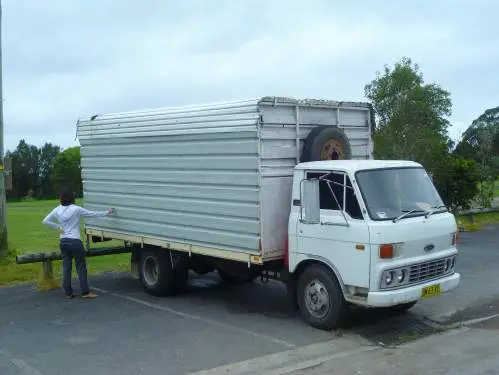
The Thames Trader was a range of trucks manufactured by Ford UK between 1957 and 1965. Its distinctive forward-control cab set it apart from other British commercial vehicles, and it was the first heavy commercial designed by Ford of Britain rather than taken from American designs.
Thames Trader at a glance
| Maker | Ford UK, Dagenham |
|---|---|
| Production | 1957–1965 |
| Type | forward-control truck range |
| Weight range | 2 to 7 tons |
| Wheelbases | 118 and 138 in lower weights, 138, 152 and 160 in heavy, 108 in tipper |
| Engines | Dagenham family, four- and six-cylinder petrol or diesel |
| Four-cylinder petrol | 3,261 cc, 68 bhp |
| Six-cylinder petrol | 4,891 cc, 110 bhp |
| Four-cylinder diesel | 3,613 cc, 70 bhp |
| Six-cylinder diesel | 5,419 cc, 100 bhp |
| Mk 2 | mid-1962, with new badges and grille lettering |
| Normal-control version | Thames Trader NC, from early 1962 |
This page is based on English Wikipedia only.
History of the Thames Trader
A British design at last
The Thames Trader’s distinctive cab was a forward-control design, and the model covered a much wider weight range than the existing normal-control ET Thames or the earlier forward-control 7V. Both of those earlier models had been based on Ford of America designs, while the new Thames Trader was the first heavy commercial to be designed by Ford of Britain, though its headlight surrounds hinted at a family resemblance to the American Ford C series truck of the mid-1950s.
Engines and chassis
The range covered weights from 2 to 7 tons with petrol or diesel engines in four- or six-cylinder form. Lower-weight vehicles came on 118- and 138-inch wheelbases and heavy vehicles on 138, 152 and 160 inches, with a 108-inch tipper wheelbase and a low-frame chassis for furniture van bodywork. All the engines came from the Dagenham family developed for the Fordson tractor in 1952 and updated to Mark 2 specifications: a 3,261 cc petrol four of 68 bhp, a 4,891 cc petrol six of 110 bhp, a 3,613 cc diesel four of 70 bhp and a 5,419 cc diesel six of 100 bhp, all with a 115 mm stroke and mounted at a 45-degree slant to leave more space above.
The Mk 2 and the normal-control car
A Mk 2 version arrived in mid-1962 and is easy to tell from the Mk 1: the earlier truck had THAMES TRADER in red on a chrome strip along the bonnet opening and a white grille with a vertical divider and a red four-star badge, while the Mk 2 had just THAMES under the bonnet and TRADER in spaced white letters between the headlights, with 4D or 6D badges on the front wings of diesel cars. Ford began building the Thames Trader NC, for normal control, at Dagenham in early 1962 using the cabin Ford Germany had developed for its slow-selling Köln truck, discontinued in 1961. The lighter NC had only the four-cylinder petrol or diesel engines, producing 73 and 70 bhp, and covered 1.5 to 5 long tons. After the Thames brand ended in 1965 the NC became the K Series. London Transport ordered five double-decker buses on Thames Trader chassis to carry cyclists through the Dartford Tunnel, with a bicycle deck below and the cyclists above, reached by a ladder; the service was dropped in 1965.
Design and features
- Forward-control cab: a distinctive British design unlike the American-based Fords before it.
- Wide range: from 2 to 7 tons on several wheelbases.
- Dagenham engines: the Fordson-derived family in petrol and diesel form.
- Normal-control NC: the 1962 model using a German-designed cabin.
Thames Trader versions
- Forward-control Thames Trader (1957–1965): the main range.
- Mk 2 (1962): the revised model with new badges and lettering.
- Thames Trader NC (1962–1965): the normal-control version, later the K Series.
- Low-frame chassis: for furniture van bodies.
- London Transport buses: five special double-deckers for cyclists.
The Thames Trader was replaced by the D series in 1965, and its chassis was developed into the R series bus range. More Ford vehicles are in the Ford collection.
Sources
- Thames Trader, English Wikipedia: design, engines, wheelbases, NC version, London Transport