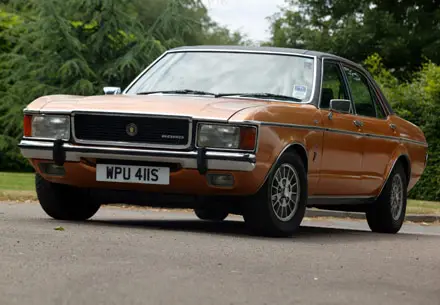
The European Ford Granada was an executive car built by Ford of Europe from 1972 until 1994. The first generation, launched in March 1972, succeeded the British Zephyr and the German P7 and completed the integration of Ford’s British and German model ranges.
Ford Granada at a glance
| Maker | Ford of Europe, Cologne and Dagenham |
|---|---|
| Production | 1972–1994 |
| Launched | March 1972 |
| Replaced | Ford Zephyr and the German P7 series |
| First-generation plants | Cologne and Dagenham; Cologne only from 1976 |
| Bodies | four-door saloon, five-door estate (Turnier), two-door coupe |
| British engines | Essex V4 2.0, Essex V6 2.5 and 3.0 |
| German engines | Taunus V4 1.7, Essex 3.0, Cologne V6 2.0, 2.3 and 2.6 |
| Front suspension | double wishbones instead of MacPherson struts |
| Rear brakes | drums, unlike the Zephyr’s discs |
| Third generation | 1985–1994, sold as the Scorpio outside Britain |
This page is based on English Wikipedia only.
History of the Ford Granada
One range for Britain and Germany
The Granada of March 1972 replaced both the British Ford Zephyr and the German P7 series and completed the integration of Ford’s two European ranges. At first the lower models were sold as Ford Consul, possibly because of a lawsuit by the Granada Group, a British conglomerate; the injunction failed on appeal and Ford registered the name, so from 1975 every car in the range was a Granada. The car soon became popular with taxi, fleet and police buyers, and British coachbuilders Coleman Milne and Woodall Nicholson converted it into limousines and hearses, including a four-door “coupe limousine” of which only 12 were built.
British and German engineering
The British Granada followed Ford convention with the Essex V4 of 2.0 litres and Essex V6s of 2.5 and 3.0 litres, while German cars used a 1.7-litre Taunus V4, the 3.0 Essex or, more commonly, the Cologne V6 in 2.0, 2.3 and 2.6 litres. The V4 option was short-lived and was replaced by the inline Pinto engine in 1974. The car kept the mechanical layout of its Zephyr predecessor with a coil-spring independent rear end, but front MacPherson struts gave way to double wishbones, which had appeared 18 months earlier on the smaller Cortina and Taunus. Like the 17M, 20M and 26M, the Granada had drum rear brakes rather than the Zephyr’s discs.
Bodies and the later generations
The range offered a four-door saloon, a five-door estate sold as the Turnier and a two-door fastback coupe; the early 1972–73 coupe had more pronounced Coke-bottle styling, revised in 1974 to straighter lines. A two-door saloon joined in May 1973, cutting the entry price in Germany by 415 marks, though it was never sold in Britain, and the revised coupe came to Britain only as a 3.0 Ghia. In continental Europe the 1976–77 cars could be ordered with a fuel-injected Cologne V6 of 150 PS. South Africa had the Granada Perana V8 from Basil Green Motors with a 302 cu in Windsor engine of 255 PS. A second generation replaced the first in 1977, and from 1985 to 1994 the Granada name was used in Britain and Ireland for the car sold elsewhere as the Ford Scorpio.
Design and features
- Two ranges merged: the first car to combine Ford of Britain and Ford of Germany engineering.
- Double wishbone front suspension: a change from the Zephyr’s MacPherson struts.
- Three bodies: saloon, Turnier estate and fastback coupe.
- Fleet favourite: widely used as a taxi, police car and company car.
Ford Granada versions
- Granada Mark I (1972–1977): saloon, estate and coupe, British and German engines.
- Consul-badged cars: the lower models until 1975.
- Granada Perana V8: South African version with a 302 cu in Windsor engine.
- Granada Mark II (1977–1985): the second generation.
- Granada Mark III (1985–1994): the Scorpio under the Granada name in Britain.
The Granada replaced the Zephyr and its cheaper versions were sold as the Consul, while its successor was sold in most of Europe as the Scorpio. More Ford vehicles are in the Ford collection.
Sources
- Ford Granada (Europe), English Wikipedia: launch, engines, bodies, later generations