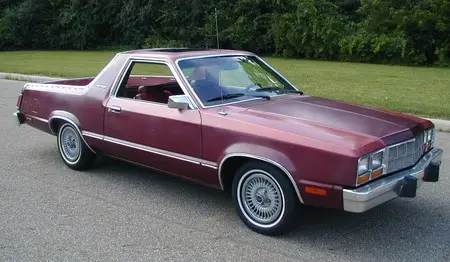
The Ford Durango was a two-seat coupe utility pickup sold in limited production between the 1979 and 1982 model years. It came from a joint venture between Ford and National Coach Works of Los Angeles, and it was built from the Ford Fairmont Futura coupe rather than on a line of its own.
Ford Durango at a glance
| Maker | Ford with National Coach Works, Los Angeles |
|---|---|
| Model years | 1979–1982 |
| Body | two-seat coupe utility |
| Base car | Ford Fairmont Futura two-door coupe |
| Engine | 200 cu in straight six |
| Gearbox | three-speed automatic |
| Converted | 212 known cars by National Coach Works |
| Estimated production | between the low 200s and 350 |
| Rival | downsized 1978 Chevrolet El Camino |
| Prototype builders | Jim Stephenson and his sons |
This page is based on English Wikipedia only.
History of the Ford Durango
A coupe utility for the Fairmont era
The Durango was developed as a possible competitor to the downsized 1978 Chevrolet El Camino, and Ford commissioned it to be sold through its dealers. Where the El Camino was based on the Chevrolet Malibu wagon, the Durango was closely related to the Fairmont Futura two-door coupe. Ford did not build it officially, and neither company kept totals: estimates range from the low 200s to 350 cars, with 212 conversions known to have been made by National Coach Works.
How it was made
The prototype was designed and built by Jim Stephenson and his sons Jim Jr and Bill at their shop in Pacoima, California, using hand-fabricated sheet metal; the fibreglass moulds for the pickup bed and tailgate were made by G&K Fiberglass in Sylmar. The rights to sell the Durango through Ford dealerships were licensed to National Coach Works after Hal Koch, a friend of Stephenson who worked there, saw the prototype. Production started from the Fairmont Futura body: the roof behind the B-pillar, the boot lid and the rear seats were removed, a flat-floor fibreglass cargo bed, a bulkhead and a new rear window were added behind the front seats, and the rear fascia above the bumper became a fold-down tailgate.
The details that identify one
Because the conversion was unofficial, converted cars have their own marks. Apart from a single prototype on a 1979 Mercury Z-7, every Durango was based on the Fairmont Futura, and only National Coach cars have a working tailgate, with a fibreglass filler panel between bed and tailgate that stores the hinges when it is folded down. Factory cars came only with the Fairmont’s mid-range 200 cubic-inch straight six and a three-speed automatic. Pickup, Van and 4WD magazine reported in December 1981 that only a little over 100 units were assembled before the model year ran out, and nearly all factory Durangos were built for 1981.
Design and features
- Fairmont base: a Futura coupe with its roof and boot removed behind the B-pillar.
- Fibreglass bed: a flat cargo floor, bulkhead and new rear window.
- Working tailgate: fitted only to the National Coach conversions.
- One powertrain: the 200 cu in six with a three-speed automatic.
Ford Durango versions
- Prototype: hand-built sheet-metal car by the Stephenson family.
- Mercury Z-7 prototype: the only car not based on the Fairmont Futura.
- National Coach conversions: 212 known cars, the only ones with a working tailgate.
- 1982 cars: a small number, of which the total is unknown.
The Durango was meant as an alternative to the Ranchero and was built from the Fairmont Futura coupe. More Ford vehicles are in the Ford collection.
Sources
- Ford Durango, English Wikipedia: origin, conversion, production estimates