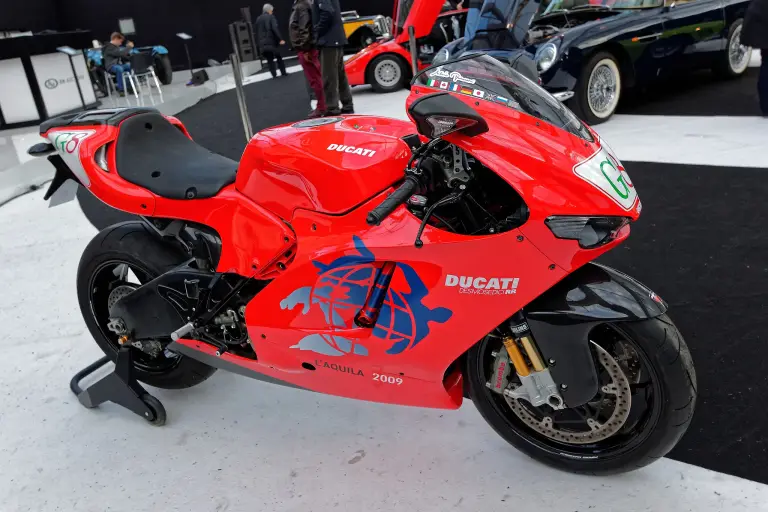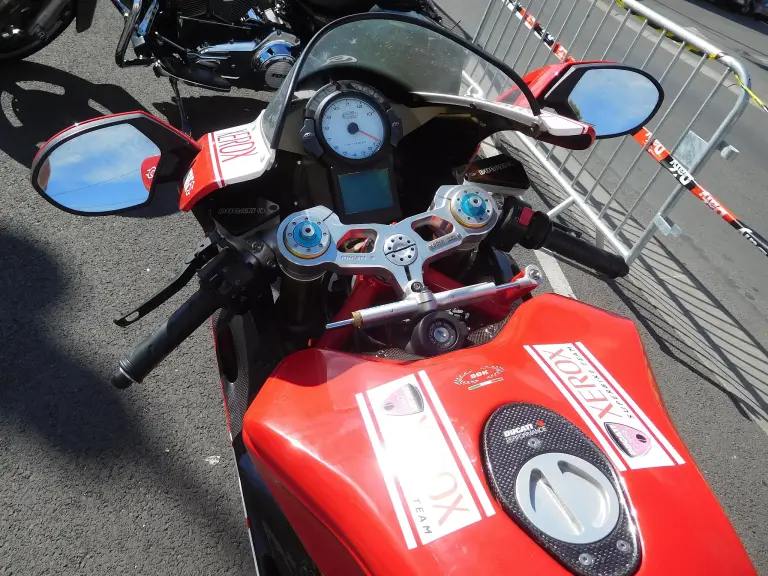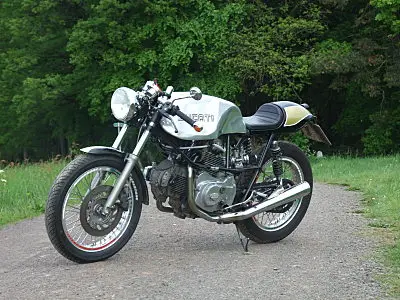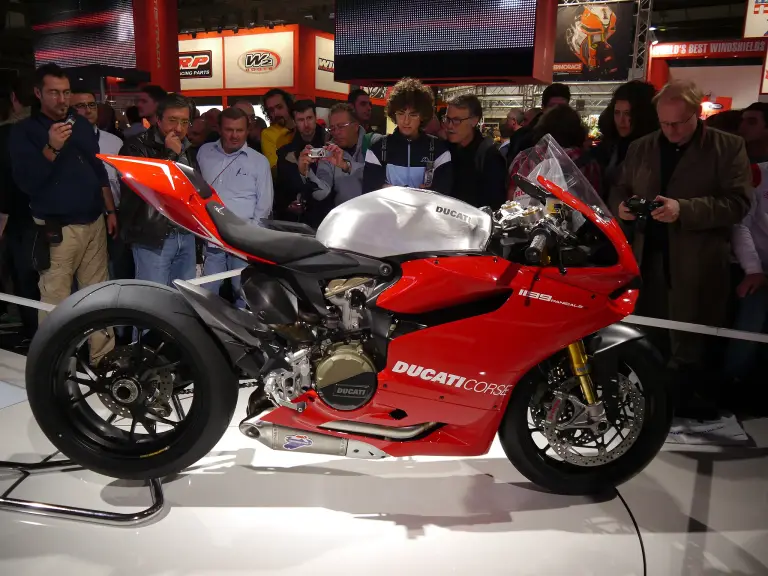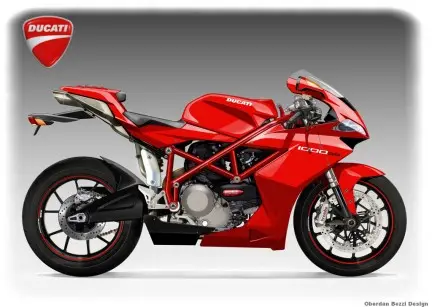
The Ducati Supersport and SS are a series of air-cooled four-stroke desmodromic two-valve 90° L-twin motorcycles made by Ducati from 1988 to 2007. A limited-edition Supersport, the SuperLight, was sold in 1992. The name harks back to the round-case 1973 Ducati 750 Super Sport and the square-case 750 and 900 Super Sport of 1975.
Ducati Supersport at a glance
| Maker | Ducati, Borgo Panigale |
|---|---|
| SS line | 1988–2007 |
| Engine | air-cooled four-stroke desmodromic two-valve 90° L-twin |
| 1988 engine | 904 cc Desmodue based on the Pantah, crankcases derived from the 851 |
| Frame | tubular trellis |
| 1974 Super Sport | 10.5:1 compression, 151 kg claimed, 401 built |
| 1975 square-case | 864 cc, 250 examples each of the 750 and 900 |
| SuperLight | limited edition of 1992 |
| TT Formula 1 | 1978 Isle of Man win by Mike Hailwood on a 900 Super Sport |
This article is based on one source, the English Wikipedia page on the Ducati Supersport, whose extract covers the history up to the start of the 1988 SS line.
History of the Ducati Supersport
Imola, 1972
Modern Ducati, and the Super Sport with it, can be traced back to April 1972, when Ducati won the Imola 200 with a for-production 750 cc desmodromic 90° V-twin developed by Fabio Taglioni. Ducati markets its 90° V-twin as an L-twin to stress the angle. Imola was a traditionally fast circuit that rewarded high-speed handling rather than brute horsepower. The Super Sport prototypes were developed from a 750 GT based engine and frame, and the legendary racer Paul Smart and Bruno Spaggiari finished first and second, lifting Ducati from a maker of “quaintly individual” motorcycles into the superbike market.
The prototypes and 1974
The first official Super Sport prototypes used the 750 Sport and 750 GT as their basis but wore bodywork styled like the Imola bikes: a blue frame with a fibreglass tank, covers and upper fairing in silver, and a translucent strip in the tank to show the fuel level. In 1974 the Super Sport entered mass production with 10.5:1 compression, a six-gallon tank and a claimed 151 kg. Only 401 were built, and the bike set new standards for production motorcycles; in effect it was a production racer with the minimum needed for the road. The complicated bevel-gear camshaft made it uneconomical to produce, so the 1974 model was the only round-case 90° V-twin with desmodromic valve gear. It is considered the most significant production bike in Ducati’s history, and essentially saved the company.
Square case, 1975–1981
In 1975 two versions appeared on the 864 cc square-case twin: the full 864 cc 900 and a sleeved-down 750. About 250 of each were made, and the two are virtually identical. The 1975 Super Sport still used a right-side gearshift, against the 1974 American rule requiring the lever on the left, though a handful reached the United States. Later changes were mostly to satisfy legislation: quieter mufflers, a relocated shift and rear brake, new footpegs and, most importantly, a redesigned kick-starter, since on the 1975 model it could rotate and engage first gear. The 750 cost almost as much as the 900, so few were built, most going to Australia, Germany or staying in Italy for racing. By 1978 the bike looked the same but the engine was more reliable, with crankshaft breakages solved, better electrics and a much improved gearshift; most 1978 900s had a dual seat and a lockable toolbox. That year Mike Hailwood won the Isle of Man TT Formula 1 race on a 900 Super Sport in his popular comeback. In 1979 the Super Sports were painted black with gold accents for the British market, cast Campagnolo wheels replaced the Borrani rims and a Mike Hailwood Replica appeared in limited numbers. In 1982 the model was replaced, mostly in name, by the S2.
The SS line from 1988
Announced in 1988, the Ducati Supersport used a Pantah-based 904 cc air-cooled two-valve Desmodue engine with crankcases derived from the 851, mounted in a tubular trellis frame. The SS name was applied only to these later belt-drive models, and the line continued until 2007, with the limited SuperLight of 1992 in between.
Design and features
- Imola pedigree: the line began with the 750 that won the 1972 Imola 200.
- Round-case desmo: the 1974 model, the only round-case twin with desmodromic valve gear, 401 built.
- Square case: the 864 cc 750 and 900 of 1975, 250 of each.
- Hailwood at the TT: the 1978 Formula 1 win at the Isle of Man on a 900 Super Sport.
- Belt-drive revival: the 1988 SS with a 904 cc Desmodue and 851-derived crankcases.
Ducati Supersport versions
- 750 Super Sport (1973–1974): the round-case model derived from the Imola racer.
- 750 and 900 Super Sport (1975–1981): square-case 864 cc twins, 250 of each.
- 900 Super Sport (1978): the most refined of the bevel models.
- Mike Hailwood Replica (1979–): a limited edition in green and red.
- SuperLight (1992): a limited-edition Supersport.
- SS (1988–2007): the air-cooled two-valve line with a Pantah-based engine.
The SS line shares its name with the earlier Ducati 750 GT family and its engine with the Ducati Pantah. The Monster used the 900 Supersport engine. More Ducatis are in the Ducati collection.
Sources
- Ducati Supersport, English Wikipedia: Imola, round-case and square-case Super Sports, SS line