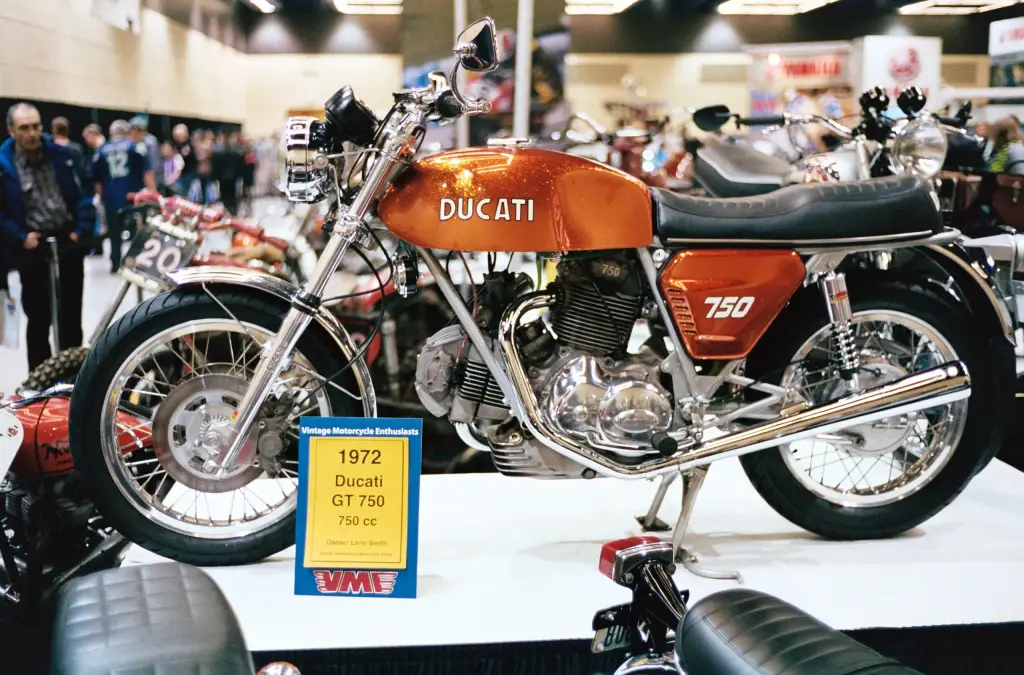
The Ducati 750 GT is a motorcycle that Ducati produced from 1971 to 1974, with a further 40 examples built in 1978. It was the first Ducati with a 90-degree V-twin engine, the layout that became the company’s signature.
Ducati 750 GT at a glance
| Maker | Ducati Meccanica, Borgo Panigale |
|---|---|
| Production | 1971–1974, plus 40 in 1978 |
| Total built | 4,133 |
| Designer | Fabio Taglioni |
| Engine | 90° V-twin, air-cooled, two valves per cylinder |
| Significance | the first Ducati V-twin |
| Racing link | basis for the 750 Sport Competizione that won at Imola in 1972 |
| Related models | 750 Sport, 750 SS |
The English article on the 750 GT is short; the history of the family comes from the Italian article on the 750 SS.
History of the Ducati 750 GT
The 750 GT was designed by Fabio Taglioni and introduced the 90-degree V-twin to Ducati, a configuration that every later Ducati twin would follow. It was built from 1971 to 1974, and Ducati added 40 more 750 GTs in 1978; the total over all years was 4,133 machines.
The GT was the touring side of the family. Its engine and chassis were the starting point for the sporting 750 Sport and, in 1972, for the 750 Sport Competizione with desmodromic valve gear that Paul Smart and Bruno Spaggiari rode to a famous one-two at the first Imola 200, a race for production-derived large-capacity machines.
That Imola result changed Ducati’s reputation, which until the 1960s had rested on small-capacity bikes. Demand followed for a road replica of the winning machines, and the 750 SS was produced from 1973 in small numbers, becoming the rarest and most sought-after Ducati of its day.
Design and features
- First Ducati V-twin: the 90-degree layout that defined every later Ducati twin.
- Taglioni design: the work of Ducati’s long-serving chief engineer.
- Touring focus: the practical member of the 750 family, from which the Sport and SS were developed.
- Racing pedigree by association: the same engine family took Ducati to the 1972 Imola 200 win.
Ducati 750 GT versions
- 750 GT (1971–1974): the standard road bike.
- 1978 batch: a further 40 machines built after the main run ended.
- 750 Sport: the sporting derivative with a narrower frame.
- 750 SS (1973–1977): the road replica of the Imola-winning machine, with desmodromic heads.
The 750 GT led to the 750 family and to the Pantah line that replaced it as Ducati’s sporting twin, while the 860 GT followed it as the bigger tourer. More Ducatis are in the Ducati collection.
Sources
- Ducati 750 GT, English Wikipedia: production years, total, engine layout
- Ducati 750 SS, Italian Wikipedia: Imola 1972, development from the GT