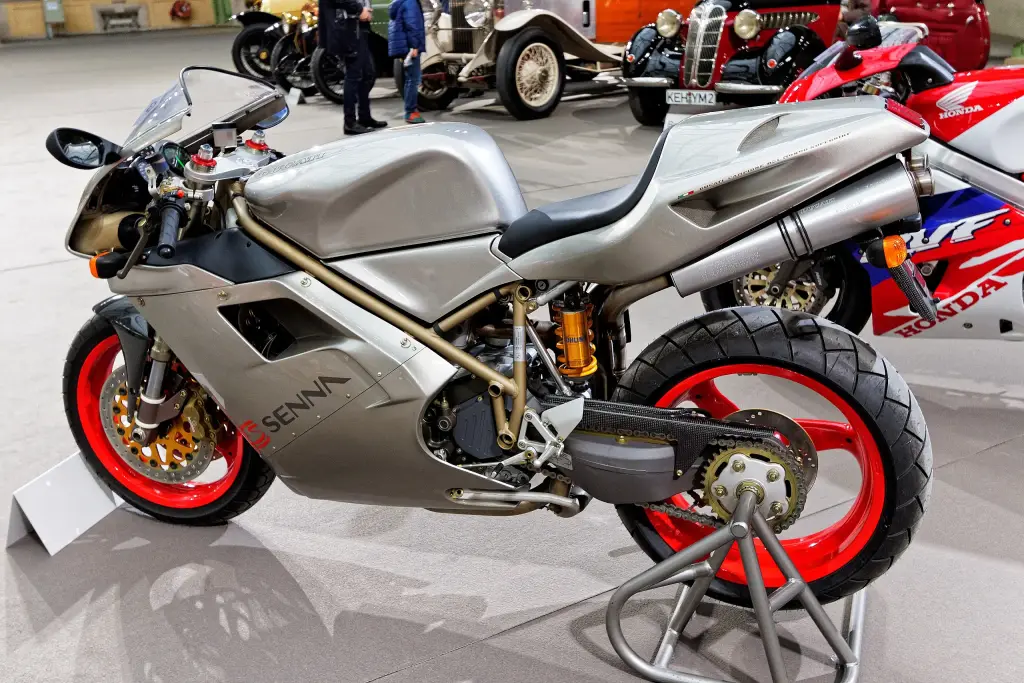
The Ducati 916 is a fully faired sport bike made by Ducati from 1994 to 1998. It has a 916 cc fuel-injected four-valve desmodromic liquid-cooled 90° V-twin engine in a trellis frame with a single-sided swingarm and upside-down forks, and it is frequently cited as one of the most beautiful motorcycles ever built.
Ducati 916 at a glance
| Maker | Ducati, Borgo Panigale |
|---|---|
| Production | 1994–1998 |
| Designer | Massimo Tamburini with Sergio Robbiano, Cagiva Research Centre |
| Engine | 916 cc Desmoquattro, liquid-cooled, four desmodromic valves |
| Bore × stroke | 94 × 66 mm, stroke raised from the 888’s 64 mm |
| Frame | chrome-moly trellis, shared with the 748 |
| Swingarm | single-sided, for faster wheel changes in racing |
| Exhaust | underseat |
| Racing | World Superbike titles in 1994, 1995, 1996 and 1998 |
| Successor | Ducati 996 |
History of the Ducati 916
From Pantah to Desmoquattro
The 916 family can be traced back through the four-valve Desmoquattro engine, the racing Pantah models and the road-going 851 and 888. Fabio Taglioni, Ducati’s chief designer since the 1970s, introduced the Pantah in 1979 and its camshafts opened and closed the valves without springs, the desmodromic system. Taglioni had no interest in four-valve heads, so the eight-valve V-twin was the work of his successor, Massimo Bordi.
The design
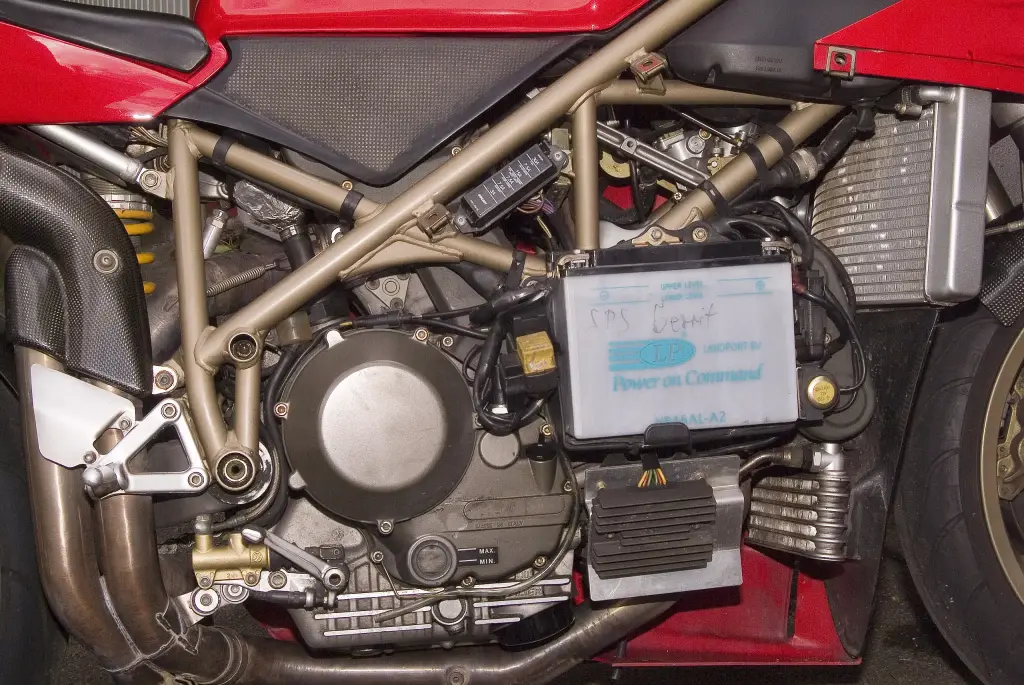
The 916 was designed by Massimo Tamburini with Sergio Robbiano and his team at the Cagiva Research Centre in San Marino. Its water-cooled engine was a revision of the 888’s, with larger displacement from a longer 66 mm stroke instead of 64 mm while keeping the 94 mm bore, and a new engine management system. The 916 was a smaller motorcycle than the 888, with a chrome-moly trellis frame later shared with the 748. Against Japanese four-cylinder rivals its V-twin made less outright power but a more even torque spread. The single-sided swingarm was designed for faster wheel changes in racing, and the underseat exhausts improved aerodynamics and gave very clean lines.
Reception
The 916 arrived in 1994 and was immediately seen as a landmark. It won every magazine’s Bike of the Year award for 1994, and Ducati sold out its entire first year of production for the United States before any had arrived there. Journalist Kevin Ash called it one of the most influential machines of the last twenty years, though he argued the design derived from the Honda NR750, sharing the underseat exhaust, narrow waist, squared-off dual headlights and single-sided swingarm holding a large rear tyre.
The Senna editions
First presented at the Bologna Motor Show in December 1994, the 916 Senna commemorated the Formula One world champion Ayrton Senna, a Ducati enthusiast who had endorsed the model shortly before his death in May 1994. Claudio Castiglioni, Ducati’s owner, was a personal friend of Senna’s. Ducati released three Senna editions, in 1995, 1998 and 2001, and in every case the net proceeds went to the Instituto Ayrton Senna charity.
Racing and legacy
Ducati won four Superbike World Championships with the 916, in 1994, 1995, 1996 and 1998, with Carl Fogarty and Troy Corser, and took the manufacturers’ title in all those years. The 916 was replaced by the 996 in 1999 and developed into the 998. Tamburini went on to design the MV Agusta F4, seen as his replacement for the 916 and sharing much of its tail, and both designs appeared in the Guggenheim’s The Art of the Motorcycle exhibition.
Design and features
- Tamburini bodywork: aggressive lines that made the 916 a design reference for sports bikes.
- Single-sided swingarm: chosen so that racing wheel changes would be quicker.
- Underseat exhaust: cleaner lines and better aerodynamics, a trademark of the whole line.
- Racing record: four World Superbike titles between 1994 and 1998.
- Senna editions: three charity series between 1995 and 2001.
Ducati 916 versions
- 916 (1994–1998): the standard model.
- 916 Senna (1995, 1998, 2001): three charity editions for the Instituto Ayrton Senna.
- 916 SPS: the higher-specification version with a stronger engine.
- 748 (1995–): the smaller model sharing the same frame.
The 916 followed the 851 and 888 and was developed into the 996 and 998. Its smaller sister was the 748. More Ducatis are in the Ducati collection.
Video: Ducati 916 Sound
Video by cicoraru61 on YouTube.
Sources
- Ducati 916, English Wikipedia: design, engine, reception, Senna editions, racing