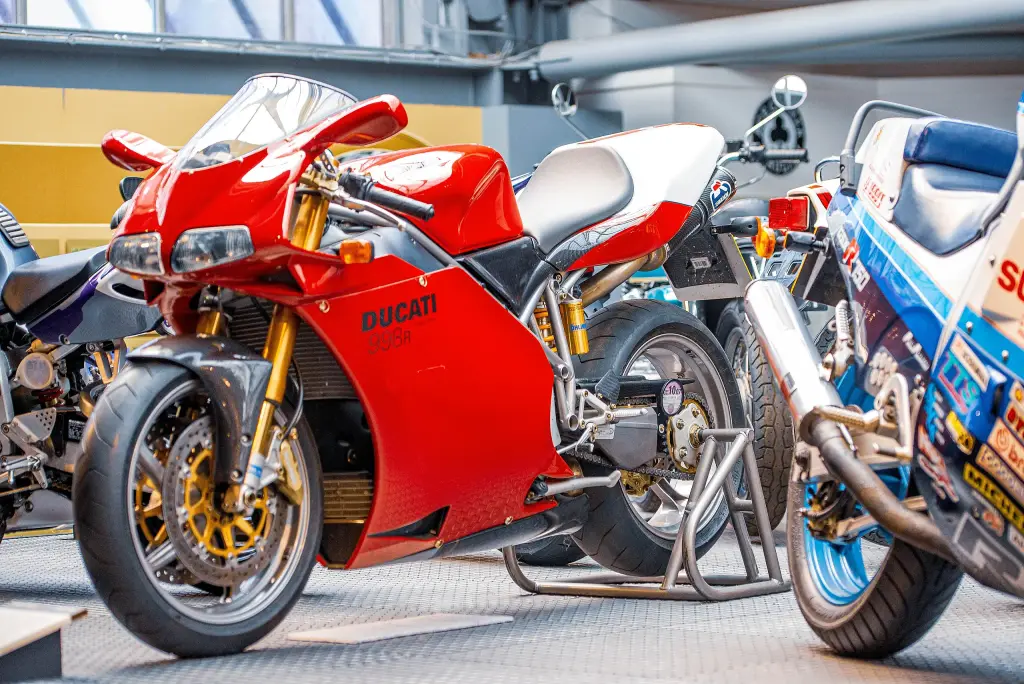
The Ducati 998 is a sport bike made by Ducati from 2002 to 2004. It was the successor to the Ducati 996 and the final variation on the Ducati 916. The new Testastretta engine shared many similarities with the Desmoquattro of the 996, although it was completely new from the crankshaft up.
Ducati 998 at a glance
| Maker | Ducati, Borgo Panigale |
|---|---|
| Production | 2002–2004 |
| Predecessor | Ducati 996 |
| Engine | 998 cc Testastretta desmodromic V-twin |
| Bore × stroke | 100 × 63.5 mm |
| Included valve angle | 25°, down from 40° on the 996 |
| Power | 123 hp, up from 112 hp |
| Versions | Strada, S, R, Matrix, Final Edition |
| 998R | 104 × 58.8 mm, 999 cc |
| Final Edition units | 981, of which 419 biposto and 562 monoposto |
History of the Ducati 998
The Testastretta engine
Testastretta means narrow head, and the name refers to a complete redesign of the cylinder heads. The desmodromic valve actuation was retained. The 996 had a bore and stroke of 98.0 × 66.0 mm; the 998 was more oversquare at 100.0 × 63.5 mm, and the included valve angle fell from 40° to 25°. Valve sizes were increased and the camshafts had slightly more lift with shorter duration, lifting power from 112 to 123 hp.
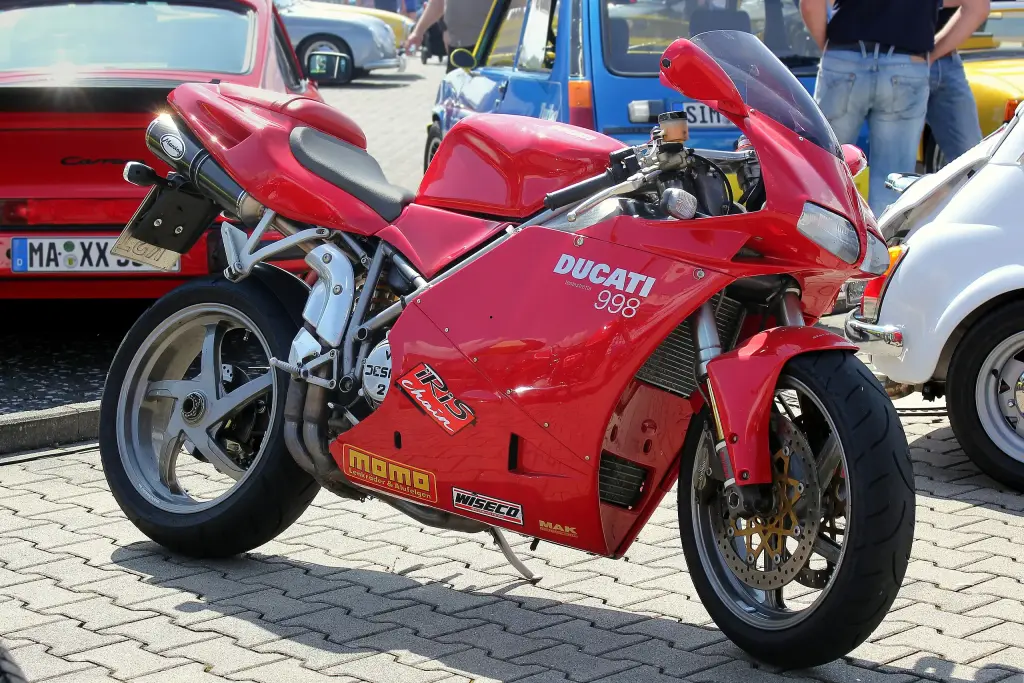
R and S differences
The 998R and the non-US 998S had different crankcases with a deep oil sump; the standard 998 kept crankcases very similar to the earlier Desmoquattro. The non-US 998S and the 998R had revised cam profiles giving more power. The 998R used a 104.0 × 58.8 mm bore and stroke, displacing 999 cc, and was very similar to the engine of the later 999R.
The 996R of 2001
In 2001 Ducati introduced the 996R with the 998 cc Testastretta engine, the true introduction of both the engine and the 998 model. It was similar to the 2002 non-US 998S. Only 500 were sold, enough to homologate the bike for the World Superbike Championship, and it won that championship in 2001 with Troy Bayliss. Michael Rutter won the Macau Grand Prix on a 998 in 2002 and 2003.
The Matrix and the end
A 2001 Ducati 996 in dark green appeared in the 2003 film The Matrix Reloaded, and Ducati announced a limited edition in a very dark green for 2004; as 996 production had ended, these were actually 998-series bikes. The 998 ended production in 2004 with the 998s FE, Final Edition, sold only by special order in biposto and monoposto forms. It was largely similar to the US 2002 998S, with the standard engine but uprated Öhlins suspension and Brembo four-piston calipers. Of the 981 built, 419 were biposto and 562 monoposto; the engine made 136 bhp and each bike had a limited-edition plaque on the headstock, tank graphics and a tricolore tail.
Design and features
- Narrow head: the 25° included valve angle that gave the Testastretta its name.
- More power: 123 hp in the standard 998 against the 996’s 112.
- Racing: the 2001 world title with Troy Bayliss on the 996R, and two Macau wins with Michael Rutter.
- Final Edition: 981 hand-finished bikes with Öhlins suspension and a numbered-style plaque.
Ducati 998 versions
- 998 Strada (2002–2003): biposto and monoposto versions.
- 998S (2002): including Ben Bostrom and Troy Bayliss replicas for the USA.
- 998R (2002): 999 cc from a 104 mm bore.
- 998 Matrix (2004): the dark green film tie-in edition.
- 998 FE (2004): the Final Edition, 981 built.
The 998 followed the Ducati 996 and closed the 916 family. Its successor was the Ducati 999. More Ducatis are in the Ducati collection.
Video: 2002 Ducati 998 with full Termignoni exhaust
Video by b009a on YouTube.
Sources
- Ducati 998, English Wikipedia: engine, versions, racing, Final Edition